Customs warehousing is a special procedure in which non-Union goods sit under customs supervision without duty or import tax being paid. The charges arise only when the goods are released for free circulation, and on re-export they may never arise at all. It is a cash-flow tool for importers, not a storage service in the everyday sense.
Where the benefit lies
An importer bringing goods in batches and selling them over several months pays duty and tax on the whole lot on clearance day under ordinary import. Under customs warehousing they pay when the goods actually reach the market, and only on the part that left. The difference shows most clearly on seasonal goods, on safety stock and on ranges whose turnover is hard to forecast. The second scenario is goods that will partly travel on outside the Union: on re-export from the warehouse no customs debt arises.
When customs warehousing makes sense
- Large imports with sales spread over time, where tying up cash in duty hurts more than the handling cost.
- Regional distribution where part of the stock leaves the Union and is never released for free circulation.
- Goods carrying a high duty rate, where deferral has real financial value.
- Situations where the final destination of the goods is unknown at the time of import.
When it does not
With fast turnover and low duty rates, the cost of running the procedure, the records and the guarantee usually exceeds the benefit of deferral. The same applies to a one-off import of a small batch: starting a special procedure for a single delivery is disproportionate effort. In many cases a simpler tool is deferred payment of charges or the right treatment of import VAT, covered in duty deferment and regime 42. A freeport customs site works on a similar principle, only at a different scale and only inside a designated area around a port, an airport or a rail hub; what it actually offers an importer is broken down in UK freeports.
How it differs from an ordinary warehouse
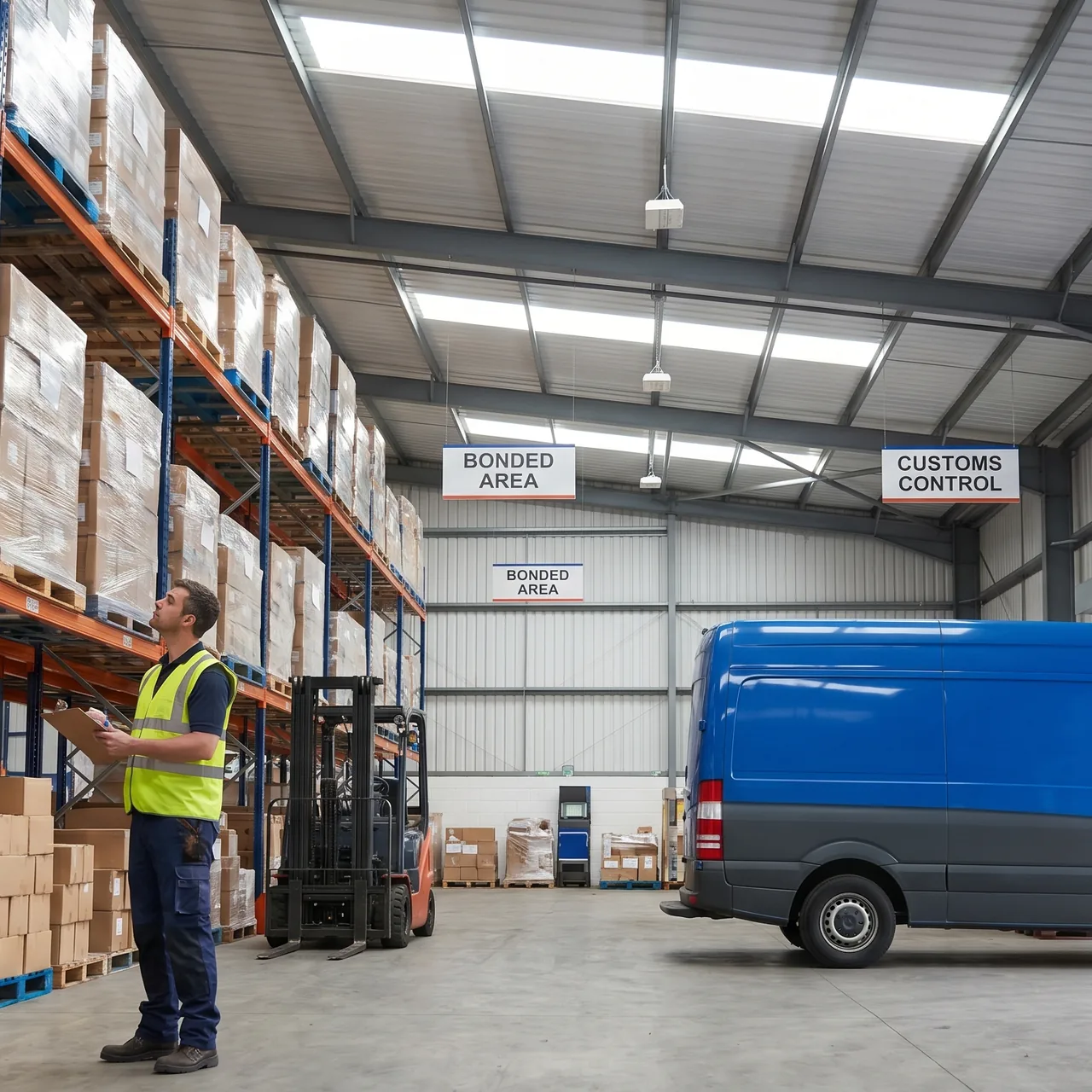
This distinction is worth stating plainly, because it causes confusion. An ordinary warehouse holds goods already cleared and in free circulation; you can do what you like with them. A customs warehouse holds goods under supervision, with records, limits on what may be done to them and a guarantee for the charges. OPTIMUS TRANSPORT does not operate a customs warehouse. Our Milton Keynes facility is our own operational warehouse: cross-docking, repacking, inspections, chilled and frozen zones and short-term storage, but for goods already cleared. Where a client needs the warehousing procedure, we point them to a customs agent and build the transport around its requirements.
What can be done to goods in a customs warehouse
The procedure allows handling that preserves the goods in their existing state plus a listed set of preparatory operations: repacking, sorting, marking, making up sets within the limits the rules allow. It is not a place for processing or manufacture; other procedures exist for that. The permitted scope follows from the authorisation and is worth confirming before the first delivery rather than after.
Customs warehousing and imports from Britain
Since Brexit, goods from the UK are non-Union goods, so the warehousing procedure is available on that lane too. For companies bringing in British components in batches it can be a way of ordering their payments. The documentary practice is described in import from the UK to Poland and VAT and duty on UK imports. Moving non-Union goods to a warehouse normally happens under transit, described in the T1 procedure.
Sources
- EUR-Lex: the Union Customs Code (Regulation 952/2013)
- European Commission: customs warehousing and free zones
This is general information, not customs advice; the terms of an authorisation come from the customs authority. Need transport aligned with a customs procedure run by an agent? Describe the consignment through the quote form. Our customs scope is on the customs clearance page.