A UK returns address is a physical address in the United Kingdom that a seller gives the buyer as the place to send goods back, so the customer returns the parcel by cheap domestic post instead of an international courier to Poland. OPTIMUS TRANSPORT does not run such an address and does not book in individual return parcels from end customers, because our operating unit is the pallet. Our Milton Keynes warehouse works one level up: short-term storage, consolidation of batches and cargo inspection.
Why sellers outside Britain look for a UK address
The United Kingdom is the most online retail market in Europe: internet sales account for roughly 27-28% of all retail sales according to the ONS J4MC series. With that volume come returns: the ZigZag and Retail Economics UK Returns Benchmark 2025 puts the value of UK non-food returns at around GBP 25.1 billion in 2025, with the returns rate falling from about 21% to about 19.5%. Even after that improvement, roughly one in five items bought online goes back.
For a seller in Poland the question is therefore not whether returns will happen but where they will land. Without a local address three ways out remain, and each has its own bill.
An international courier for every parcel
Sending a single parcel back from the United Kingdom to Poland costs tens of pounds, plus export formalities and transit time. For goods worth less than the freight itself the sum never closes, and at any real returns volume single courier shipments eat the margin of many successful orders.
A refund without taking the goods back
The second route is refunding without asking for the item. It can be sensible for very cheap products, but at any real price it means losing the money and the goods at once, with no information on whether the claim was justified. A policy of that kind travels fast among buyers inclined to abuse it.
An address where nobody opens the parcel
The third route is an acquaintance's address or a cheap unit that accepts the parcel and puts it on a shelf. No booking in, no inspection, no report. A year later you own a pile of boxes in a foreign country with unknown contents and a value nobody can account for.
Who usually performs which part of the reverse flow
A well-organised return has two tiers, and one company rarely runs both. The parcel tier starts the moment a consumer posts the shipment and ends with the decision on a single item. The pallet tier starts once the collected goods stand on a carrier and have somewhere to go.
| Stage | What happens | Who usually does it |
|---|---|---|
| Publishing the returns address | the entry in the shop or marketplace, the returns rule | seller |
| Receiving the parcel from the buyer | booking the shipment in and tying it to the order | parcel operator |
| Assessing the condition of a single item | completeness, signs of use, hygiene | seller or parcel operator |
| Putting an item back on sale in the UK | a new selling label and re-dispatch | seller or parcel operator |
| Storing the collected batch | a buffer while the return load is built up | carrier with a UK warehouse |
| Cargo inspection and report | examining the pallet with photographic documentation | carrier with a UK warehouse |
| Consolidation and the leg back to the Union | one collective load with the customs side handled | carrier |
| Disposal of rejects | handover to a licensed waste carrier | carrier with a UK warehouse |
The split of roles matters more here than usual, because a consumer return starts with a single parcel while collective transport ends at the pallet. Mixing the two levels in one contract usually means paying for work the other side does not perform.
What OPTIMUS TRANSPORT does not do
We put this plainly so nobody builds a sales plan on a wrong assumption:
- we do not run a returns address for end customers, so our address does not go into Amazon Seller Central, or any other shop, as a returns address;
- we do not receive or book in individual return parcels from buyers;
- we do not sort returned items by condition and we do not put them back into sellable stock one unit at a time;
- we do not pick or despatch parcels to buyers;
- we do not label individual selling units.
Those steps stay with the seller or their parcel operator. The full list of limits on the warehouse service is set out in what our warehouse does not do.
What we do instead in Milton Keynes
We start where the goods already stand on a pallet or in an outer carton. The Milton Keynes warehouse covers:
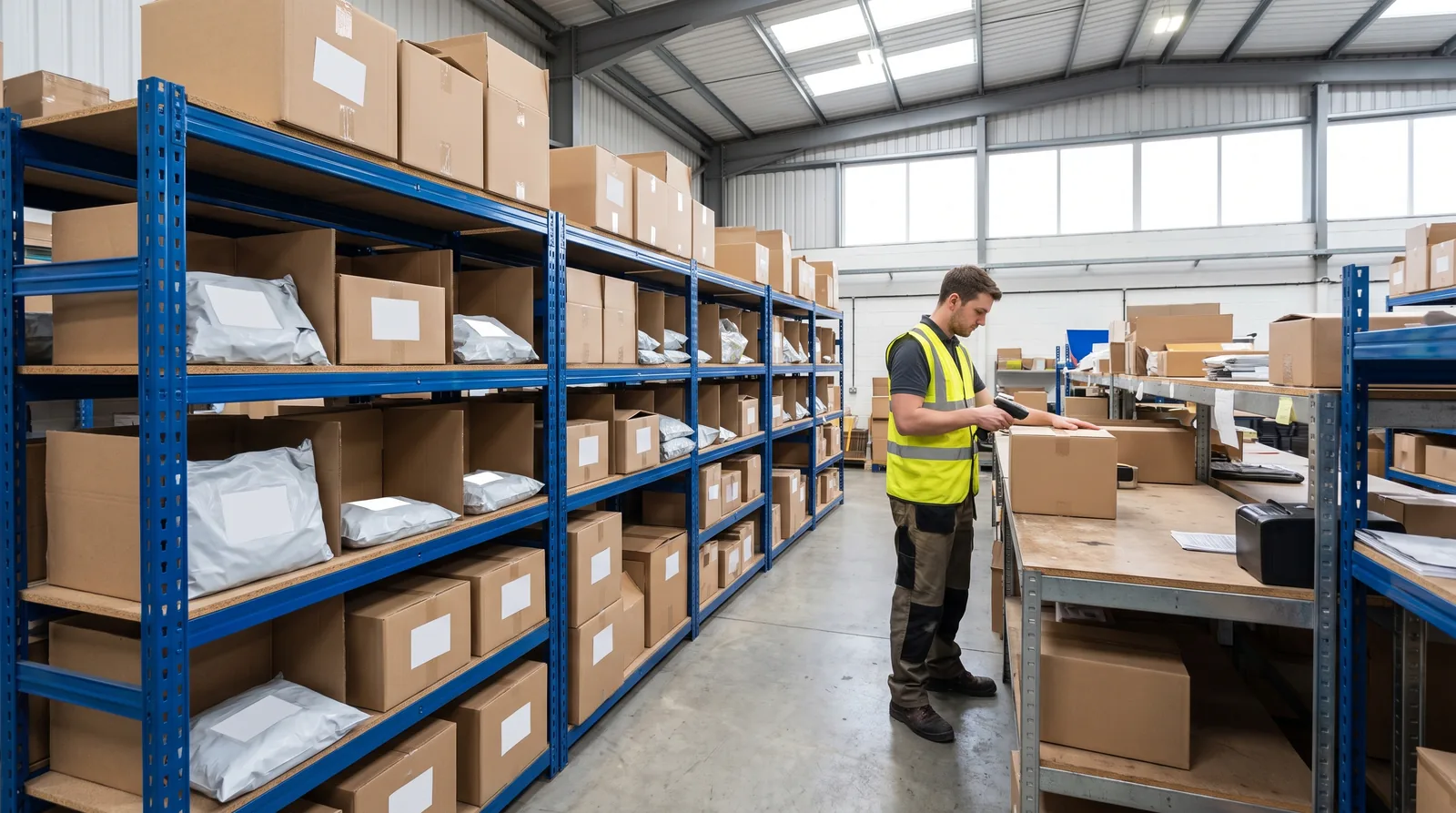
- short-term storage, meaning a buffer between arrival and onward delivery and a place where a batch waits while the return load is built up;
- cross-dock and transhipment, when the goods only need to change vehicle or direction;
- repacking and rebuilding the carrier, SSCC pallet labels and outer-carton markings;
- cargo inspection and recovery with photographic documentation, including after trailer tampering;
- temperature control where the goods require it, with chilled and frozen zones;
- disposal with a destruction confirmation, which we cover in disposal of rejected goods;
- consolidation of pallet batches to the Union together with clearance on both sides, which we run with the customs agencies we work with permanently;
- round-the-clock access, so a load does not bounce off a closed gate.
How the work divides across the whole reverse flow is set out in returns and reverse logistics from the UK, and the options for stock already sitting in Britain in unsold stock in the UK.
When this arrangement is enough and when you need a parcel operator
It is enough when the returns already accumulate somewhere else and your problem is a transport one: what to do with a batch that has grown, and how to move it to the Union without paying for a dozen separate couriers. It is also enough when returns arrive from a B2B channel, meaning pallets from a consignee rather than parcels from consumers.
You need a parcel operator when customers are to send goods directly to a British address and somebody has to open every parcel, assess the item and rule on its fate. In that setup our warehouse works well as the base feeding such an operator and taking the collected pallets from them, but it does not replace one. The same split is described in Amazon returns for an FBM seller.
The refund deadline: 14 days
The UK Consumer Contracts Regulations 2013 (reg. 34) give the seller 14 days to refund, counted from getting the goods back or from the consumer's evidence of having sent them. That is the seller's duty towards the buyer and no logistics provider takes it over. The deadline does shape the choice of model, though: the longer a parcel travels to the place where somebody opens it, the less time is left to assess condition before the money goes out.
The customs side of the leg back to the Union
Goods returning from the United Kingdom to the Union are an import and need a customs declaration. Where they come back unaltered and within the permitted period, relief from duty may apply as returned goods, but that is a matter of the right declaration rather than an automatic exemption. The conditions and documents are covered in returning goods from the UK to Poland, and the e-commerce specifics in e-commerce returns from the UK to the EU. What builds the cost of that work is shown in what UK returns handling costs.
Sources
- ZigZag / Retail Economics: UK Returns Benchmark 2025
- ONS: internet sales as a percentage of total retail sales (J4MC)
- Consumer Contracts Regulations 2013, reg. 34: refund deadlines
Have a collected batch of returns in the United Kingdom and want it home in one movement? Describe the load in the quote form and we will cost the collection, the storage until the batch is complete and the carriage with clearance.