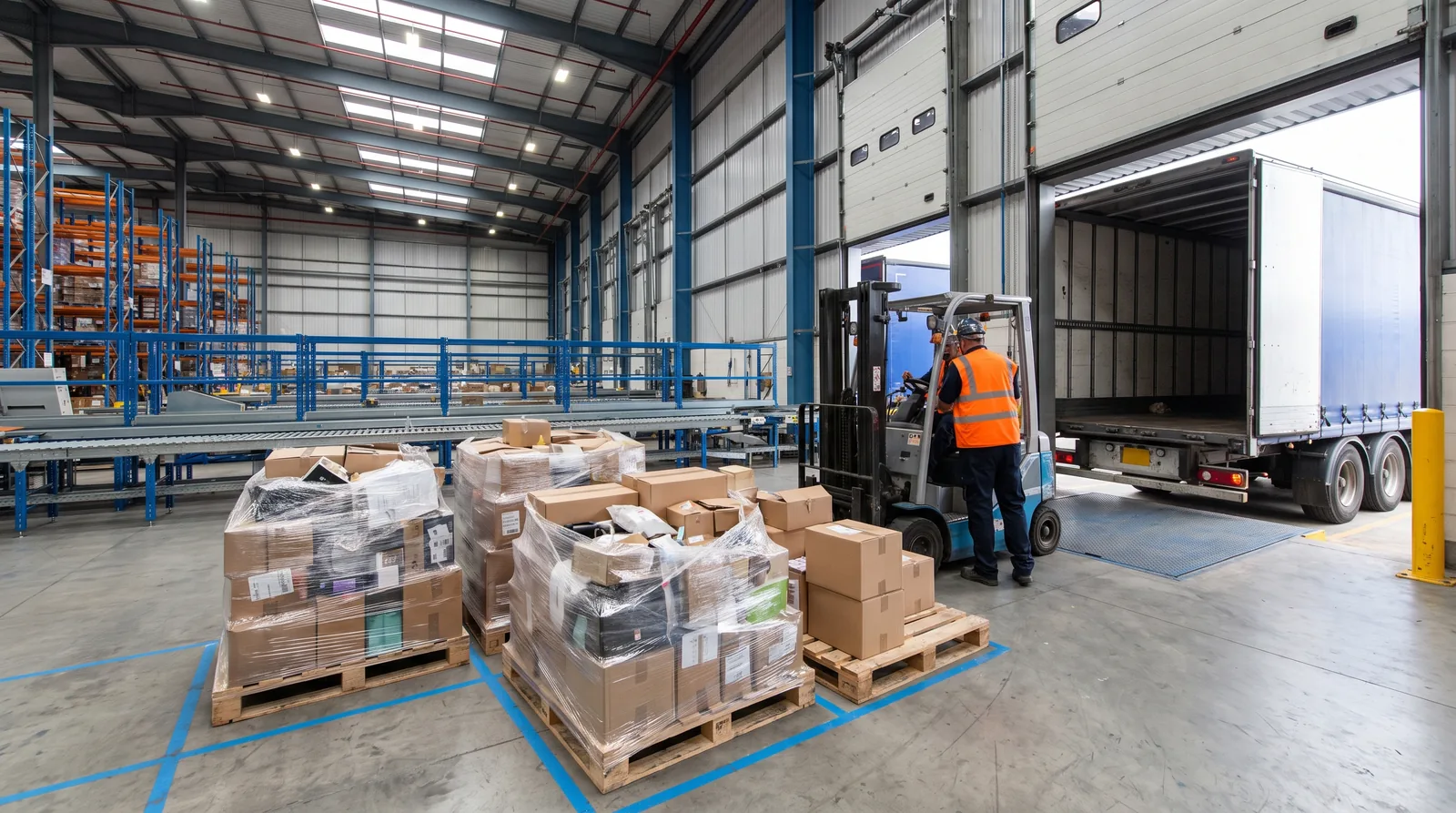
Reverse logistics from the UK is the handling of returned goods after they leave the customer: receiving, sorting, assessing condition and deciding what goes back into sale, into refurbishment or into disposal. We join that flow once the returns already stand on a pallet: we receive and store pallets in Milton Keynes, examine the load, document it in a photo report and consolidate transport back to the EU. We do not assess goods unit by unit or handle individual parcels from end customers.
Why UK returns need a base in the UK
An e-commerce or retail operation selling into the United Kingdom generates returns in the United Kingdom. Without a local base, every return either sits at a random address or crosses the Channel one parcel at a time, which is slow and expensive and delays any refund or resale. A well-ordered reverse flow has two storeys. The first is the parcel level: someone receives individual parcels from buyers, examines them and decides the fate of each item. The second is the pallet level: whatever is going back to the EU travels as one consolidated load. The parcel level belongs to the seller or their parcel operator; the pallet level is ours. Exactly where that line runs is set out in our article on what our warehouse does not do.
Who does what in a reverse flow
| Step | What happens | Whose side |
|---|---|---|
| Receiving a parcel from the buyer | book in the return, record identity and reason | seller or their parcel operator |
| Condition check on the item | inspect for damage, completeness, hygiene | seller or their parcel operator |
| Sorting by condition | resellable, B-grade, refurbish or dispose | seller or their parcel operator |
| Putting an item back on sale in the UK | a fresh selling label and re-despatch | seller or their parcel operator |
| Receiving the pallet of returns | pallet receipt and release, storage including chilled and frozen | OPTIMUS |
| Cargo inspection | examining the pallet and a report with photographic documentation | OPTIMUS |
| Restacking and stabilising pallets | securing the load, SSCC pallet label, outer-carton markings | OPTIMUS |
| Consolidation and return to the EU | one collective load with the customs side handled | OPTIMUS |
| Disposal | destruction with confirmation | OPTIMUS |
What happens to goods that can be recovered
The point of assessing returns is to recover value, and the goods owner decides what qualifies. Items judged sound go back into sellable stock; those needing fresh packaging or a new selling label pass through the parcel operator's hands. We do not apply labels to individual units. Our part starts one level up, on the logistics unit: SSCC pallet labels and outer-carton markings we do ourselves, which ties into our article on re-labelling and GS1 barcodes for UK retail. Where a pallet arrives badly built or the load has to be restacked, we do that in the warehouse, as covered in our article on repacking in the UK warehouse. Only what the goods owner marks for disposal is disposed of, and we record what and why.
Consolidating returns back to the EU
Rather than send returns back to the EU one parcel at a time, we hold the pallets and batch them, then move a single consolidated load back across the Channel. One consolidated movement is cheaper per unit and simpler to clear than a stream of individual returns, and it keeps the reverse flow predictable.
The customs side of a UK return
Goods returning from the United Kingdom to the EU are an import into the EU and need clearing like any other import, unless a relief applies. Where goods are being re-imported in an unaltered state, Returned Goods Relief may allow relief from import duty and VAT if the conditions are met, which is a matter for the customs declaration, not an automatic exemption. We do not decide your customs treatment; we flag it and work with the clearance so the return does not stall at the border. The full customs picture is set out in our article on returning goods from the UK to Poland and how customs clearance works. For low-value consignments, the UK's 135 GBP threshold changes how VAT is handled at import.
Why the UK and not one parcel at a time
Handling returns in the destination market recovers value fast and keeps the reverse flow under control. Returns land at a receiving point, are assessed within days, and sellable stock is earning again while the rest waits to travel back as one clean load. Letting returns trickle back individually loses the resale window, multiplies the customs work and buries the value in handling cost.
What we need from you
For the pallet stage we need a settled decision on what travels back to the EU and what is to be destroyed, the address we collect the pallets from, the destination for the consolidated load, and the data for clearance. The rules for assessing individual items are set and applied by the seller or their parcel operator, and we take delivery of the finished result of that work. We record every pallet received and released and the condition we found it in, so the trail ends in a document rather than a black hole at a UK address.
Where we do it
We run the pallet side of reverse logistics in our Milton Keynes warehouse between London and Birmingham, within our warehousing and cargo handling services. The central location keeps collection and consolidation efficient across the UK.
Sources
- GOV.UK: Returned Goods Relief when re-importing goods (conditions apply)
- GOV.UK: tax and duty on goods sent from abroad, including the 135 GBP threshold
Returns waiting in the UK with nothing to move them? Describe the flow in the contact form: we will collect the pallets, examine the load, produce a photo report and consolidate transport back to the EU with clearance.
Want to know exactly where the warehouse service ends? See our article on what our warehouse does not do.