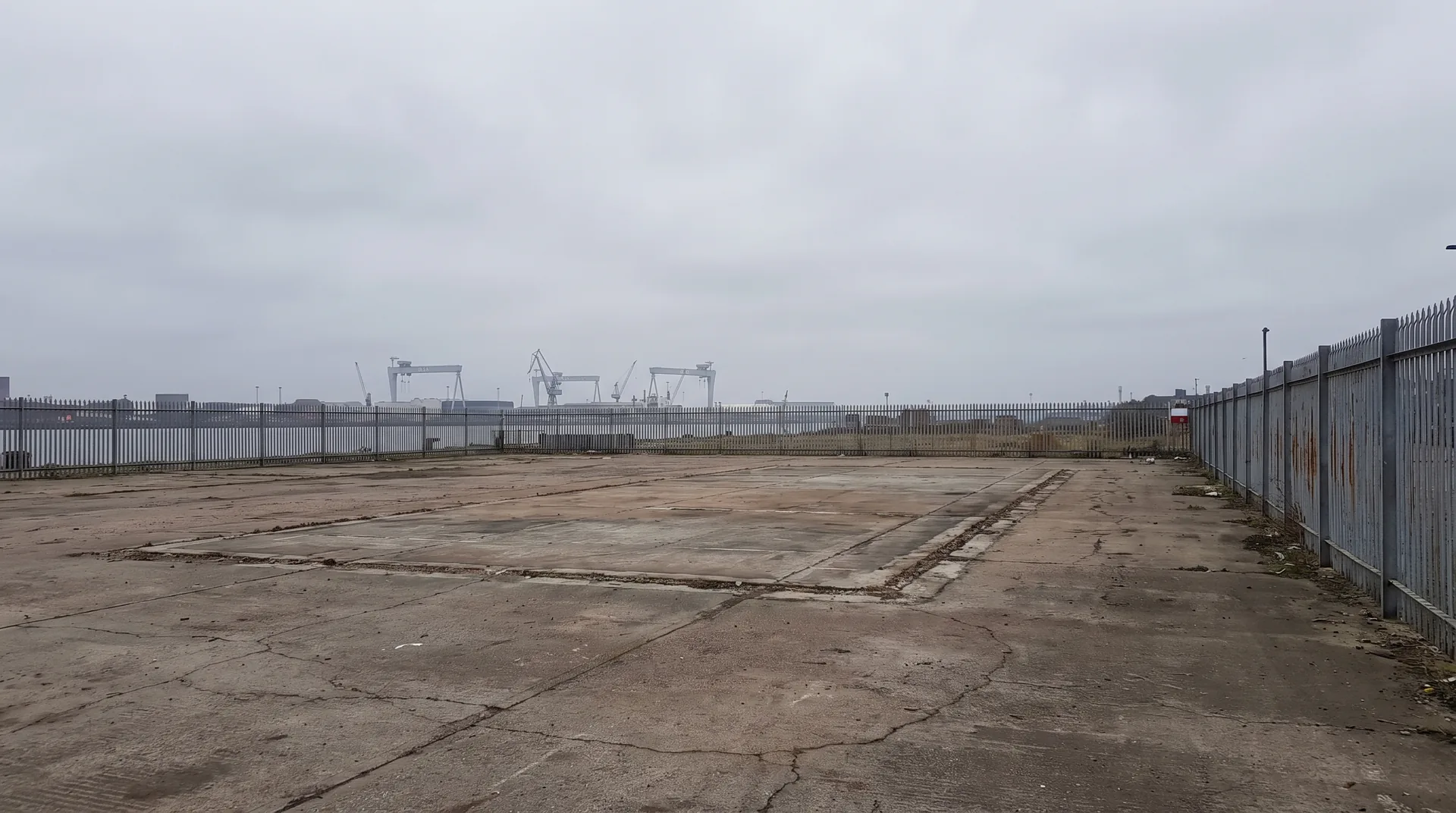
The Titanic Exhibition Centre on Queens Road in Belfast, in the Titanic Quarter, no longer operates. It closed permanently and dismantling began in December 2024. The reason was repeated storm damage and the cost of repairs. It was not a masonry hall: the structure was an aluminium frame with PVC coated polyester fabric, and the building ran on a series of temporary planning consents. The venue domain does not respond.
What happened and when
The building went up in 2015 in around eighty days as a temporary structure of 6,000 sqm, roughly 120 metres long, 50 metres wide and close to 16 metres high. The first consent ran for three years, was extended by five years in 2017 and by a further five in 2022. It was operated by a company connected to the nearby visitor attraction in the Titanic Quarter.
In December 2024 dismantling started, and in January 2025 the permanent closure was announced. Work began with removing the tensioned fabric exterior, leaving the frame in place for further dismantling. The cause was damage done by the weather.
Why this is a warning rather than trivia
A venue name outlives the venue in the paperwork. It still appears in conference venue directories, in archived event pages and in the memory of exhibitors who came here before 2024. Typed into a transport order it sends a driver to an address where there is nothing.
The risk is sharper because the Titanic Quarter holds several venues with similar names, including a large museum attraction with banqueting spaces of its own. A mix-up does not end with the wrong address: it ends with unloading at a place that is not expecting the goods. We describe the same mechanism at the East of England Arena in Peterborough, where a closed venue also lingered in organiser material for years.
The practical rule is simple: on a first job to a given venue we check that the venue website responds and that the organiser confirms the address in writing. A venue with no working website three months before an event is not an IT detail.
Where the events went
Belfast and its surroundings still take trade shows and industry events, but in other venues. In the city itself there is a multi-level convention centre in the core, where a load travels a service route to a specific floor. Outside the city, near Lisburn, there is a large exhibition campus with halls and outdoor ground. We unpack both delivery scenarios in the articles on trade fairs in Northern Ireland and on entrances and site traffic at the Eikon Exhibition Centre in Lisburn.
If the organiser still uses the old name in their communications, we ask for the full address with postcode and the name of the venue where the event actually takes place. The postcode matters more than the name here, because in Northern Ireland it also settles the document route.
The customs regime has not changed
The closure changes nothing in the formalities. Northern Ireland is part of the United Kingdom but operates under separate rules for goods, and the formalities depend above all on the route: through Great Britain or through Dublin. A BT postcode means Northern Ireland and an Eircode means the Republic, and that single line of the address decides the document route. Clearances run in cooperation with the customs agencies we work with regularly on both sides. We set out the differences in the article on shipments between Northern Ireland and the Republic.
What to do if you were exhibiting here
- Ask the organiser for written confirmation of the venue and the full address with postcode.
- Check whether the new venue is a single-level hall or a multi-level building, because that changes the maximum item dimension.
- Establish whether the new venue is inside the city or outside it, because that decides the vehicle size.
- Confirm the build-up window, because dates usually shift when a venue changes.
- Check that a stand designed for the previous hall fits the new one.
What we do at our end
We collect stands and exhibits in Poland, and from exhibitors in Czechia, Slovakia, Austria and Hungary we gather the load through our hub. At the Kielce base, about 4 km from the fairground and open around the clock, we assemble a stand into one consignment before departure. A groupage vehicle waits for the next scheduled line departure. For addresses in Northern Ireland we settle the route and the paperwork before loading rather than en route, because the formalities follow the route. We commit to an hour at the gate rather than an hour of unloading. After breakdown we collect the set and arrange the return or storage until the next show of the season, which we describe in the article on one stand, several shows.
Sources
- Plan Belfast: Titanic Exhibition Centre, structure, temporary consents and dismantling
- GOV.UK: the Windsor Framework, guidance collection
Were you planning a stand in Belfast? Send the event name and the address the organiser gave you through the quotation form and we will check the venue and plan the route. See also exhibition logistics and customs clearance.