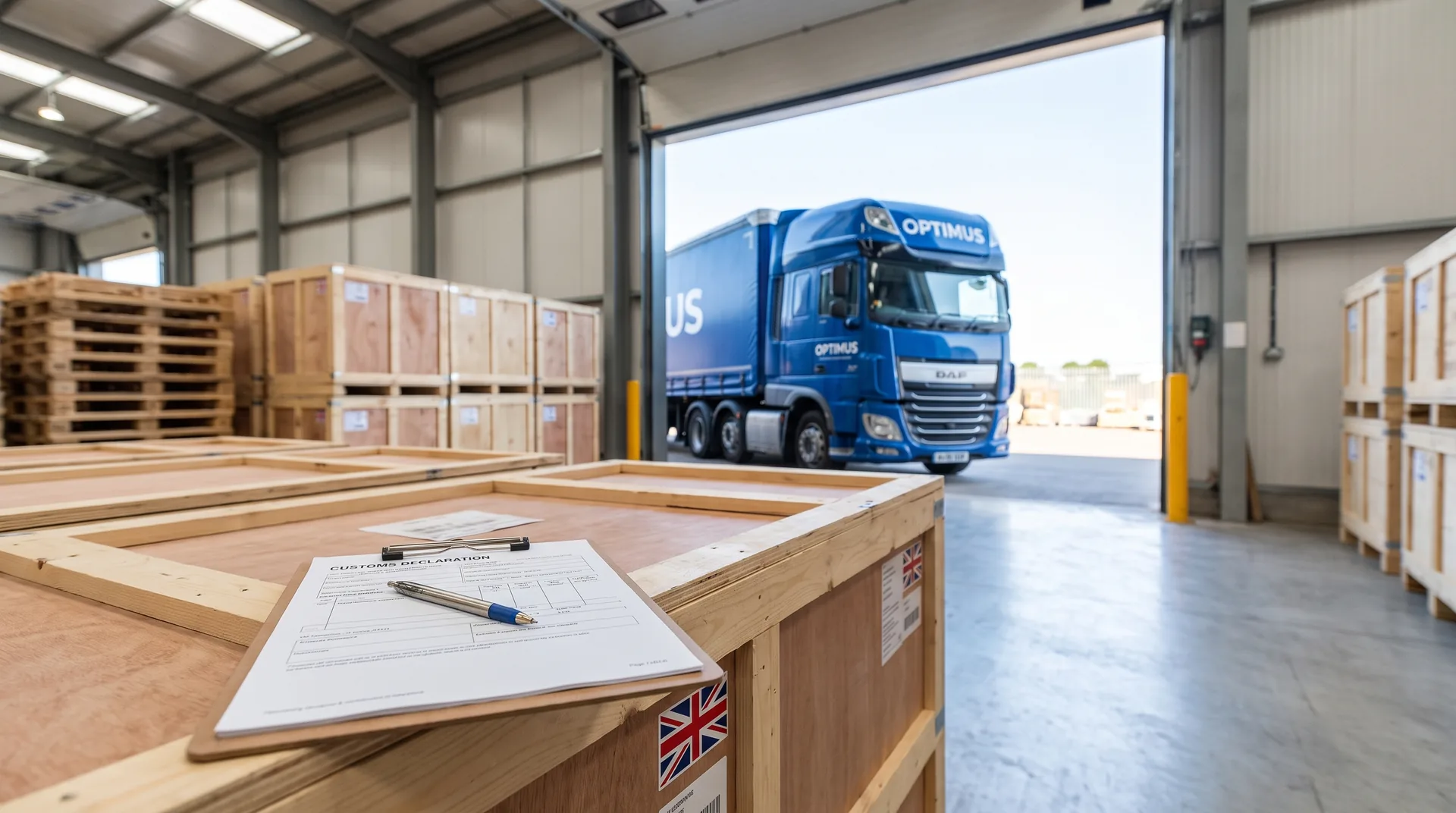
A stand serving several shows in a season need not return to its owner after each one. It can wait in a facility near the next venue, and where the next show is in Britain, in our Milton Keynes warehouse. Two decisions matter: where the stand waits, and which customs document covers the move from the EU market to the British one.
Three options between shows
The first is returning to the owner after every show. Safe and predictable, but each time you pay for two runs, and on Channel routes for two clearances as well. It makes sense when months separate the shows or when the stand needs repair and preparation in a workshop.
The second is storage near the next venue. You pay for storage instead of two runs, and the stand waits packed and ready. It makes sense when weeks separate the shows and the stand needs no intervention.
The third is a direct run from one venue to the next. Cheapest in freight and riskiest in scheduling, because breakdown at one show and build-up at the other must fit together with no slack. It works only where the windows do not overlap and the route is short.
When storage beats two runs
We will not give a numeric threshold, because it depends on route, volume and gap length. We can say what pushes the decision each way. Towards storage: a long route, a ferry or tunnel crossing on the way home, a short gap between shows, a stand of large volume and modest value. Towards returning: the need to repair or rebuild, the need to use components elsewhere, a long gap, high-value components the owner wants under their own control.
There is also a hidden cost worth counting: a stand shuttled back and forth wears out faster than one standing in a warehouse. Every load and unload is a chance of scuffs, dents and lost parts. With a system stand of panels and graphics that cost often exceeds the freight difference.
Crossing from the EU market to the British one mid-season
A stand travelling from Poland to a British fair crosses a customs border. If it is to return, the right path is temporary admission: either on an ATA carnet, or under a temporary admission procedure with a customs declaration and security. The carnet wins where there are several shows, because one document covers many crossings. It does require a complete item list and that what left comes back; details in the article on the ATA carnet step by step.
A practical note: the carnet covers goods that will return. Consumables, meaning one-use graphics, carpet, printed matter and giveaways, usually do not return, so they do not belong on the carnet list and travel as ordinary goods under permanent clearance. Separating those two streams at packing saves hours at the border later. The consequences of an undischarged document are in the article on an undischarged ATA carnet after a UK fair.
Where the stand waits on the British side
In our Milton Keynes warehouse, which works around the clock and handles pallet receipt and release, as well as restacking and rebuilding loads where a stand comes back from a show in worse shape than it left. It is the same point our groupage flows pass through, so a stand waiting for the next show needs neither a separate location nor a separate run. The scope of work is on the Milton Keynes warehouse page.
On the Polish side the same function is served by our Kielce base, minutes from the fairground, described in the article on the buffer warehouse next to Targi Kielce. Companies exhibiting there several times a year build their transport around the venue calendar, which we cover in planning transport for several Kielce shows.
How to pack a stand that travels all season
Differently from one that travels once. Components need durable labelling, a contents list on every crate and reusable packaging instead of film and tape stripped off at each unload. A crate built once for specific parts lasts the season; a carton falls apart after the second run. Keep a simple register too: what left, what came back, what got damaged. Without it, after the third show nobody knows why two panels are missing. The basics of stand carriage are in the article on transport of exhibition stands.
Who answers for the stand while it is stored
The party that took the goods into storage, within the agreed terms. That is a different regime from carriage: no weight-based cap applies, only the storage terms. With a high-value stand it is worth checking whether your property policy covers goods at a third-party location; the differences between types of cover are in the article on insuring an exhibit at a trade fair.
Planning a season: where to start
With a list of shows carrying build-up and breakdown dates, not opening dates. On that axis you see at once which gaps are too short for a return and which too long for storage. Add three facts: stand volume in loading metres, replacement value, and whether technical work is needed between shows. With that set, a whole season is arranged as one plan rather than five separate orders. The backward-counting method is in the article on the build-up and breakdown calendar, and the options after the last show in the piece on what to do with a stand after breakdown. That axis also exposes clashes that no amount of transport can solve; we take them apart in schedule, buffer and clashing dates for one stand kit.
Sources
Several shows in a season on both sides of the Channel? Send the dates and stand volume through the quotation form and we will build the whole chain instead of separate runs. See also the exhibition logistics page and the United Kingdom direction.