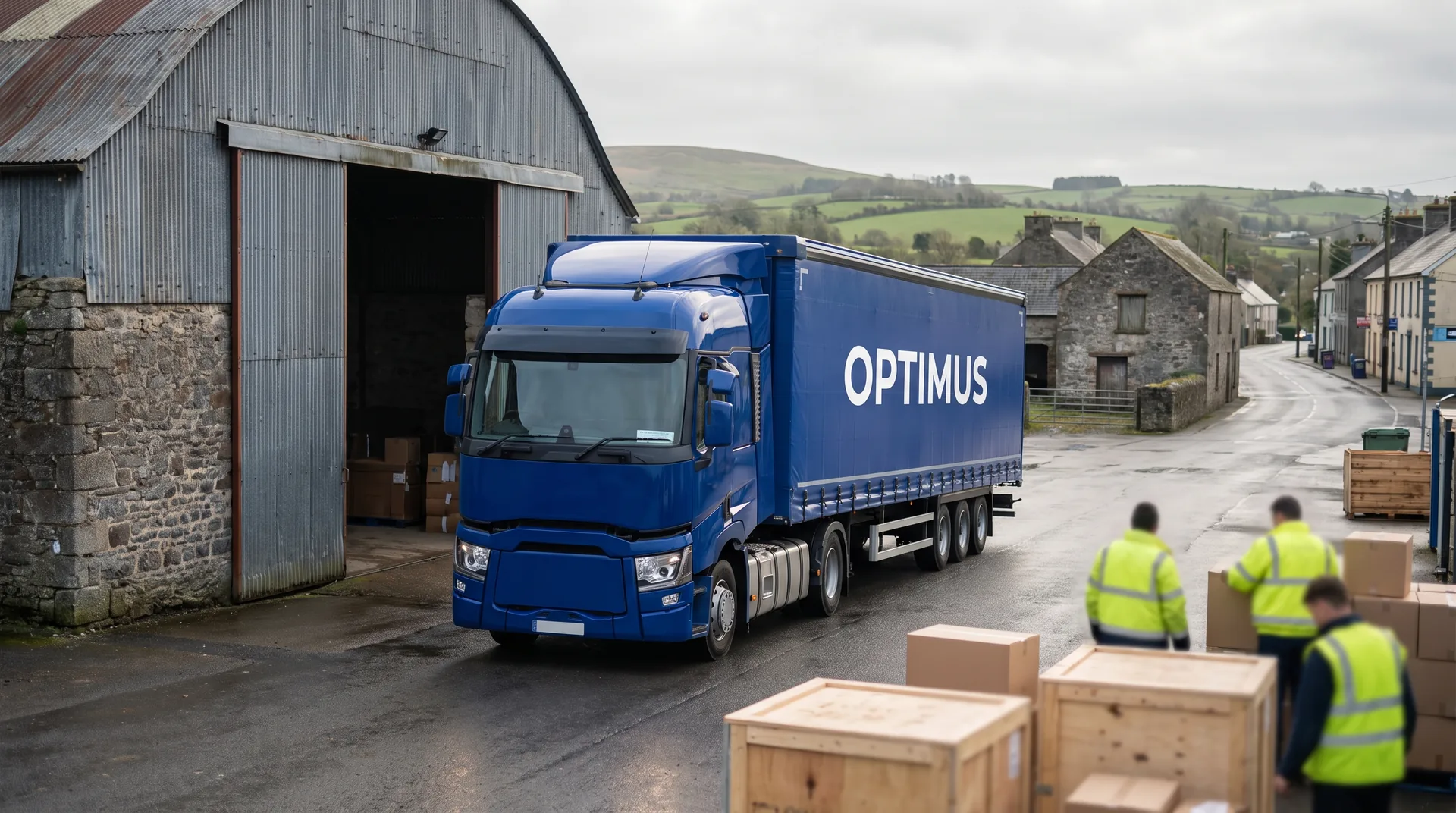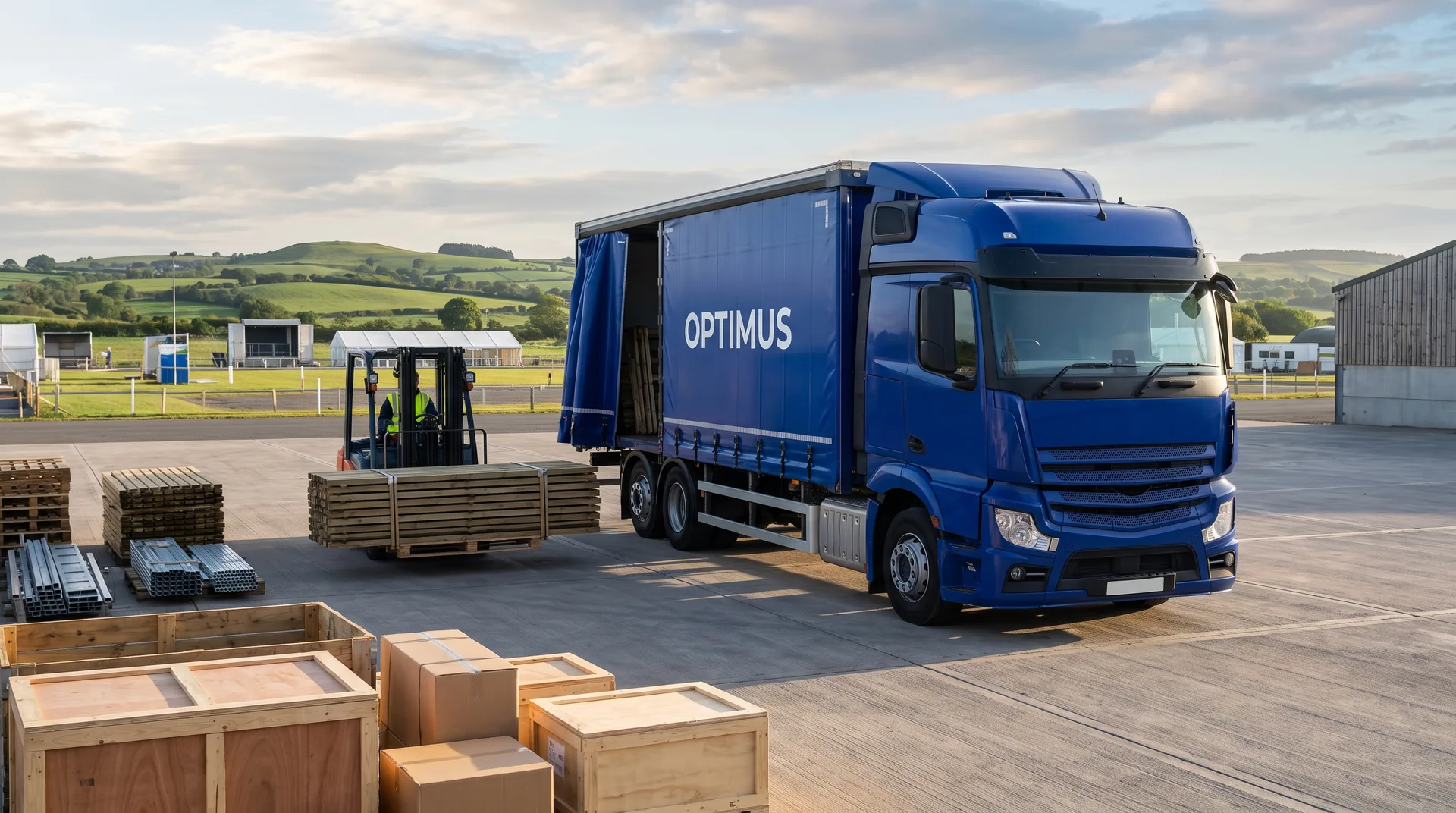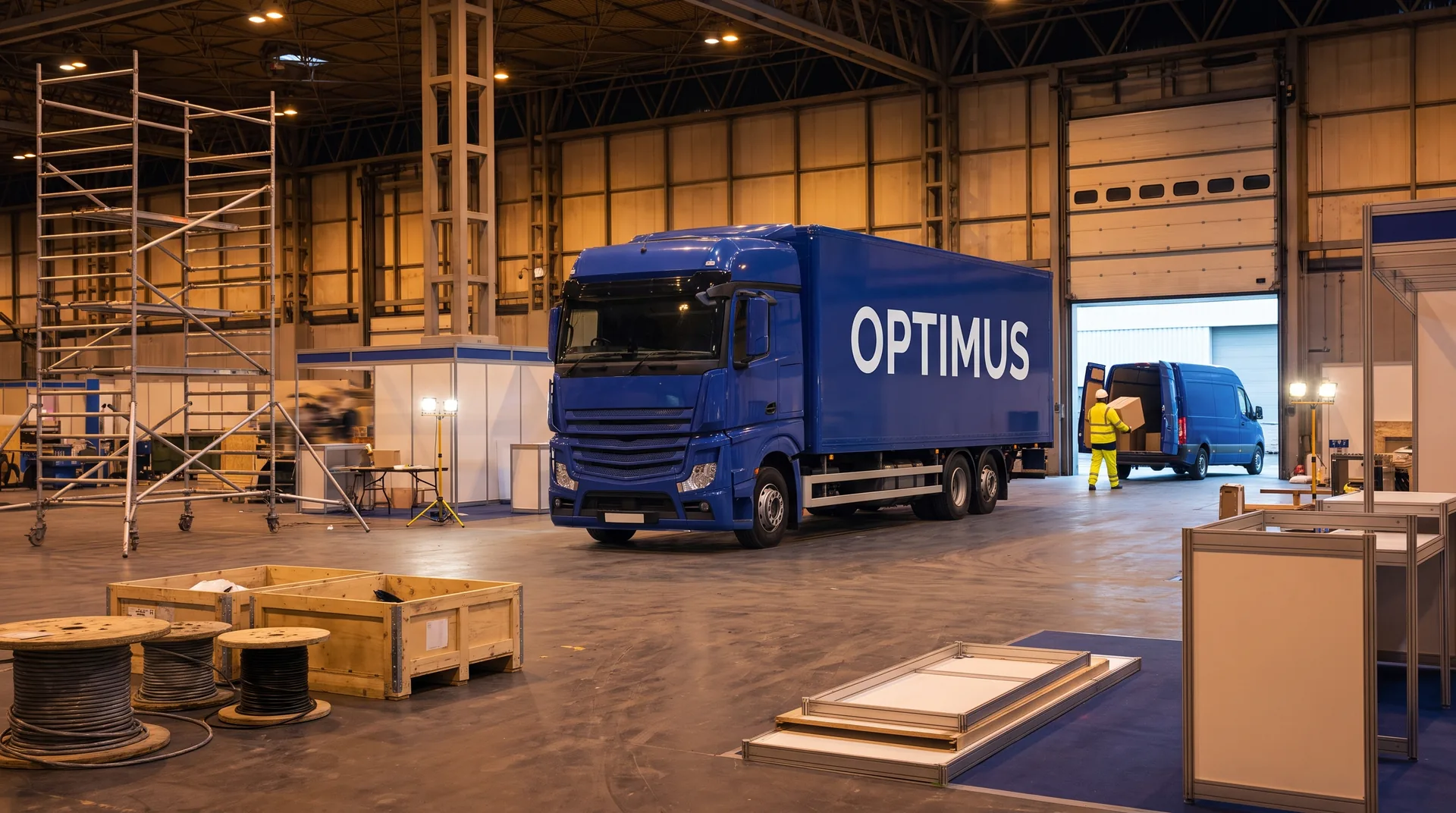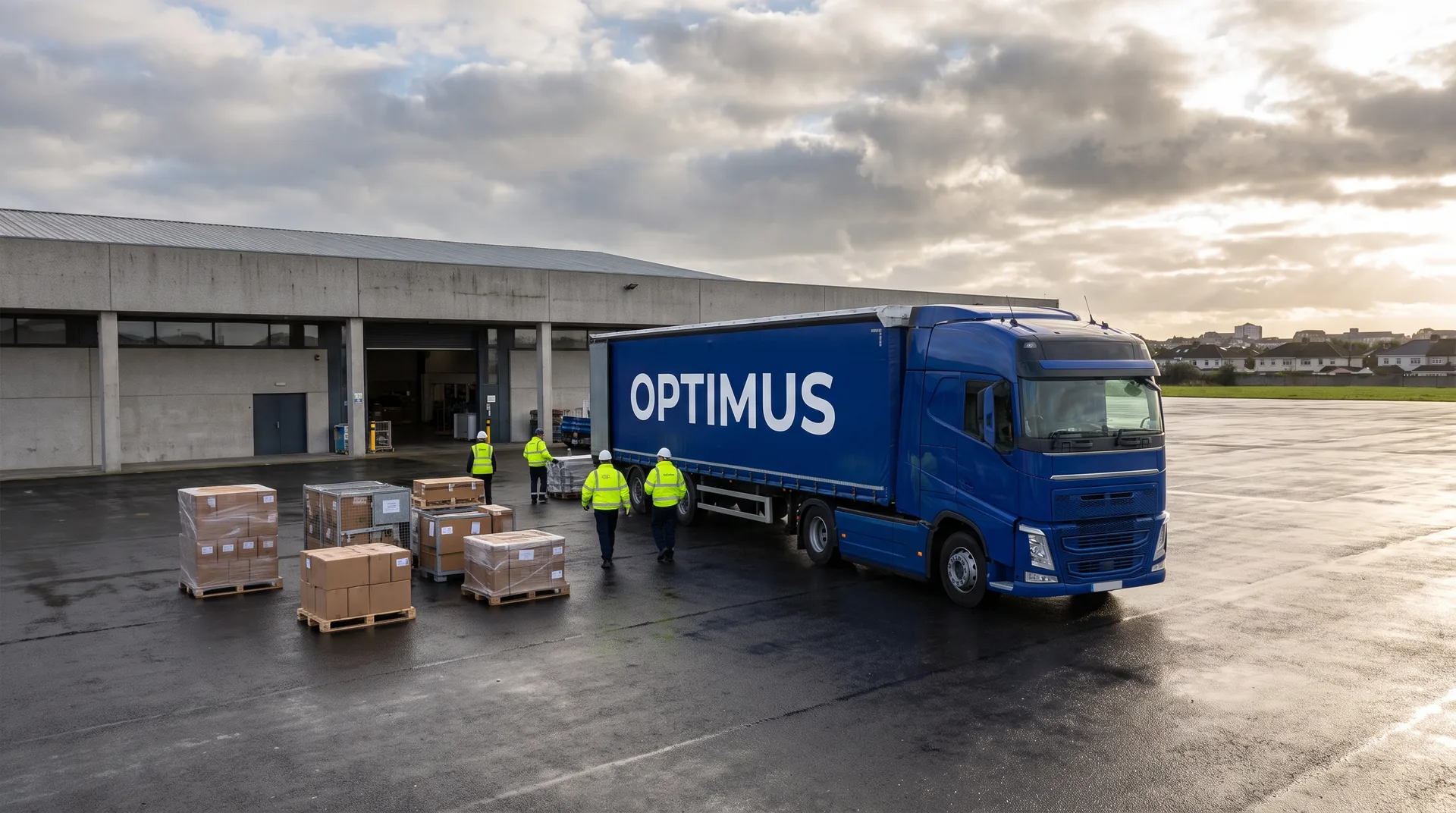
The National Show Centre lies at Cloghran near Swords in County Dublin, Eircode K67 VF43, right beside the airport. The venue publishes one main hall of 39 by 76.5 metres, that is around 2,984 sqm, with a clear height of 7.35 metres to the underside of the trusses and all supporting columns at the perimeter. Access runs from the R132 dual carriageway via Stockhole Lane, close to the M50 and M1 motorways.
Location: an airport, two motorways and a port tunnel
The venue describes its position through four references: just off the R132 dual carriageway into Dublin, adjacent to the airport, close to the M50 and M1 motorways, and beside Swords. It quotes twenty minutes to the city centre via the Port Tunnel. It also publishes drive times to other cities, including one hour forty to Belfast and two hours forty-five to Cork.
The Port Tunnel matters separately. It is a route dedicated to freight traffic running from Dublin Port to the northern ring, so a load arriving by ferry reaches this area without crossing the city. For a load from Poland arriving through Great Britain or directly, that matters when the run is planned, as we describe in the article on transport to trade fairs in Ireland.
The Dublin lorry cordon
Dublin City Council runs a heavy goods vehicle management strategy under which vehicles with five or more axles may not enter designated areas of the city without a permit. The cordon covers roughly the city centre area bounded by the canals and operates from seven in the morning to seven in the evening, seven days a week, with one coastal district under a twenty-four hour regime.
The National Show Centre sits on the R132 north of the city, in County Fingal, outside the central area the cordon covers. It is worth noting, though, that the council publishes the cordon boundaries rather than a list of exempt localities, so on a specific route you check the map rather than reason by analogy. The general principle: an approach from the port through the Port Tunnel and onward north does not enter the cordon, while a run through the city centre does. We describe a similar boundary mechanism at Sandown Park in Esher, where the requirements follow the route rather than the address.
The hall and the site
For its main hall the venue publishes dimensions of 39 by 76.5 metres, a clear height of 7.35 metres to the underside of the trusses, up to ten and a half metres to the roof at its highest and eight and a half at its lowest, and capacity for up to 1,200 conference style and two thousand in tiered seating. Facilities include three-phase power, CCTV, a sound system and a restaurant, with a first floor suite and a balcony over the hall.
The site is given as approximately eighteen acres owned plus twelve acres leased from the airport authority. Parking runs to 101 marked spaces and overflow for around six hundred vehicles on a hard core surface. The venue publishes no floor type, no door dimensions and no dock information, so the route in for a load is confirmed by the organiser.
An address discrepancy worth noting
In one place the venue gives an address on Kettles Lane in Swords, while its location page states that the site is accessed from the R132 via Stockhole Lane. That is not an unresolvable contradiction, but on a first run the difference can send a driver onto a different local road. So the order carries the Eircode together with the Stockhole Lane access description, and we ask the organiser to confirm. We describe the same problem at the Kent Event Centre at Detling.
Customs formalities
The Republic of Ireland is a member state of the Union, so a load travelling from Poland crosses no customs border, provided the route does not run through Great Britain. A land route across the British Isle requires transit, because entering and leaving British territory are two separate operations. We cover the choice between transit and a direct ferry in the article on the landbridge and transit. Clearances run in cooperation with the customs agencies we work with regularly on both sides.
What to settle before arrival
- The confirmed access: Stockhole Lane off the R132.
- The hall door dimensions, because the venue does not publish them.
- The axle count of the vehicle against the Dublin lorry cordon, if the route touches the city centre.
- Whether the load travels on a direct ferry or in transit across Great Britain.
- Who supplies the forklift and where the vehicle waits after unloading.
- The build-up window and how passes are collected.
What we do at our end
We collect stands and exhibits in Poland, and from exhibitors in Czechia, Slovakia, Austria and Hungary we gather the load through our hub. At the Kielce base, about 4 km from the fairground and open around the clock, we assemble a stand into one consignment before departure. A groupage vehicle waits for the next scheduled line departure. For Irish addresses we settle the route and the paperwork before loading, because the route decides whether transit applies. We commit to an hour at the gate rather than an hour of unloading. After breakdown we collect the set and arrange the return.
Groupage or a dedicated vehicle
The threshold runs at roughly a third of a trailer, about twelve pallets. Here a structural argument is added: with no columns inside the hall, a heavy exhibit can be positioned without planning a route around supports, so a dedicated vehicle genuinely shortens the build. For a stand of panels groupage is still enough, especially as we run the Irish direction regularly. More in the article on choosing between FTL and groupage.
Sources
- National Show Centre: the hall, dimensions, height and site
- National Show Centre: location, Stockhole Lane access and drive times
- Dublin City Council: the HGV cordon, extent and hours
Exhibiting near Dublin? Send the event name, the plot number and the dimensions of the heaviest item through the quotation form and we will settle the access and the route. See also the exhibition logistics page and the transport to Ireland route.