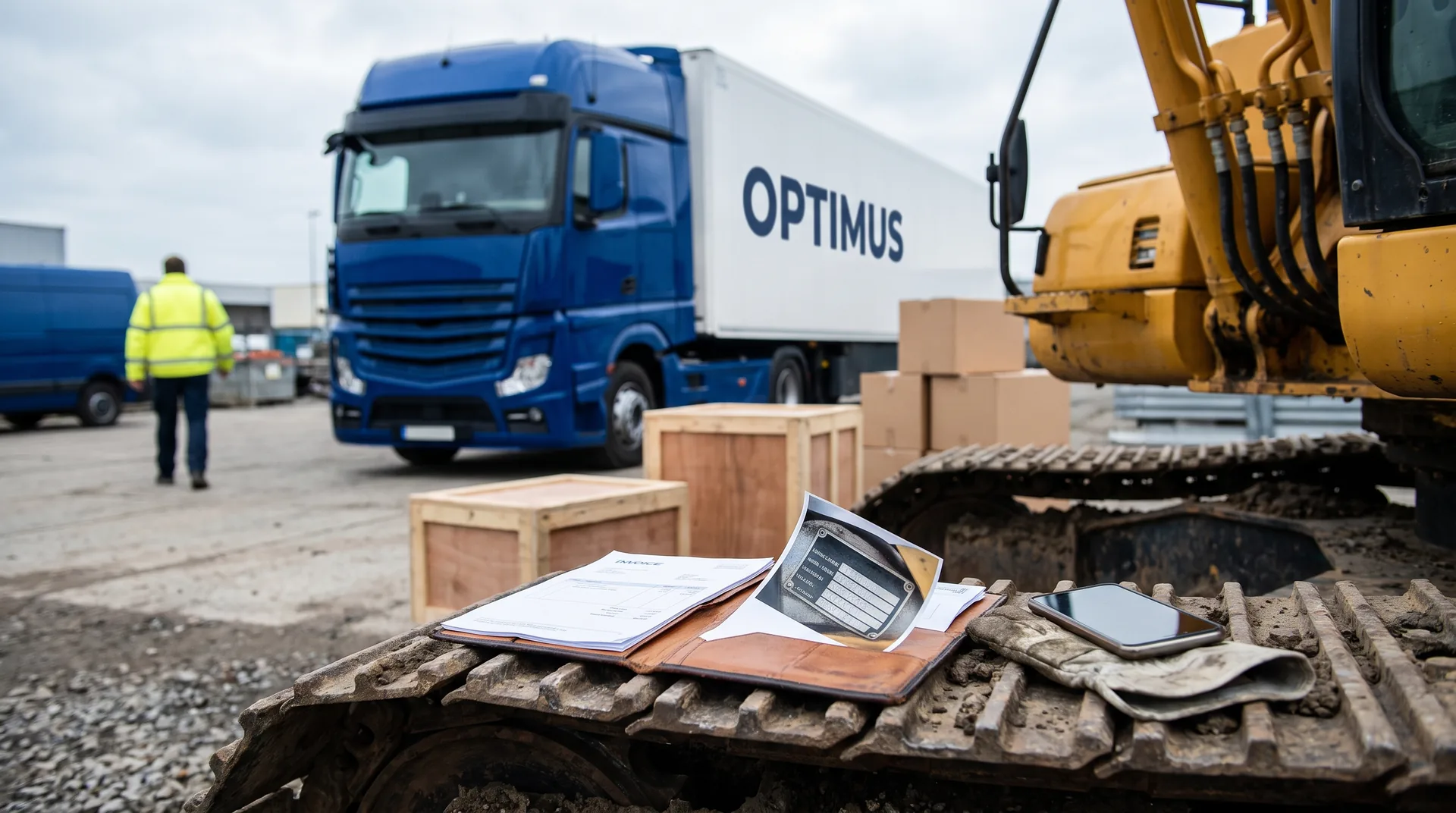
The customs declaration for an auction machine needs, above all, the invoice relating to the declared transaction value, which the implementing rules require expressly. Added to that are proof of payment, data identifying the machine, and the documents needed to establish the tariff code and the origin.
What the rules say about responsibility
It is worth starting here, because it changes how you look at the paperwork. Article 15(2) of the Union Customs Code provides that lodging a customs declaration renders the person concerned responsible for the accuracy and completeness of the information given in the declaration and for the authenticity, accuracy and validity of any document supporting it. The same provision adds that where the declaration is lodged by a customs representative, that representative is also bound by those obligations. A complete document set is therefore not an agency's bureaucratic invention: it is the basis of a liability that somebody actually carries.
Transaction documents
- The purchase invoice issued by the auction house or the seller, relating to the amount declared as the transaction value.
- The sale note or confirmation of the winning bid with the lot number, where the invoice alone does not describe the machine in enough detail to identify it.
- Proof of payment: a transfer confirmation for an amount matching the invoice. Customs value rests on the price actually paid or payable, so the payment trail is what substantiates that price.
- The auction terms or conditions of sale, in the parts covering charges added to the hammer price, the removal deadline and who is responsible for dismantling.
- Documents for costs that do or do not enter the customs value, itemised separately, which we unpack in the customs value of a used machine from auction.
Data identifying the machine
This is the part buyers most often leave until later, and the part that can stop a clearance. The declaration has to describe a particular machine, not a category of equipment. That means the manufacturer, type and model, year of manufacture and the serial number read off the machine rather than copied from the listing. Add the unladen weight and the dimensions, because they drive not only the choice of vehicle but the description in the declaration. Why the serial number and the nameplate matter so much is covered separately in machine identification at customs.
Classification and origin
The tariff code follows from what the machine is and how it works, so sometimes a manual or a data sheet is needed rather than a photograph. How to find the code is covered in the customs tariff code, and the cost of getting it wrong in wrong HS code. Origin is a separate matter: on a used machine, preference under the agreement between the EU and the UK is usually out of reach, as we explain in the origin of used machinery from the UK. There is little point waiting for an origin document the seller has no basis to issue.
Technical documents: needed, but for something else
The declaration of conformity, the operating manual and the service history are not customs documents and do not usually condition the lodging of a declaration. They matter for a different reason. In the Blue Guide the European Commission states that Union harmonisation legislation applies to used and second-hand products imported from a third country when they enter the Union market for the first time, and that a person who places second-hand products from a third country on the Union market must assume the role of the manufacturer. That obligation sits with the buyer, not the carrier or the customs agency, and it is better costed before the auction than after unloading. The wider topic is gathered in importing used machinery from the UK.
What is usually missing
Three gaps recur on almost every first purchase. The first is proof of payment, because the buyer assumes the invoice is enough, and on a used machine bought at a keen price the authority asks precisely about the transfer. The second is the serial number: auction paperwork often carries it incompletely or with a typo, while on the machine itself the plate is painted over or worn away. The third is the breakdown of charges: the auction amount arrives as a single figure, with no separation of the fees that have to be assessed against the customs value. All three can be closed before collection from the yard, and none of them closes comfortably once the border has been crossed.
How we run this
We organise and run clearance on both sides as part of the job, working with our regular customs agencies. In practice we ask for the full document set before we send a vehicle, because that is when gaps can still be closed with the seller. We also support the bidding itself and the collection from the yard. We do not guarantee the technical condition of a machine, we do not give tax advice, and we do not assess whether a machine meets EU market requirements: that is for the buyer and their expert.
What to do when the documentation simply does not exist, and where the line runs between clearance and lawful use, is set out in our article on a machine without paperwork.
Sources
- EUR-Lex: Implementing Regulation 2015/2447, Article 145 on the invoice as a supporting document (accessed 2026-08-20)
- EUR-Lex: Union Customs Code, Articles 15 and 70 (accessed 2026-08-20)
- European Commission: the 2022 Blue Guide on the implementation of EU product rules (accessed 2026-08-20)
Won the bidding and unsure whether your paperwork is complete? Send the invoice and a description of the machine through the contact form and we will flag the gaps before collection from the yard. The scope of the formalities is on our customs clearance page. This text is general information, not customs advice.