Clarke & Simpson runs an auction centre at Campsea Ashe near Wickham Market in Suffolk, holding weekly general sales and specialist sales of farm machinery and plant. For a buyer in Poland one clause of the conditions matters most: the auction house will not undertake the preparation of equipment for export, and the tax deposit is refunded only on production of documentary proof that the goods left the country.
Two addresses: the office and the auction centre
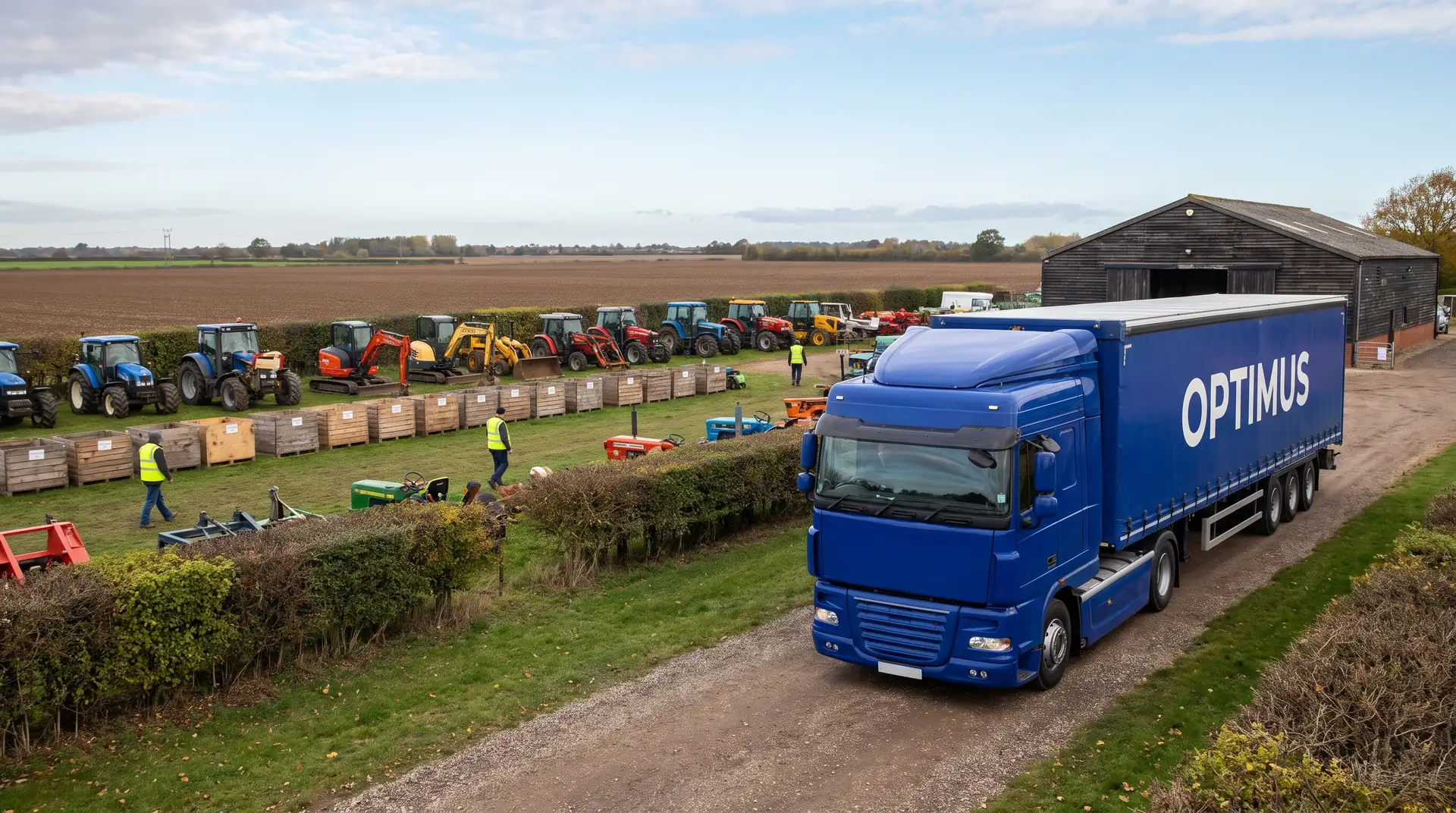
The office is at Well Close Square in Framlingham, Suffolk, and the auction centre is at Campsea Ashe near Wickham Market, under a separate postcode. The driver goes to the second address. The house sells in several strands: a weekly general sale, machinery auctions the firm describes as the largest direct-from-farm machinery sales in the region, and sales of rural bygones, fine art and interiors. The entity named in the conditions of sale is Clarke and Simpson Auctions Ltd. Bidding runs in the room and in parallel through online platforms.
Conditions worth reading before you bid
The machinery conditions of sale are considerably more specific than at many other houses. The auctioneers act as agent of the vendor only, and any contract of sale is formed between the vendor and the buyer. After the fall of the hammer the lot is at the buyer risk, and the house expressly states that it will not be responsible for its safe custody. Vendors and buyers are solely responsible for goods standing at the auction centre and must make their own insurance arrangements. All mechanical loading and unloading takes place at the vendors or purchasers risk. Buyers pay for any damage done by themselves or their agents during the removal of their lots, and lots inside a building cannot be removed while the sale in that building continues. A five mile per hour site speed limit applies, tractors and machinery are not to be driven around the auction centre other than for loading or unloading, and persons attending the sale ground do so at their own risk. We set out the post-sale sequence itself in our article on the winning bid step by step.
The tax deposit and proof of export
This is where buyers from the continent most often come unstuck. A buyer from outside the United Kingdom lodges a deposit against the tax and gets it back only on production of documentary proof of export. The house lists what it accepts: an original bill of lading or a certificate of shipment issued by a recognised shipping or transport company, or a SAD stamped by customs and clearly identifying the goods. The conditions also note that, following the United Kingdom withdrawal from the Union, buyers in Northern Ireland count as being outside the United Kingdom. The practical conclusion is simple: the transport paperwork is not an afterthought but the condition of getting money back. What a complete set of transport documents looks like is covered in our article on the CMR consignment note.
Export preparation sits with the buyer
The conditions state plainly that cleaning, phytosanitary certificates and export paperwork are entirely at the buyer cost, and that the house will not undertake the preparation for export; it is to be done by a shipping agent, which may involve them removing machinery to their own site. That is exactly the gap a carrier fills. The cleanliness requirement is not cosmetic: used agricultural or forestry machinery under the relevant tariff codes is subject to phytosanitary border control on entry to the Union and must be free of soil and plant residue. We follow that strand in our article on farm machinery auctions in the UK. The conditions also warn that some vendors cannot supply a British registration document for tractors and road-registered vehicles, and that the house gives no warranty in that respect, which feeds straight into later registration, covered in our piece on type approval and individual approval.
Where to clear a machine from East Anglia
Suffolk sits close to the east coast ports and not far from the Channel corridor, so both routes to the continent are real. Clearing in the country of entry to the Union under procedure 42 means the tax is not paid at the border but accounted for in the country of destination; the conditions are the importer VAT number in the country of clearance or that of his tax representative, the customer VAT number in the destination country and evidence that the goods are to be transported to another member state, followed by listing the supply in a recapitulative statement. Those conditions were introduced by Directive 2009/69/EC. We set them out in our articles on customs procedure 42 and on clearing in the Netherlands.
What we could not confirm
We could not confirm whether the auction centre provides loading equipment. The conditions allocate the risk of mechanical loading but say nothing about whether a loader is available on the day. The clauses above come from the machinery conditions of sale and should not be transferred to the weekly general sale, which has its own terms. We do not quote premiums, the size of the deposit or removal deadlines. We are not a representative of this auction house.
Sources
- Clarke & Simpson: the Campsea Ashe auction centre address
- Clarke & Simpson: buyer guides and conditions of sale
- Clarke & Simpson: sale strands and machinery auctions
- EUR-Lex: Directive 2009/69/EC, conditions for the import exemption with intra-Community supply
- GOV.UK: exporting goods from the United Kingdom
Buying at Campsea Ashe and needing an export document to recover the deposit? Send the lot number and the removal date through the quote form. See also Cheffins.