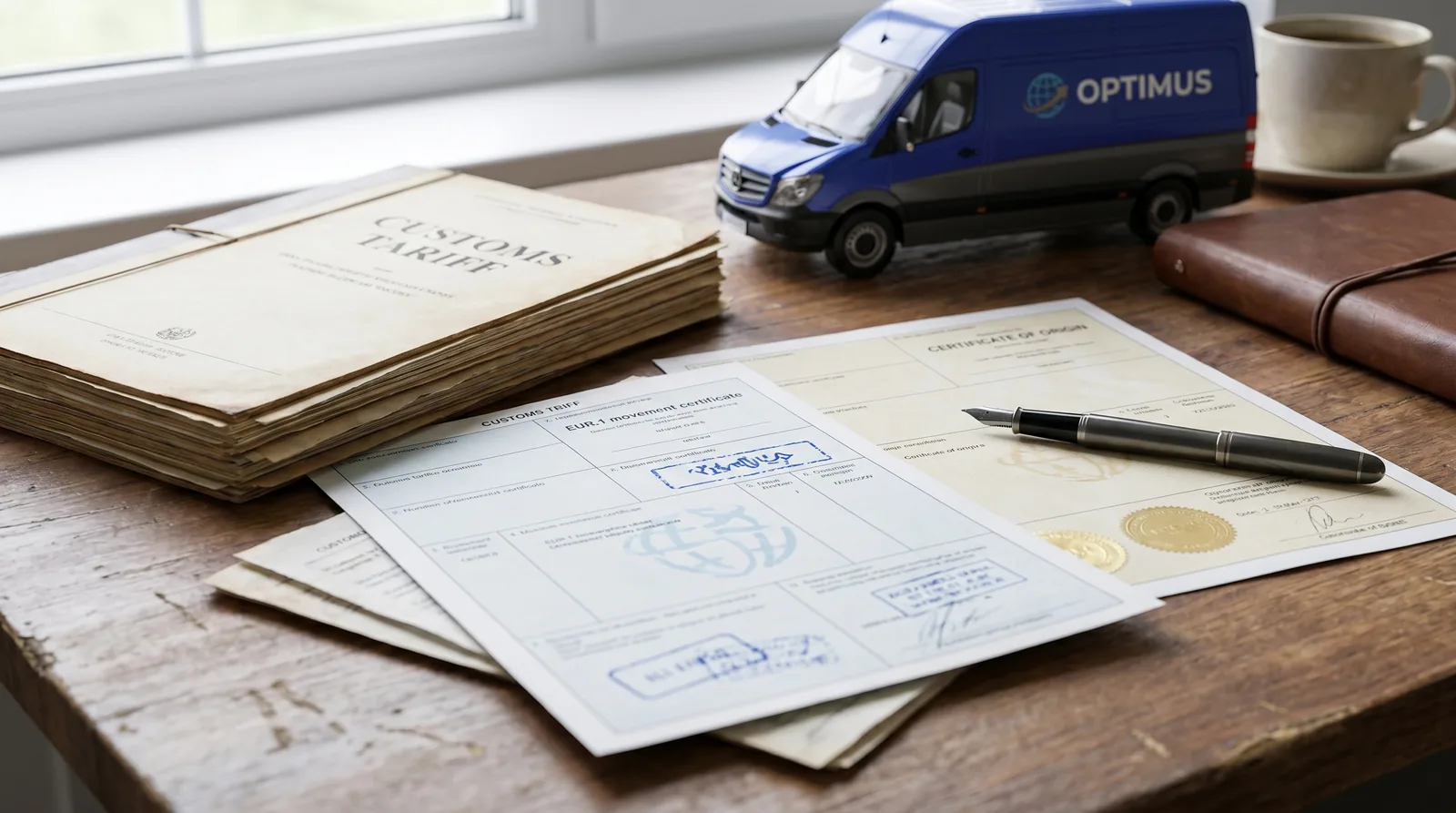
EUR.1 is a movement certificate proving preferential origin under those trade agreements that provide for such a document. In EU-UK trade preference is proven differently: by a statement on origin on a commercial document, or by importer's knowledge. A certificate of origin, by contrast, is a non-preferential document issued for other purposes.
Why EUR.1 is not issued for UK shipments
The Trade and Cooperation Agreement between the Union and the United Kingdom based proof of origin on self-certification. An exporter meeting the rules of origin places a statement on origin on the invoice or another commercial document describing the goods in a way that allows identification. The second route is importer's knowledge: the importer demonstrates that the goods meet the rules from information in its possession. EUR.1 movement certificates are not used in this relationship, so a counterparty asking for one is usually working from pre-2021 habit.
Where EUR.1 still applies
The EUR.1 certificate remains in use under agreements that provide for it, mainly in the Union's preferential relations with certain third countries. It is issued by the customs authority of the exporting country at the exporter's request, after verification that the goods meet the rules of origin. For a Polish exporter the rule is simple: the document follows the specific agreement with the specific country, not habit. For the British lane the correct path is described in rules of origin under the EU-UK agreement.
What an ordinary certificate of origin is
A certificate of origin issued by a chamber of commerce confirms the country of origin with no connection to customs preference. It may be required by a counterparty, by a bank under a letter of credit, by the rules of the destination country or by tender procedures. It does not replace a statement on origin and grants no right to zero duty, though the two are frequently confused in commercial conversation. If a buyer asks for a „certificate of origin”, it is worth clarifying whether they want a duty reduction or a commercial formality, because the answer changes the document.
Rules of origin: where the real work sits
The document is the end of the process, not its beginning. Before an exporter signs a statement it needs grounds: knowledge of the composition of the goods, the origin of materials, and whether processing in the Union is sufficient to confer Union origin. The rules differ by product group and usually refer to a change in tariff classification or to the value share of non-originating materials. So the first step is establishing the tariff code, described in the CN and HS tariff code, and only the second is analysing the rule for that code.
What happens when a statement is unfounded
Customs preference is not a declaration of intent. The customs authority of the importing country may request verification of origin, and the exporter then has to document its basis. If it cannot, the importer loses the preference and pays the duty, often with interest, and liability returns to the exporter under the terms of the sales contract. The scale of the cost depends on the duty rate for the goods, which we take apart in how customs duty is calculated. That is why signing statements „just in case” is a bad idea.
What to send with the shipment
- A commercial invoice with a full goods description and, where applicable, the statement on origin.
- A packing list matching the contents of the consignment.
- A tariff code for every line, agreed in advance rather than settled at the border.
- Any additional documents required for the product category, such as certificates or licences.
The full document set for the British lane is collected in documents for export to the UK, and the clearance process itself in EU export clearance step by step.
Sources
- GOV.UK: claiming preferential rates of duty between the UK and EU
- European Commission: Access2Markets, rules of origin and duty rates
Not sure which origin document your shipment needs? Describe the goods and destination through the quote form and we will point to the right path, alongside the scope described on the customs clearance page. This text is informational and is not legal or customs advice.