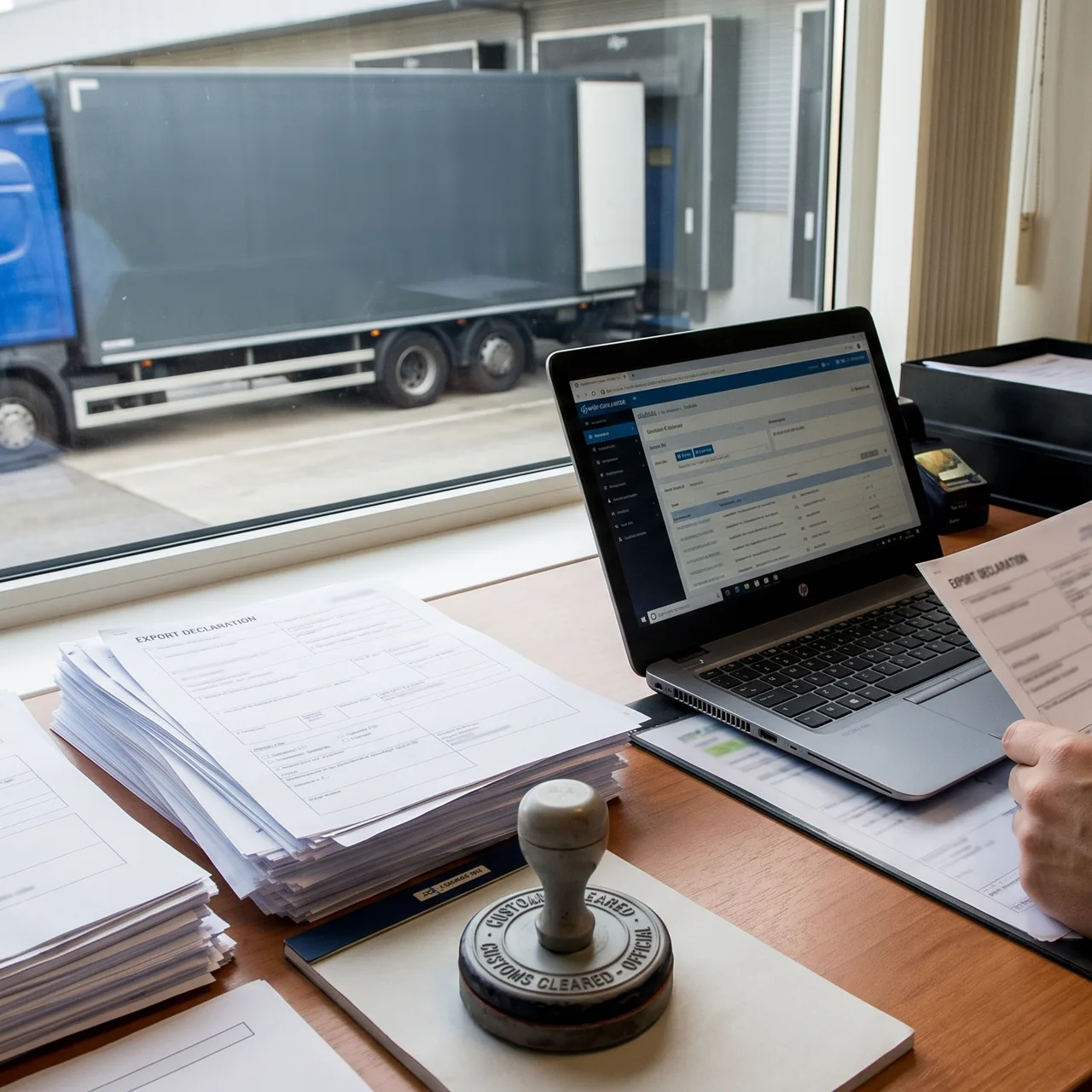
EU export clearance means declaring goods for the export procedure. The exporter lodges a declaration in the customs system, receives an accompanying document with an MRN, and once the goods leave the customs territory of the Union the office of exit confirms departure electronically. That confirmation is what supports zero-rating VAT on export.
When export clearance is required
Whenever Union goods leave the customs territory of the Union, which includes every shipment from Poland to the United Kingdom. The value of the consignment, the mode of transport and whether the receiver is a business or a private person make no difference: a declaration must exist. Only the way it is lodged and the depth of data change. For a shipper that means a single pallet to Manchester needs the same information set as a full trailer, just on a smaller scale.
Step by step
- Goods data: precise commercial description, CN tariff code, quantity, net and gross weight, value and currency, country of origin.
- Parties: shipper and consignee with addresses, EORI numbers, Incoterms, payment details.
- Lodgement: the export declaration is submitted by the exporter or their representative.
- Release: an accompanying document with the MRN and a barcode is issued and travels with the goods.
- Exit: departure from the EU customs territory is confirmed and the procedure is closed electronically.
The tariff code: the most common source of trouble
A wrong CN code can change the duty rate on the British side, trigger extra requirements or force a post-clearance amendment. Descriptions such as "trade goods" or "parts" are not enough: an officer has to read from the description what is actually travelling. How to pick and verify a code is explained in CN and HS tariff codes, and the consequences of getting it wrong in the wrong HS code.
Origin and duty on the British side
The export declaration alone says nothing about duty in the country of destination. Where the goods meet the rules of origin under the EU-UK trade agreement, a statement on origin on the invoice allows a zero rate. The conditions and the traps are in rules of origin, and the certificates used on other trade lanes in the EUR.1 certificate.
Who lodges the declaration
The exporter, or a customs representative acting under a written authorisation. The choice between direct and indirect representation has real consequences for liability, so it is worth settling deliberately rather than inheriting it from a previous job. The subject is developed in customs representation and agency. Who owns which clearance also follows from the Incoterms, described in Incoterms 2020.
When the exit confirmation never arrives
Sometimes the confirmation message does not come: the goods left, but the system did not record it. Then you apply for alternative proof of exit, built from transport documents, proof of delivery and import paperwork from the destination country. The sooner the gap is spotted, the easier the evidence is to assemble, so declaration statuses are worth checking after each delivery rather than once a quarter.
How we tie it to the transport
In our jobs export clearance is set up before loading, so the document carrying the MRN leaves with the goods instead of chasing the vehicle. That same reference later goes into the GMR, described in the GMR article, and the British side is closed by GB import clearance.
Sources
- European Commission: the export procedure
- PUESC: the Polish electronic customs and tax services platform
This is general information, not customs advice. Want export clearance and transport in one order? Describe the consignment through the quote form. Our customs scope is on the customs clearance page.