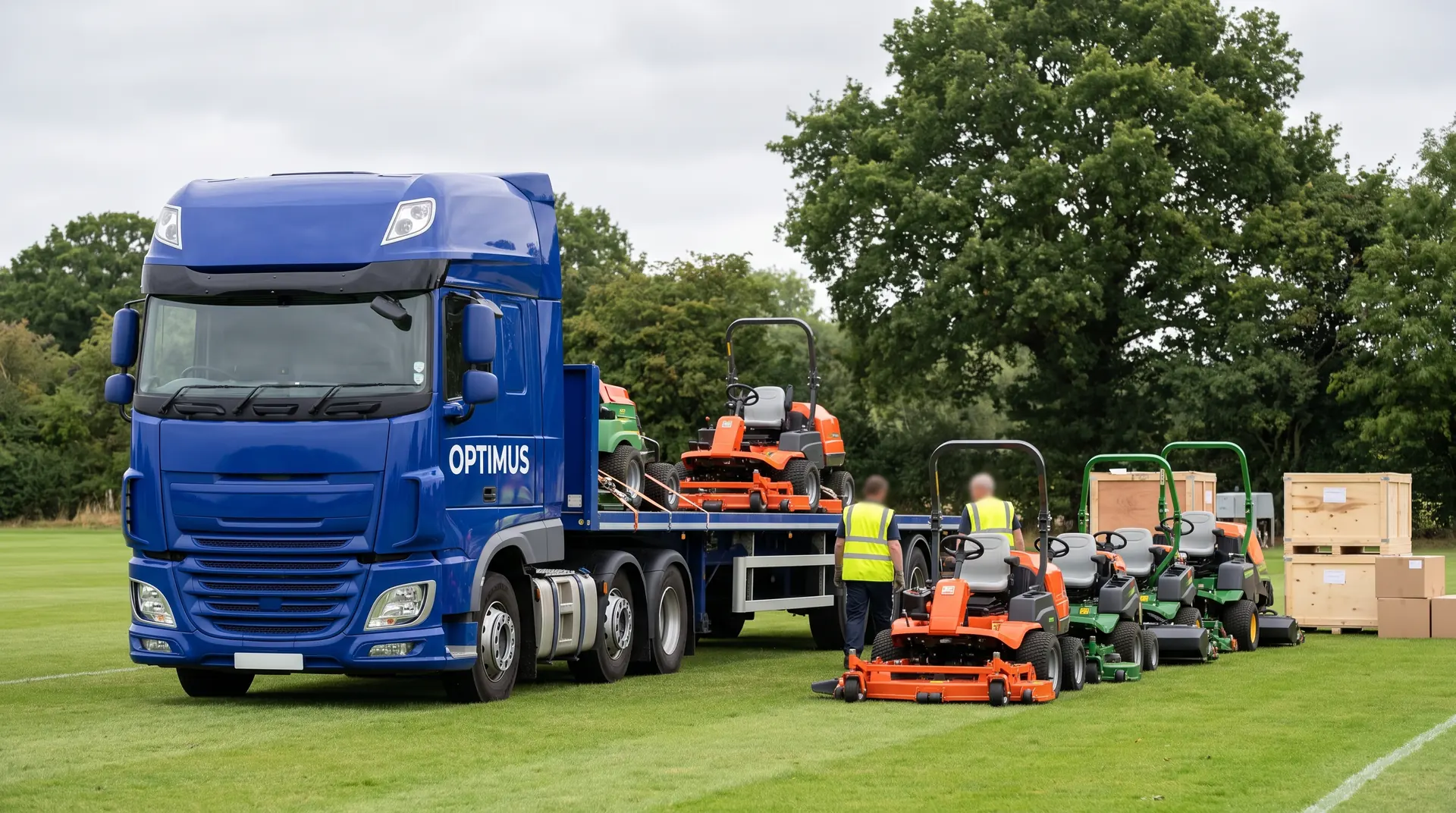
Groundcare equipment is one of the most thoroughly British auction categories. Golf courses, sports clubs, parks departments and local authority grounds teams replace fleets on regular cycles and release them in batches to dispersal sales, so supply runs all year round. For a haulier it is welcome material: the machines are light and low, several fit on one outfit, and nothing here needs a low loader.
What actually turns up at these sales
The range is wider than the word mower suggests. Cylinder mowers for sports turf and greens, rotary mowers for park grass, machines with collection boxes and mulching decks that leave the clippings, aerators driving tines into the sward, scarifiers cutting out thatch, and finally the small utility vehicles the grounds team uses to move tools and sand around a golf course. All of it drives on its own wheels, but none of it belongs on a public road, so collection still means arriving at the yard with a vehicle or a recovery truck.
- Cylinder mowers are set to fine tolerances — a knock against a kerb upsets the adjustment.
- Machines with a high-tip collector can be tall; the hopper comes down for travel.
- Aerators and scarifiers are dense weight on a small footprint, so they ride near the axles.
- Utility vehicles have a tipping body that must be latched before the journey.
Units and blades: what comes off, what gets covered
On multi-unit machines the cutting heads unhook from the arms and travel separately, usually on pallets or stacked with packing between them. You gain twice over: the machine becomes narrower and the units stop hanging on linkages and hoses. Rotary blades and cylinder knives stay sharp even after a season in sandy turf, so we cover them with board or heavy card before anything is stood alongside. During packing every unit is marked to match its machine, because after two transhipments on the route nobody will guess which set belongs to which serial number. The general principles for choosing lashings are gathered in our article on cargo securing under EN 12195.
Fuel, batteries and cell type
Petrol and diesel machines are collected with minimal fuel in the tank and the cap closed, and a lead-acid battery is disconnected with the terminals covered. That is routine. Battery-electric versions deserve more attention, and British golf fleets carry more of them every year: the cell type and capacity must be established before collection, because carriage rules treat some batteries as a category of their own with their own packaging and marking requirements. The information usually sits on a label under the seat or on the pack casing. Where it cannot be read, we ask for a photograph of the plate at inspection rather than guessing at the loading point.
- Tank down to a sensible minimum, cap tight, and no fuel can travelling with the machine.
- Terminals disconnected and wrapped, battery restrained so it cannot shift in its housing.
- The charger for a battery pack is a separate item — we box it and label it.
Grass and soil under the deck
It looks harmless, yet this is equipment that works in the sward. Under a cutting deck a crust of matted grass and soil builds up, clippings stay in the collector, wet thatch winds onto rollers and shafts, and an aerator brings soil home inside the tines themselves. On entry to the European Union this kit faces border plant health control in exactly the same way as full-size farm machinery, despite being a fraction of the size. The consolation is that a pressure washer deals with it quickly, provided the units are already off and you can get underneath. The requirements, notifications and order of steps are covered in the separate article on farm machinery auctions in the United Kingdom.
How a batch from one sale is costed
A golf club rarely releases a single machine — several lots usually go at once, and that is the point at which haulage becomes cheap per unit. A few mowers with their units take a fraction of the floor, so up to roughly twelve pallets, about a third of a trailer, they travel as a groupage load and wait for the next scheduled line departure. Above that threshold a dedicated outfit pays for itself and you set the date yourself. The same arithmetic applies to site fencing, formwork and small plant from auctions. Insolvency sales from clubs and landscaping firms are worth watching separately, because whole fleets appear there at once, as the piece on John Pye auctions and insolvency disposals explains. We do not repair machines and we do not assess their mechanical condition.
Sources
- GOV.UK: rules for moving dangerous goods
- UNECE: the ADR agreement on international carriage of dangerous goods
- PIORiN: phytosanitary conditions for used machinery entering the European Union
- GOV.UK: exporting goods from the United Kingdom
Won several mowers or a whole set of kit from one golf course? Put the lot numbers into our haulage quote form and we will cost them as a single batch. Collection detail and unit packing are agreed with the OPTIMUS TRANSPORT team, and the declaration route is outlined on our customs clearance page.