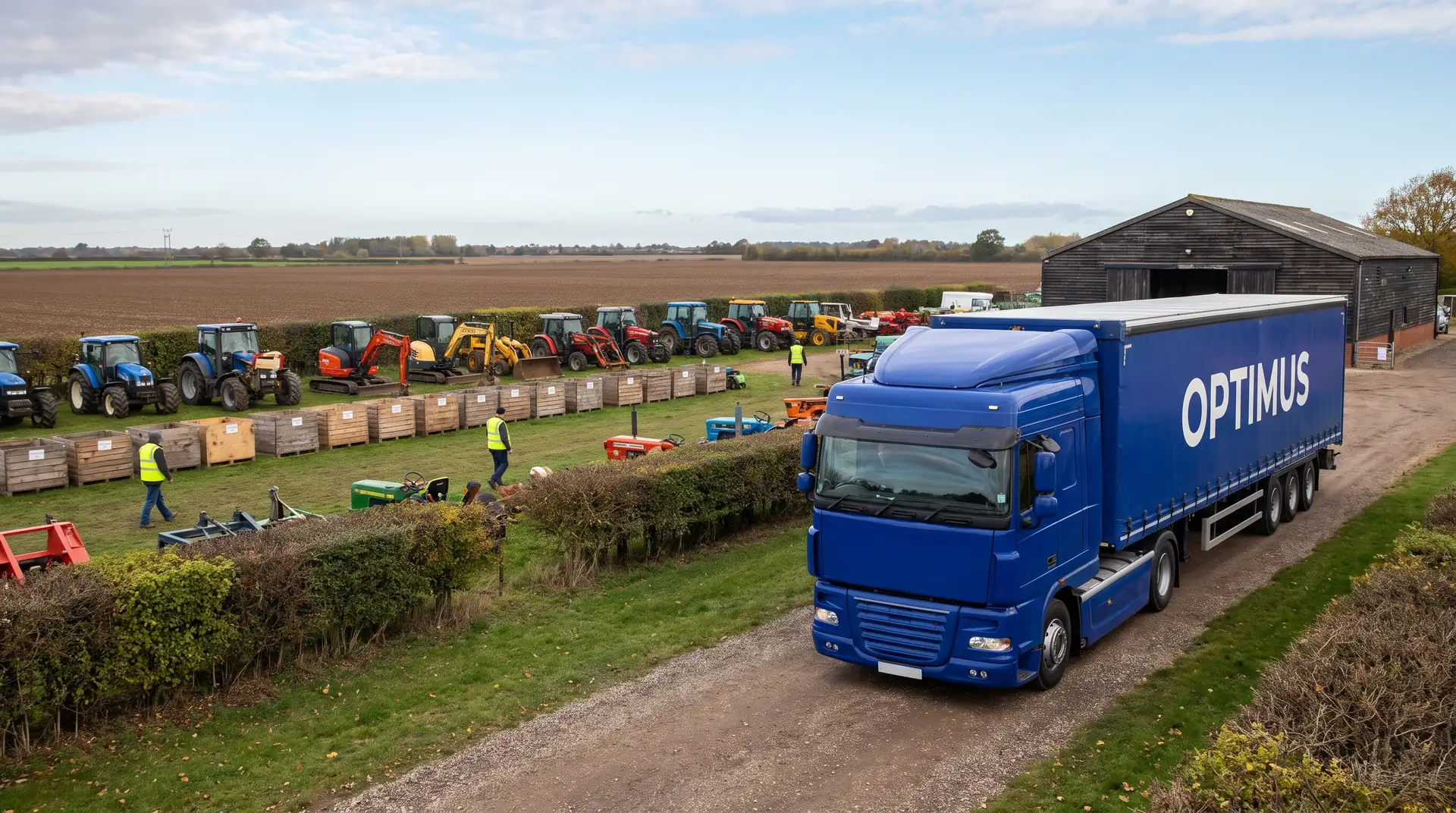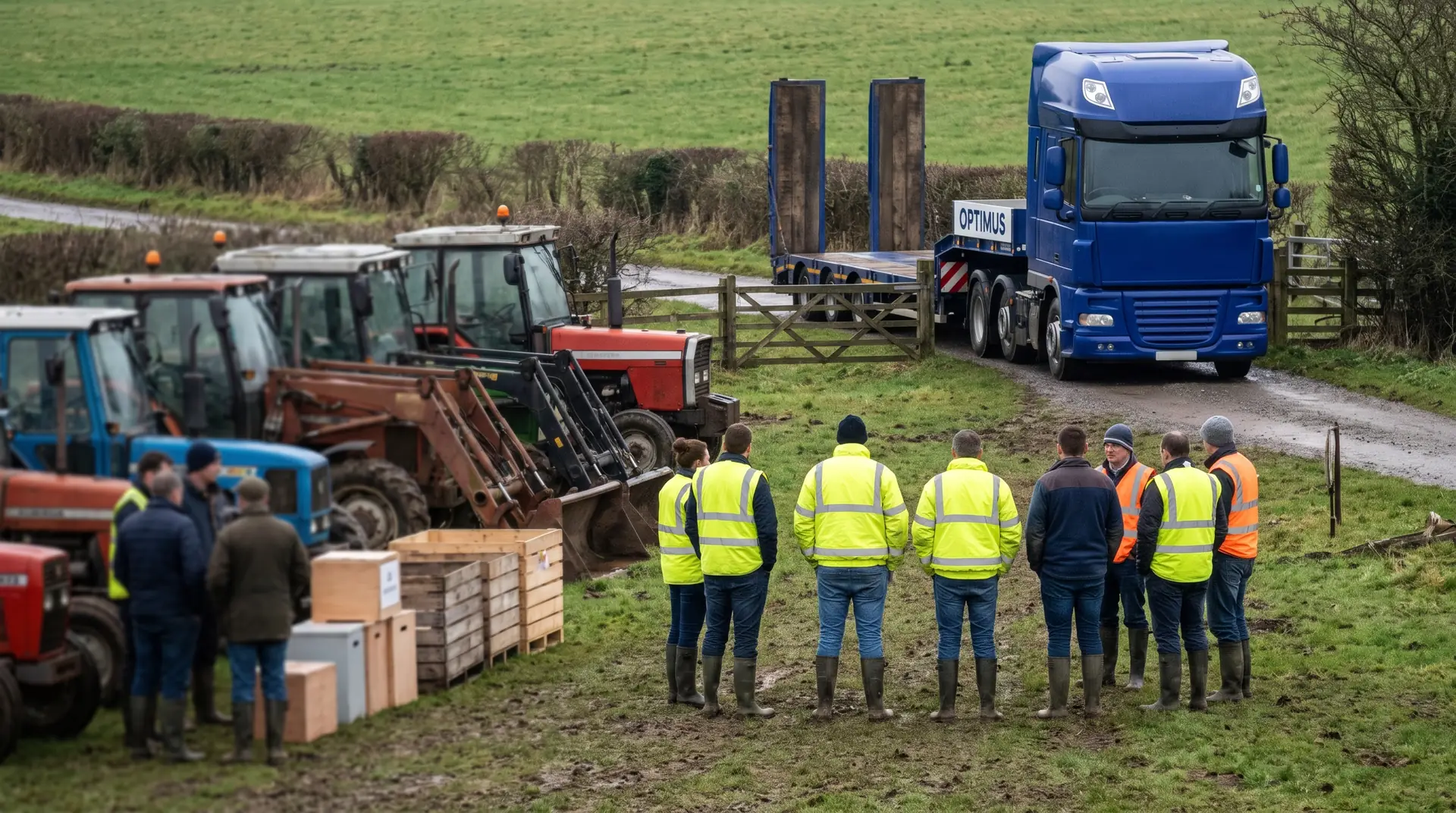
Tractors, combines, balers and cultivation equipment are sold in the United Kingdom by more than a dozen auction houses, some regional and some national. Three formats dominate: a collective sale at a permanent saleground, a dispersal sale on a farm, and an internet-only auction. For a machine that has worked in a field there is one further requirement buyers usually discover too late: the phytosanitary border inspection.
Who runs agricultural sales
- Cheffins – a monthly machinery sale at the saleground in Sutton near Ely, Cambridgeshire, separate vintage machinery auctions and dispersal sales on farms. We cover it in detail in our article on Cheffins auctions.
- Clarke & Simpson – a Suffolk auction house running collective farm machinery sales as timed online auctions.
- Brightwells – Easters Court, Leominster, Herefordshire, with a dedicated plant and machinery department.
- Thimbleby & Shorland – Reading, Berkshire, with contractors plant auctions plus separate farm and vintage sales.
- Morris Leslie – Errol Airfield in Perthshire, Scotland, running plant and classic tractor sales as timed online auctions.
- Stags – a south-west England house running machinery sales both online and on site.
- Brown & Co – organises farm machinery sales across England, mainly as on-farm dispersals.
On top of that sit the bidding platforms many of these houses sell through: BidSpotter.co.uk and i-bidder.com belong to Auction Technology Group and host industrial and machinery auctions on behalf of individual auctioneers. So you bid with the auctioneer but register and pay to the rhythm the platform sets.
Plant health inspection: the most commonly missed requirement
Used machinery and vehicles that have been used for agricultural or forestry purposes, imported from a country outside the Union, whose tariff code appears in the list in Annex XI, Part A, point 1 of Commission Implementing Regulation (EU) 2019/2072, count as goods of high phytosanitary risk and are always subject to a phytosanitary border inspection. In practice that means:
- the importer registers in the official register of professional operators at the regional plant protection and seed inspectorate covering their place of residence or business;
- they open a TRACES NT account in order to notify the consignment for inspection;
- the machine must be accompanied by an original phytosanitary certificate issued by the plant protection organisation of the country of dispatch;
- the machine must be free from soil and plant debris;
- the CHED-PP notification is lodged at least twenty-four hours before arrival at the first point of entry into the Union;
- the consignment enters through a designated border crossing point where the inspection can be carried out;
- the inspection happens at the first point of entry even if the machine is destined for another member state. Skipping this risks the shipment being sent back.
New, unused agricultural and forestry machinery is not subject to the border inspection. That distinction drives the whole schedule: for a used machine the certificate has to be arranged on the British side, before the equipment leaves the yard.
Washing before loading
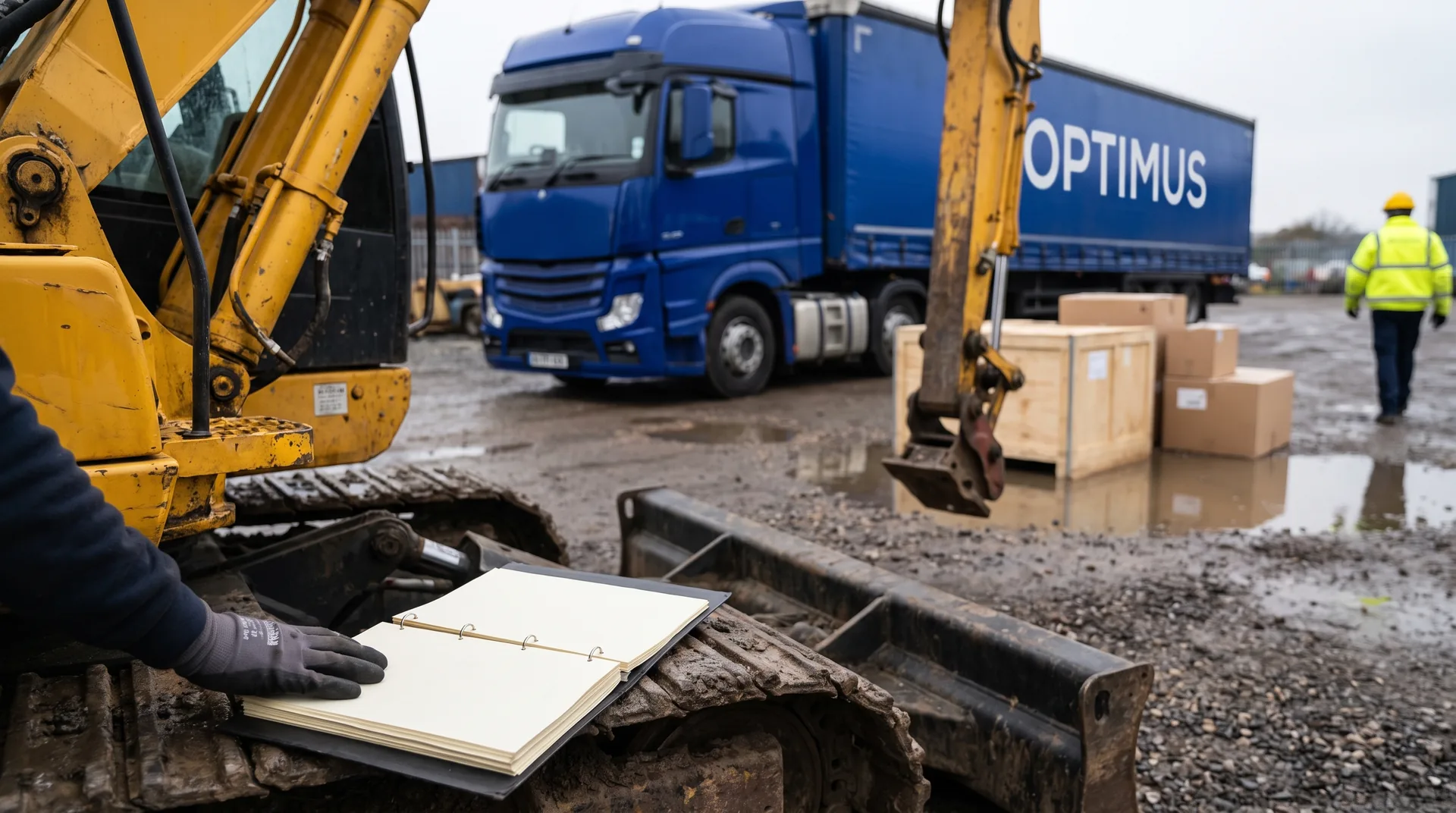
The requirement to be free of soil and plant debris sounds trivial until a combine straight off harvest is standing in front of you. Earth sits in the undercarriage, in the mudguards and on the tyres; straw sits in the radiator and the sieve channels. Washing is arranged on the British side, before loading, and a separate day is planned for it. Once the machine is on the trailer, cleaning it becomes much harder, and at a border inspection dirt in the undercarriage is not a matter of opinion but the basis for the inspector’s decision.
What else farm equipment changes
- Dimensions: a combine without its header can still be an abnormal load, and the header travels separately on its own trailer. Permits are covered in our piece on oversized transport.
- Machine paperwork: declaration of conformity, manual, service history. Context in our article on importing used machinery.
- The tariff code, which drives both the duty rate and whether the machine falls into the plant health list. We cover this under the customs tariff code.
- Fuel and fluids: tanks are often drained and the battery disconnected before carriage.
What you will not find here
We do not quote buyer’s premiums, removal deadlines or storage charges. Every auction house sets them in its own terms and they vary between individual sales at the same house. Nor do we quote the number of machines at forthcoming auctions or their dates, because calendars shift through the season.
Among the western English houses there is one more address worth knowing: machinery and heavy goods vehicles are consigned into the Madley yard, which we cover in our article on Brightwells at Leominster and Madley.
Sources
- Polish plant health inspectorate: phytosanitary conditions for importing used agricultural and forestry machinery into the EU
- Clarke & Simpson: collective farm machinery sales
- Brightwells: plant and machinery department, Leominster
- Thimbleby & Shorland: contractors plant auctions in Reading
- Morris Leslie: machinery auctions, Errol Airfield, Perthshire
- Auction Technology Group: the BidSpotter and i-bidder platforms
Buying a tractor or a combine at a UK auction? Write through our contact form with the model, the site and the removal date, and we will check dimensions, whether a phytosanitary certificate is needed, and price the carriage. The wider picture is in our guide to UK machinery auctions.