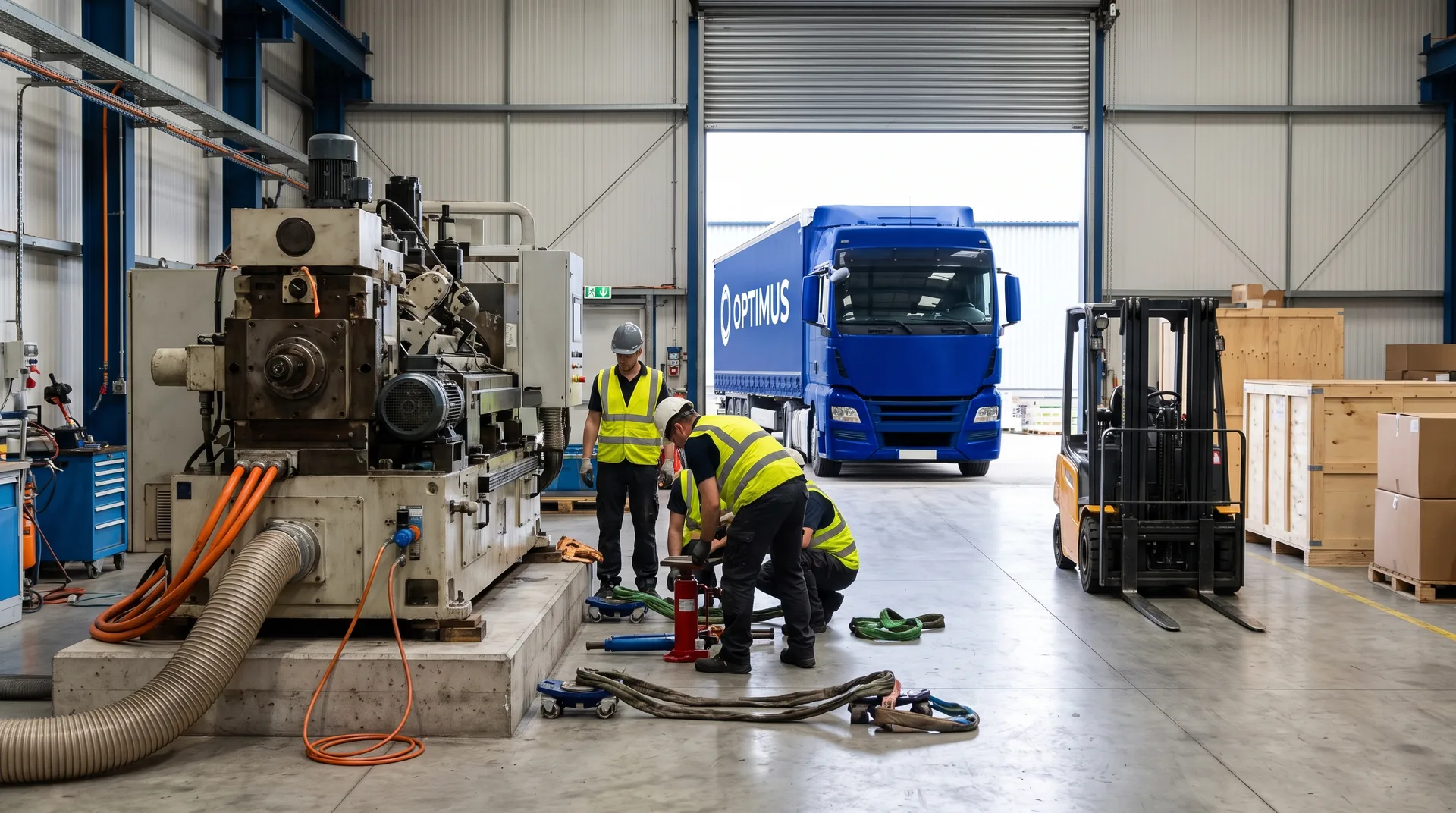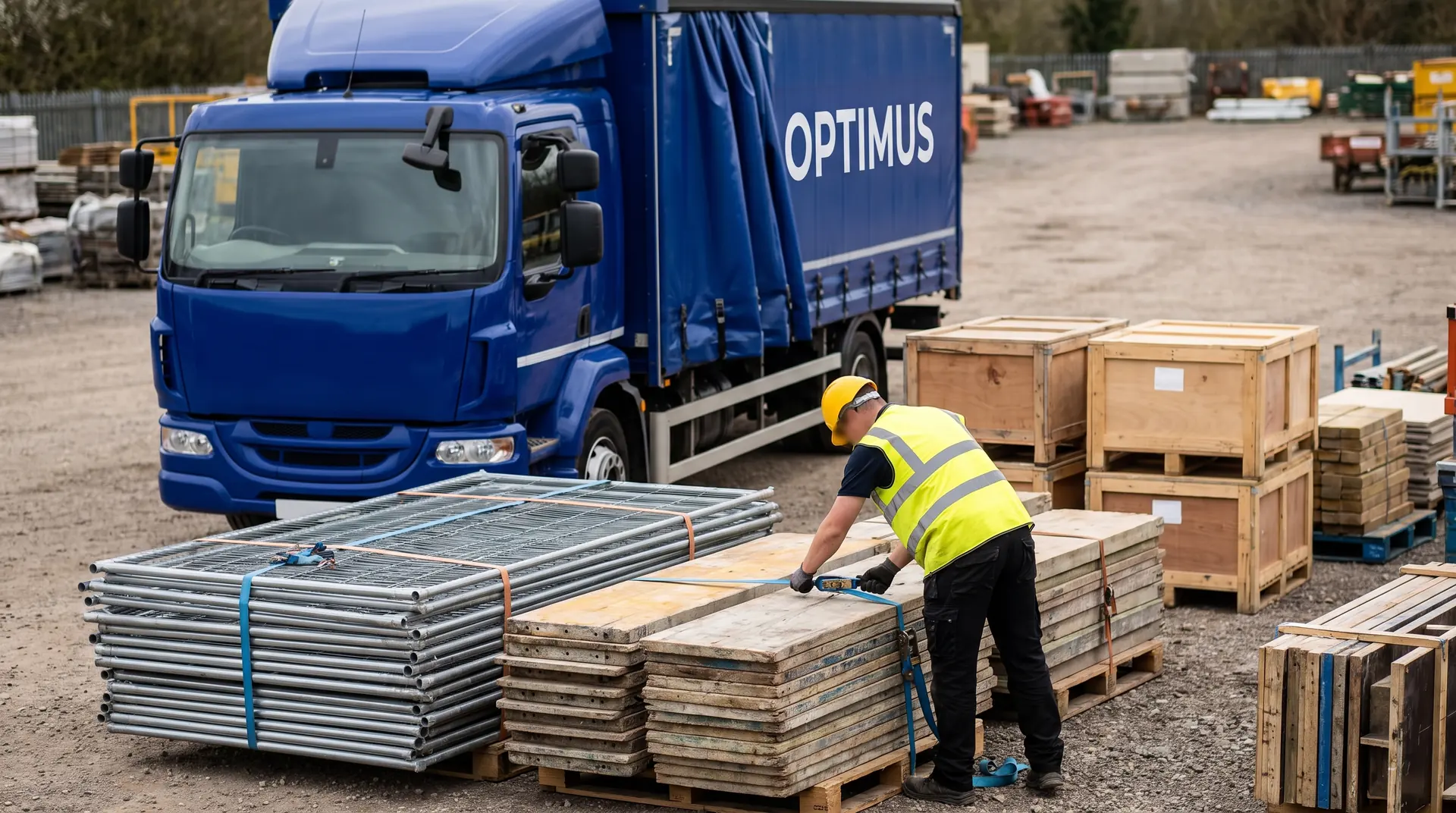
Temporary fencing, formwork and small plant from auctions rarely deserve a truck of their own. They normally travel in groupage, but only where they can be palletised or strapped into stable bundles of known size and mass. A loose stack of panels, a pallet of concrete feet and a crate of small parts are three entirely different lines in a quote.
Groupage or a dedicated truck
The line is practical: around twelve pallets, roughly a third of a trailer, is where groupage stops being cheaper than a dedicated truck. Below that the consignment waits for the nearest scheduled line departure and shares the vehicle with other goods, which means two transhipments: cross-dock at our warehouse in Milton Keynes and transhipment at the Polish hub. Every transhipment is a moment when a badly packed load comes apart, so in groupage packing matters more than in a full load. How a consolidated truck works and what happens when it does not fill up are covered in our articles on LTL groupage and on part-loaded groupage.
Fence panels and feet: two different problems
Temporary fence panels are light, flat and large. They are strapped into bundles across the full height, with dunnage between layers, and set on a pallet or on two bearers so that a forklift has somewhere to put its forks. An unstrapped bundle spreads at the first transhipment, and a single panel slid between other people pallets ends up as a scratch on somebody else goods. Zinc coating is soft: panels rubbing against each other on the road come out covered in white scoring, so the dunnage is not decoration.
Concrete feet are the opposite of panels: small and very heavy. A pallet of feet reaches its permitted mass at modest height, and concrete does not forgive uneven stacking, because an unevenly laid layer breaks the boards of the carrier. Here density builds the price, not volume. Why mass and dimensions drift between the booking and the weighbridge at the hub is explained in our article on weighing and measuring pallets before departure.
Formwork, ties and small fittings
- Formwork frames are strapped into bundles of one type and one size. A mixed bundle cannot be stacked stably or counted on receipt.
- Concrete residue breaks off on the road and ends up in the trailer or on the load beside it. Cleaning before packing costs less than a claim.
- Plywood and formwork board travel flat rather than on edge, and always covered, because moisture delaminates the edges faster than people expect.
- Ties, locks, clamps and small fittings go into crates or tubs with the contents described, never loose. Unpacked small parts cannot be counted or claimed for.
- Sharp edges and protruding parts are protected, because somebody handles them at transhipment.
Wood in the packaging: the trap people forget
A crate knocked together in the yard from whatever boards were around, bearer blocks and dunnage used to chock the load all fall under the rules for wood packaging material. Where a consignment enters the EU from the United Kingdom, the wood has to be treated and marked accordingly, and a missing mark applies just as much to a hastily built crate as to a pallet. The rules and how to read the mark are set out in our article on ISPM 15 and wooden pallets. A simple rule applies: if the seller supplies the wood, we check the mark in the yard rather than on arrival.
Overhang, dimensions and labelling
Cargo protruding beyond the pallet outline is a problem in a warehouse rather than a detail: it cannot be set beside another pallet, it cannot be stacked and it is a common reason for refusal. Panels longer than the pallet therefore either go onto a longer carrier or are booked as a non-palletised load with declared dimensions. The consequences of overhang are described in our article on pallet overhang, and consignments that by their nature do not fit a pallet in our piece on non-palletised groupage.
Collecting from several yards and the paperwork
Auction lots rarely sit in one place. When we collect items from several yards, each consignment gets its own consignment note, and only at the warehouse do they become a single batch for export. That way it is visible what came from where and in what condition it was accepted, and a claim has an addressee. How documentation works when consignments are combined is covered in our articles on consolidation and the number of CMR notes and on filling in a consignment note.
Sources
- GOV.UK: wood packaging material for import and export
- IPPC: ISPM standards, including ISPM 15
- GOV.UK: securing loads on HGVs and goods vehicles
Bought several lots of small plant at different auctions? Send the list of items and the yard addresses through the quote form and we will bring them together into one batch. See also LTL groupage.