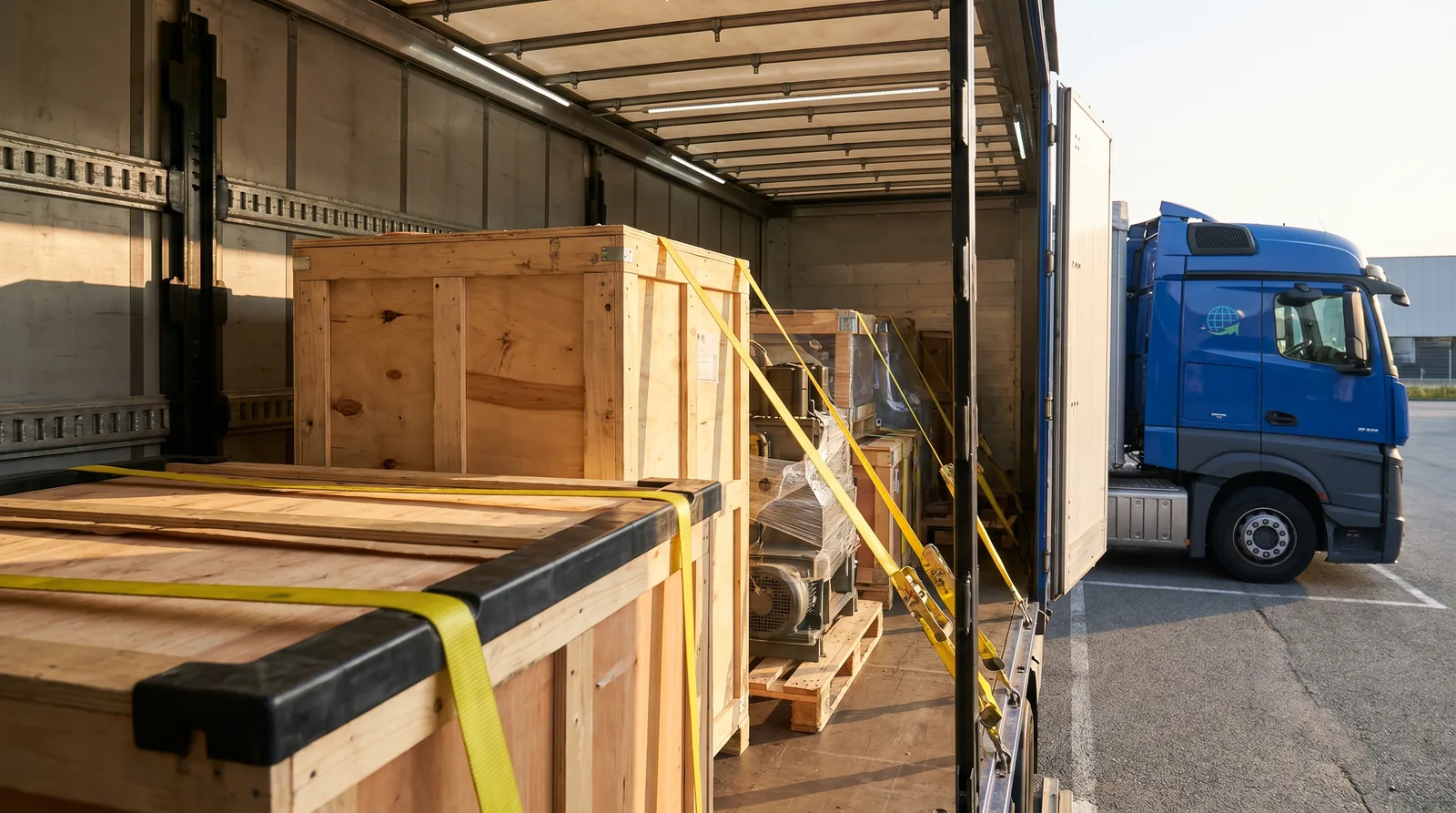
EN 12195-1 sets out how to calculate the forces needed to secure cargo in road transport. It works with accelerations of around 0.8 g forward and 0.5 g rearward and sideways. Securing itself is the responsibility of the carrier and driver, while correct loading and accurate information about the goods sit with the consignor and the loader.
Where 0.8 g and 0.5 g come from
The values reflect the real accelerations a load experiences on the road. Emergency braking is the harshest case, which is why the forward coefficient is the highest. An avoidance manoeuvre or a bend generates lateral forces, and pulling away or climbing generates rearward ones. Securing is calculated so the load stays put in every one of those scenarios, not only the most likely one. The same values appear in EU rules on technical roadside inspection, which is what an inspector assesses cargo securing against.
Four methods and when to combine them
- Blocking: the load bears against the headboard, the sides or another load. The most effective method for heavy, compact units.
- Top-over lashing: a strap presses the load down onto the deck and works through friction. Popular, but sensitive to load height and rigidity.
- Loop and diagonal lashing: straps work along the direction of the force, transferring it directly rather than through friction.
- Filling voids: airbags and dunnage remove the empty space in which a load builds up momentum.
Friction matters more than strap count
The most common mistake is adding straps instead of adding friction. An anti-slip mat under a pallet can change the calculation more than two extra lashings, because the friction coefficient enters the formula directly. Deck condition matters too, along with damp, dust and whether the pallet sits on timber or on film. With smooth loads such as sheet metal or shrink-wrapped packaging, downward pressure alone is often insufficient and the load has to be blocked structurally.
Who is responsible for what
The split of roles is a frequent source of argument after a claim, so it is worth knowing in advance. The consignor is responsible for packaging and for accurate information about the goods: weight, centre of gravity, whether stacking is permitted. The loader is responsible for how the load is distributed on the vehicle. Carrier and driver are responsible for the load being secured and for not setting off in an unsafe condition. The legal consequences after a loss are set out in carrier liability under the CMR convention and in claims and the CMR damage report.
What happens when securing fails
A shifted load is not only damaged goods. It also means axle overload, a risk of rollover and a vehicle stopped by enforcement. The consequences of a weight check are covered in misdeclared weight and axle overload. Once a load has moved, what counts is fast and documented action: inspection, photographs, re-stacking and a decision on whether to continue. We provide that support under cargo inspection and recovery, with the practice described in cargo inspection after trailer tampering.
Preparing a load so it can be secured at all
Many problems start at the packing bench rather than at the loading bay. A pallet with overhanging cartons, badly distributed weight or loose wrapping cannot be secured properly however many straps the driver carries. Practical guidance is collected in how to secure a pallet for export and how to prepare a pallet for the UK. For unusual loads we agree the securing method before the vehicle is sent, so the driver arrives with the right equipment.
A roadside check: what the inspector actually looks at
Checking cargo securing is not a matter of counting straps. The inspector looks at whether the load can move: whether it bears against the headboard or is blocked, whether there are voids between units, whether the lashings have adequate strength and are free of chafing, damage or sharp edges without protection. They also check that the load does not exceed permitted point loading on the deck and that weight distribution does not overload an axle. A finding normally means a prohibition until the securing is corrected, which on a timed delivery means a lost unloading window. That is why securing is agreed before the vehicle is sent: the driver has to carry the right equipment, anti-slip mats and void fillers rather than improvise at the bay. The consequences of a weight check are covered in axle overload.
Sources
- EUR-Lex: Directive 2014/47/EU on technical roadside inspection, including cargo securing
- UNECE: CMR Convention
This is general information, not a technical assessment of a specific load. Have goods that need unusual securing? Describe them in our quote form and we will match the trailer and the securing method before loading.