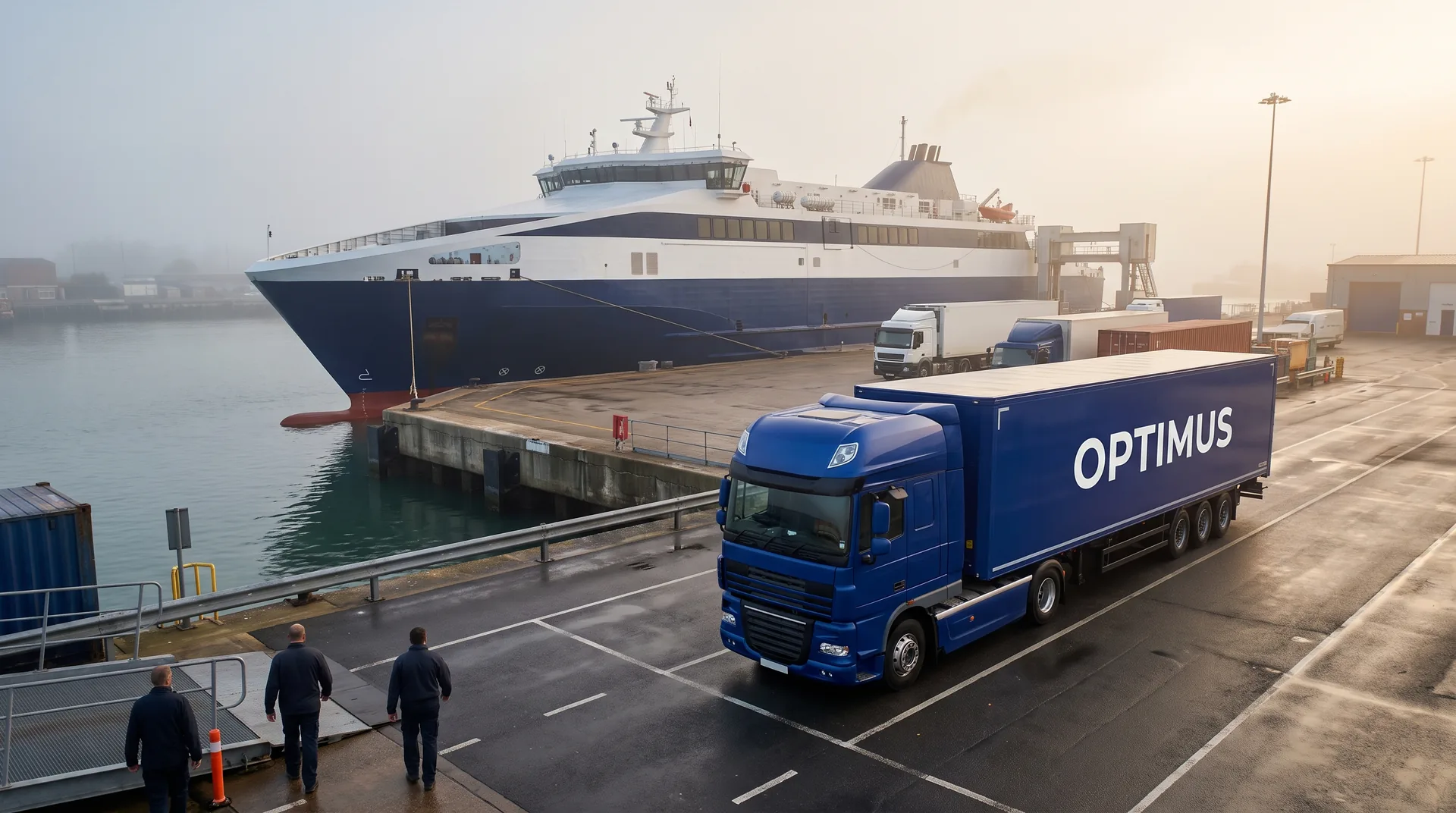
We deliver to Belfast and Northern Ireland two ways: through Great Britain and a ferry from Cairnryan in Scotland (to Larne or Belfast), or via Dublin and the M1 motorway north. Formalities follow the route: entering through GB means Windsor Framework rules, entering through Dublin means a standard EU import into Ireland.
The Scottish route: Cairnryan
Two regular ferry lines run from Cairnryan on the Scottish coast: P&O Ferries to Larne and Stena Line directly to Belfast port. The truck crosses England and Scotland like a normal GB delivery and the sea leg is short. This route wins when part of the load is dropped in England or Scotland anyway.
The Dublin and M1 route
Ferries from France and from Welsh ports to Dublin bring the truck onto the island from the south. The M1 motorway links Dublin with Belfast, and the land border between Ireland and Northern Ireland stays open, with no border infrastructure. This option can be better when a shipment combines consignees in the Republic and the North.
Documents by route
- Entry through GB (Cairnryan): first a normal import into the United Kingdom, then a GB-NI movement under the Windsor Framework; simplified where the consignee holds UKIMS.
- Entry through Dublin: an EU import declaration in Ireland, then carriage across the open land border with no further clearance.
- On both routes: invoice, packing list, the consignee's EORI and a CMR note.
The regulatory background is covered in our articles on Northern Ireland and the Windsor Framework and on the differences between shipping to Northern Ireland and the Republic.
What to watch
- Consignee status: a company without UKIMS may pay duty as if the goods entered the EU, even if they stay in NI.
- Goods descriptions: vague wording stops a shipment on the Irish Sea just as it does on the Channel.
- Mixed GB plus NI drops need the paperwork split at loading, not at the port.
Which route when: a simple test
- The whole load stays in Northern Ireland and the consignee holds UKIMS: the route through Great Britain usually wins, because the formalities are predictable and drops in England and Scotland can be served on the way.
- The shipment combines consignees in the Republic and in the North: entry through Dublin is the natural choice, because one EU import covers everything and the land border needs no further declarations.
- The consignee has no UKIMS and does not intend to apply: we cost both options, because the duty exposure can outweigh the difference in freight.
- Time-sensitive cargo: sailing availability on the specific day decides, not the length of the route on a map.
The most common mistake: treating Northern Ireland as another English county
Northern Ireland is part of the United Kingdom but, for goods, remains within EU rules. That is why an order written simply as delivery to the UK, with one set of documents for every address, is the most frequent source of trouble: a consignment to Manchester and a consignment to Belfast need different paths, even when they travel on the same vehicle. We separate them at loading, with separate consignment notes and separate declarations, because unpicking it at the port instead costs a day or two.
What to prepare before a first shipment to the North
- The consignee's status: whether they hold UKIMS authorisation and under what number.
- An exact goods description with the commodity code, not a generic parts or foodstuffs.
- Whether the goods stay in Northern Ireland or travel on to the Republic, because that changes the declaration path.
- The address with postcode and a contact on site, exactly as for any delivery in Britain.
Sources
- GOV.UK: the Windsor Framework collection
- GOV.UK: UKIMS authorisation for goods brought into Northern Ireland
- P&O Ferries: Cairnryan-Larne route
- Stena Line: Cairnryan-Belfast route
Planning deliveries to Belfast, Derry or mixed routes with the Republic? Use the contact form and we will pick the route and complete the documents.