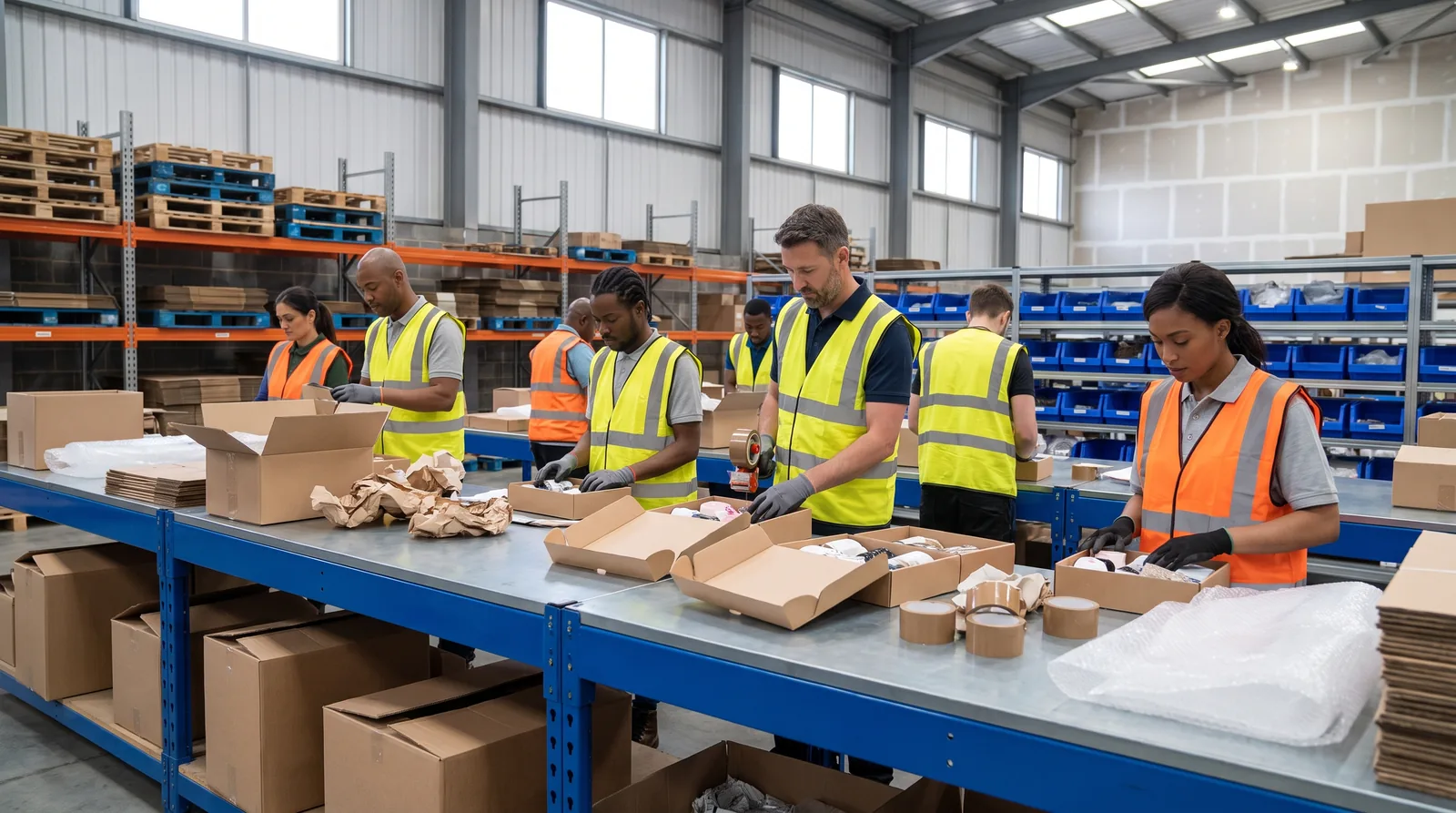
Co-packing, kitting and bundling means combining separate products or components into a single ready-to-sell or ready-to-ship unit. Co-packing is contract packing to a brief; kitting is assembling a fixed set from several parts; bundling is joining items for a promotion, such as a multipack or a display pack. All three are unit-level work, carried out by a co-packer or a prep operator. We do not do that work: we handle the transport and the warehousing around it, at the level of the pallet and the outer carton.
Why brands co-pack in the destination market
A promotion in the UK rarely matches the pack a factory in mainland Europe produces for its home market. The retailer wants a specific multipack, a shelf-ready display, English-language sleeving or a seasonal bundle. Building that at origin means committing to the exact promotion months ahead and shipping finished packs that may never sell. Building it in the UK, close to the retailer, lets the brand decide the promotion late and only assemble what the market actually orders. That depends on sound transport and warehousing on the British side, and the limits of what the warehouse takes on are set out in our article on what our warehouse does not do.
What contract packing covers
Below is the scope a co-packer normally takes on. It is unit-level work, carried out on a packing line.
| Task | What it means | Typical use |
|---|---|---|
| Co-packing | packing a finished retail unit to a brief | sleeving, over-wrapping, sealing, labelling |
| Kitting | a fixed set from several components under one code | starter sets, spare-parts kits, gift sets |
| Multipacks | several selling units joined into one | buy-two, buy-three, family packs |
| Display packs | shelf-ready or floor-standing units | promotions, seasonal ranges, launches |
| Order assembly | picking and combining units to an order | e-commerce, retailer orders, sampling |
Kitting: one code out of many parts
Kitting turns several stock items into a single sellable unit with one barcode. The operator picks the components, assembles them in the right quantity and configuration, packs them and applies the kit label so the finished set scans as one product at goods-in and at the till. Once the finished kits stand in cartons on a pallet, the logistics-unit marking, meaning the SSCC pallet label and the outer-carton description, is ours, as described in our article on re-labelling and GS1 barcodes for UK retail.
Bundling for promotions
Promotional bundling is time-sensitive: the offer runs for a window, then the surplus reverts to single units. The co-packer builds the multipacks and display packs for the campaign, and when it ends the unsold stock can be broken back down to sellable singles rather than written off. Because this happens in the UK, the brand commits to the promotion late and matches the volume to real demand instead of guessing months ahead. Our role in such a campaign is transport and warehousing: we bring the components over from Poland, hold them until the line runs, and move the finished pallets on to the retailer.
Order assembly and the limit of our service
Retail picking unit by unit, adding inserts or samples, despatching parcels to end customers and preparing consignments for Amazon FBA (FNSKU labels, poly-bagging, expiry-date formatting) are all unit-level work and sit outside our scope. They stay with the client or with their parcel or prep operator. What an Amazon FBA delivery itself requires is covered in our article on Amazon FBA deliveries to the UK. Our part of such a project is the transport and the pallet: pallet receipt and release, storage including chilled and frozen zones, inspection with a photo report, restacking and stabilising the load, the SSCC pallet label, and emergency transhipment at any hour.
Why the UK and not back at origin
Packing in the destination market keeps options open and keeps stock moving. The trailer of components reaches the warehouse, the line assembles to the live promotion, and finished packs go to the retailer on time. Sending components back to origin to be packed, or shipping pre-built promo packs speculatively, ties up cash in stock that may not sell and loses days on every change of plan.
What we need from you
For the transport and warehousing part we need the address of the co-packer or prep operator, the campaign window, any temperature requirement, and the pallet specification: height, stacking pattern and outer-carton markings. The pack specification itself you settle with the co-packer. We flag anything that will not fit the pallet standard or the transport requirements before the goods move.
Where we work
We take in pallets for co-packing projects at our Milton Keynes warehouse between London and Birmingham, within our warehousing and cargo handling services. The central location keeps the diversion short between the sender, the co-packer and the retailer.
Sources
Planning a campaign with packing in the United Kingdom? Describe the flow in the contact form: we will bring the components in, store them and move the finished pallets on to the retailer or the fulfilment centre. The packing itself you arrange with a co-packer, and we make sure the goods arrive in the condition they left in.
Handling returns from the United Kingdom? See also our article on returns and reverse logistics from the UK.