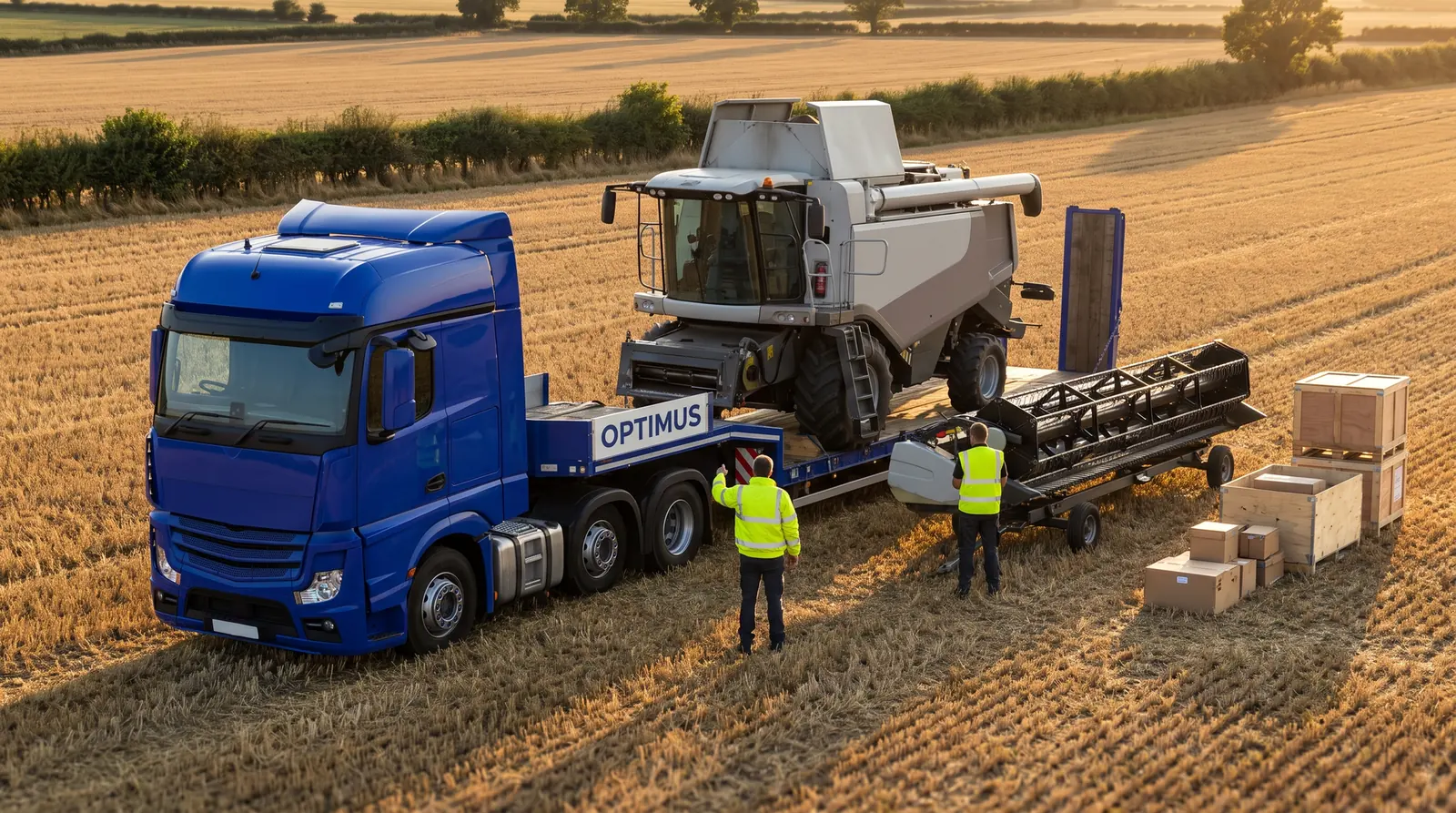
A combine harvester bought at a UK auction travels as two loads: the body of the machine and the header on its own wheeled trailer. The quote shows that as two lines, not one journey. Even with the header removed, the body usually stands too tall for a standard trailer, so a low loader is needed. The collection date is planned backwards from the permit, because the road authority decides when an abnormal movement may run.
Why a combine counts as two loads
In the auction yard the machine stands complete, so it is easy to assume it will travel complete. It will not. Once the header comes off, it sits on its own trailer and becomes a load in its own right, with its own width, its own weight and its own lashing points. Two loads mean two spaces on trailers, two sets of straps and two lines on the paperwork.
Sometimes the header and its trailer fit on the same deck as the body. What decides that is deck length and axle loading, not the wish to save a journey. More often the header travels separately, because the body takes up almost the whole low loader. This is why a question about the cost of moving a combine cannot be answered without the model and the header width; the full list of details to send is set out in our guide to a transport quote before a UK auction.
- the body — height and width measured with the header off, not copied from a brochure;
- the header on its trailer — the length of the whole assembly, normally handled as a separate unit;
- ladders, mirrors, walkways and the unloading auger — items that fold or come off before anything is measured.
Getting off the yard: own wheels or a winch
An auction combine is sometimes a runner, in which case it moves off its standing under its own power and climbs the ramps unaided. It is just as often sold as a non-runner, with a flat battery, air in the fuel system or simply no key, and then a winch is required, occasionally helped by a loading shovel pushing from behind. That has to be known before a vehicle is despatched, because a trailer with a winch and a trailer without one are two different vehicles on two different dates.
Ground conditions matter as much as mechanical condition. Churned grass after rain stops a combine more reliably than an engine fault, and wide drive wheels dislike the edge of hardstanding and shallow drainage channels. The ways a machine can be put on a deck — ramps, a loading dock, a crane or a recovery vehicle — are compared in our piece on loading a machine at the auction yard.
What folds, what comes off, what gets locked
Before anything is measured and before the straps go on, the machine is brought into its transport configuration. The access ladder and walkway fold, the mirrors fold, and the unloading auger is swung along the body and locked into its rest. The grain tank must be empty: leftover grain is a moving centre of gravity and, under braking, material that spills onto the carriageway.
Moving assemblies are secured separately. The reel is lowered and supported, the feeder house is lowered and mechanically locked rather than left on hydraulics, which can bleed pressure overnight in cold weather. Lashings go on the points the manufacturer marks, not on the first convenient piece of frame — the reasoning and the calculation are covered in our article on cargo securing to EN 12195.
Soil, straw and chaff: washing as a separate day
A combine that has worked a standing crop carries more plant debris than any other machine on the same sale. The dirt is not on the outside but inside: in the sieves and threshing channels, in the pockets of the feeder house, on the radiator and in the fan housing, in the running gear and around the axles. A quick pass with a lance changes nothing, because most of the soil and chaff sits where the water jet never reaches.
So washing is booked in Britain as a day of its own, before loading rather than after arrival in Poland. The machine needs time to dry, sieves sometimes have to come out, and opening the guards takes longer than the rinsing itself. What this means formally when agricultural equipment is brought into the European Union, and which documents follow from it, is set out in our guide to farm machinery auctions in the UK.
The permit sets the collection calendar
A combine is never groupage, in any configuration. There is no point asking whether it can share space with other consignments: the threshold at which we send a dedicated vehicle instead of a groupage one is around twelve pallets, and a combine body fills a whole trailer from the start. A groupage vehicle waits for the next scheduled line departure and passes two transhipments on the way — a combine runs differently, yard to delivery address, with no transhipment.
An abnormal movement needs a permit, and the road authority on each side of the border issues it. That permit, and not the seller's diary, fixes the realistic collection date. The sequence is therefore the reverse of the usual one: first we establish when the vehicle may legally run, then we count back to the day the machine has to leave the yard. Conditions and the application route are discussed at length in our article on oversized transport, STGO permits and escorts. We do not repair machines, we do not value them and we do not register them — we carry them and handle the transport paperwork.
Sources
- PIORiN: phytosanitary conditions for bringing used agricultural and forestry machinery into the European Union
- GDDKiA: rules for abnormal movements and permits issued by road authorities
- GOV.UK: DVSA requirements for securing loads on heavy goods vehicles
Have you found a combine in a particular sale catalogue? Send the lot number, the model and the header width through our haulage quote form and we will return a split into two lines together with the date the permit allows. Questions about export and import paperwork are answered on our page about customs clearance, and if the sale closes tomorrow the quickest route is direct contact with the team.