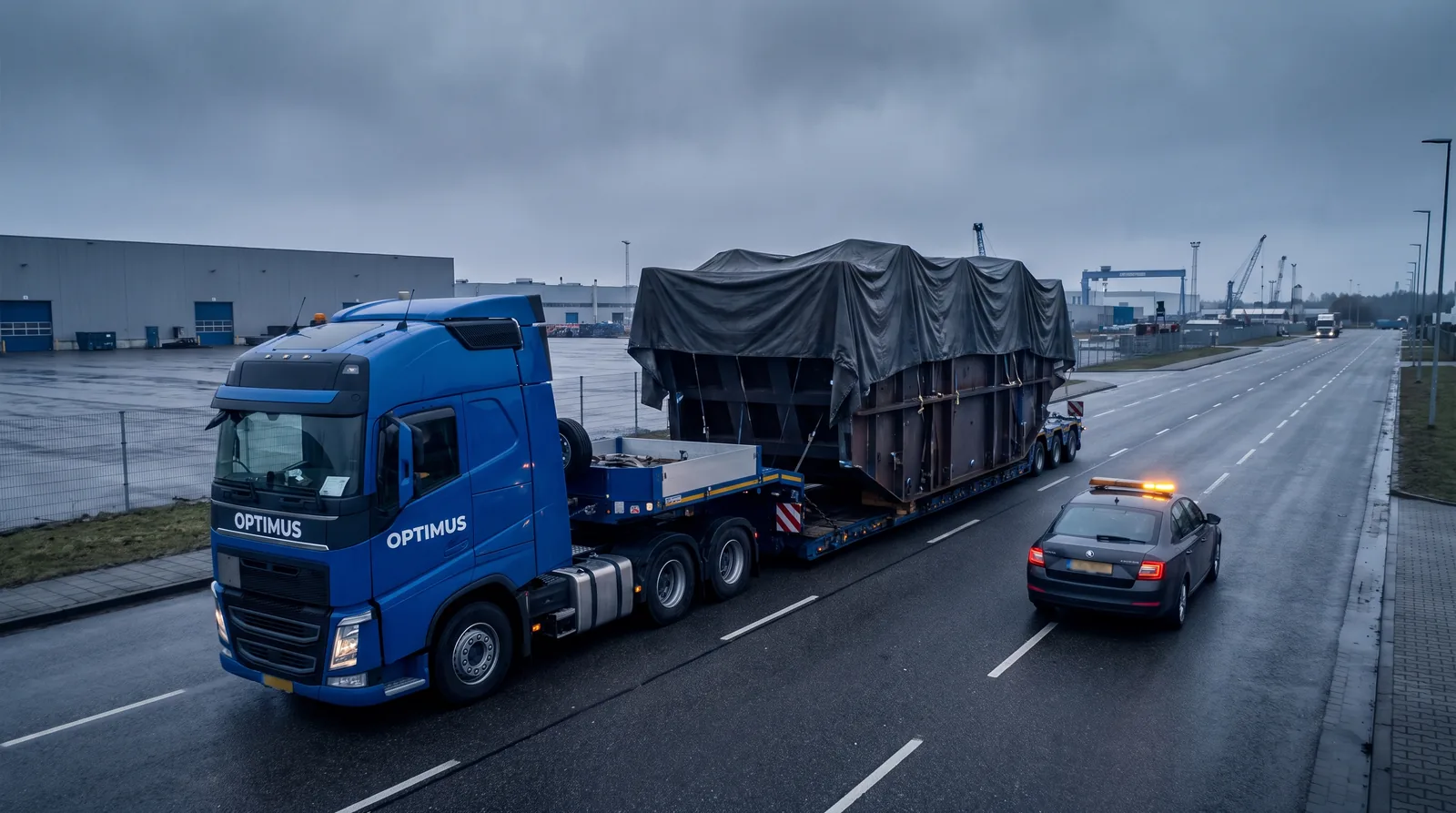
Oversized transport to the United Kingdom requires filings on both sides: in Poland a permit for a non-standard vehicle, and in the UK abnormal load notifications to the police and road and bridge authorities. Weights above 44 tonnes fall under STGO categories, and extreme dimensions need National Highways approval. Planning starts from dimensions and mass, not from a date.
When does cargo become an abnormal load in the UK?
The boundaries are countable: above 44 tonnes gross weight, above 2.9 m width or above 18.65 m rigid length the combination stops being an ordinary lorry. Entering that band means running under the Special Types General Order, or STGO, with speed restrictions and mandatory advance notice. The thresholds and enforcement rules are set out in the government's Special Types Enforcement Guide listed in our sources. On the Polish side the same cargo needs a non-standard vehicle permit of the appropriate category, which we obtain before departure.
STGO categories: what do they mean?
- STGO Category 1: combinations up to 50,000 kg gross weight; the mildest regime, marked with an STGO CAT 1 plate.
- STGO Category 2: up to 80,000 kg, with requirements on axle loads and bridge authority notifications.
- STGO Category 3: up to 150,000 kg; the heaviest movements with the longest notice periods.
- Special Order: above 150,000 kg or wider than 6.1 m; requires an individual National Highways approval issued in advance.
What does the movement notification procedure look like?
- We establish exact dimensions, mass, axle loads and the cargo's support points.
- We plan the route in England around bridges, viaducts and diversions; critically low structures are excluded at the planning stage.
- We file the notifications: police plus road and bridge authorities, usually through ESDAL, two to five clear working days ahead depending on the parameters.
- For widths above 5 m we submit form VR1 to National Highways, and above 6.1 m we apply for a Special Order.
- Once confirmed, the movement follows the notified route and time window; a route change requires a fresh notification.
Escort: when is a pilot vehicle needed?
In Poland and the transit countries escort duty follows directly from non-standard vehicle regulations, and we arrange it together with the permits. In the UK the police increasingly hand escorting to specialist private pilots, keeping police escorts for the most demanding movements. Whether a pilot rides with us depends on width, length and the route: a 3 m wide run down a motorway is a different league from leaving it for county roads. Escort costs and the slower pace are built into our quote, so there are no surprises.
Bridges, tunnels and clearance
Height is often trickier than width: the British road network has thousands of historic bridges and viaducts, and structures with clearance below the standard of around five metres are signed and must be avoided. That is why we plan a tall load's route from the bridges, not from the map: critical structures first, the rest of the road second. Trailer types for tall and long cargo, including low-deck variants, are compared in our article on trailer types for the UK.
What do we carry under this regime?
Typical abnormal loads on the England route are construction and agricultural machinery, tanks, steel structures, hall elements and production lines. The practice of carrying equipment is described in our article on construction equipment transport, and moving whole plants in machinery and production line relocation. The service scope is on our oversized loads page, and examples of unusual movements on the project cargo page.
Sources
- GOV.UK: abnormal loads and the ESDAL system
- GOV.UK: Special Types Enforcement Guide (STGO categories)
The schedule: how long can an abnormal movement take?
Abnormal transport is planned from the documents, not from the vehicle. The Polish non-standard vehicle permit, the UK notifications, a possible VR1 or Special Order and the escort arrangements each carry their own lead times, and they add up faster than expected. In practice a simple Category 1 movement is organised within days, a width needing VR1 within a week or two, and a Special Order movement is planned weeks ahead. Then route physics joins in: an escorted load travels slower, avoids peak hours and may be held at sections requiring shuttle passage. So with abnormal loads we never promise wish-list dates; we build the schedule from real approvals and crossing windows, and the client receives it in writing before the order is confirmed.
Planning to move a machine or structure beyond standard dimensions? Send the parameters through the quote form and we will prepare the route, permits and notifications on both sides of the Channel.