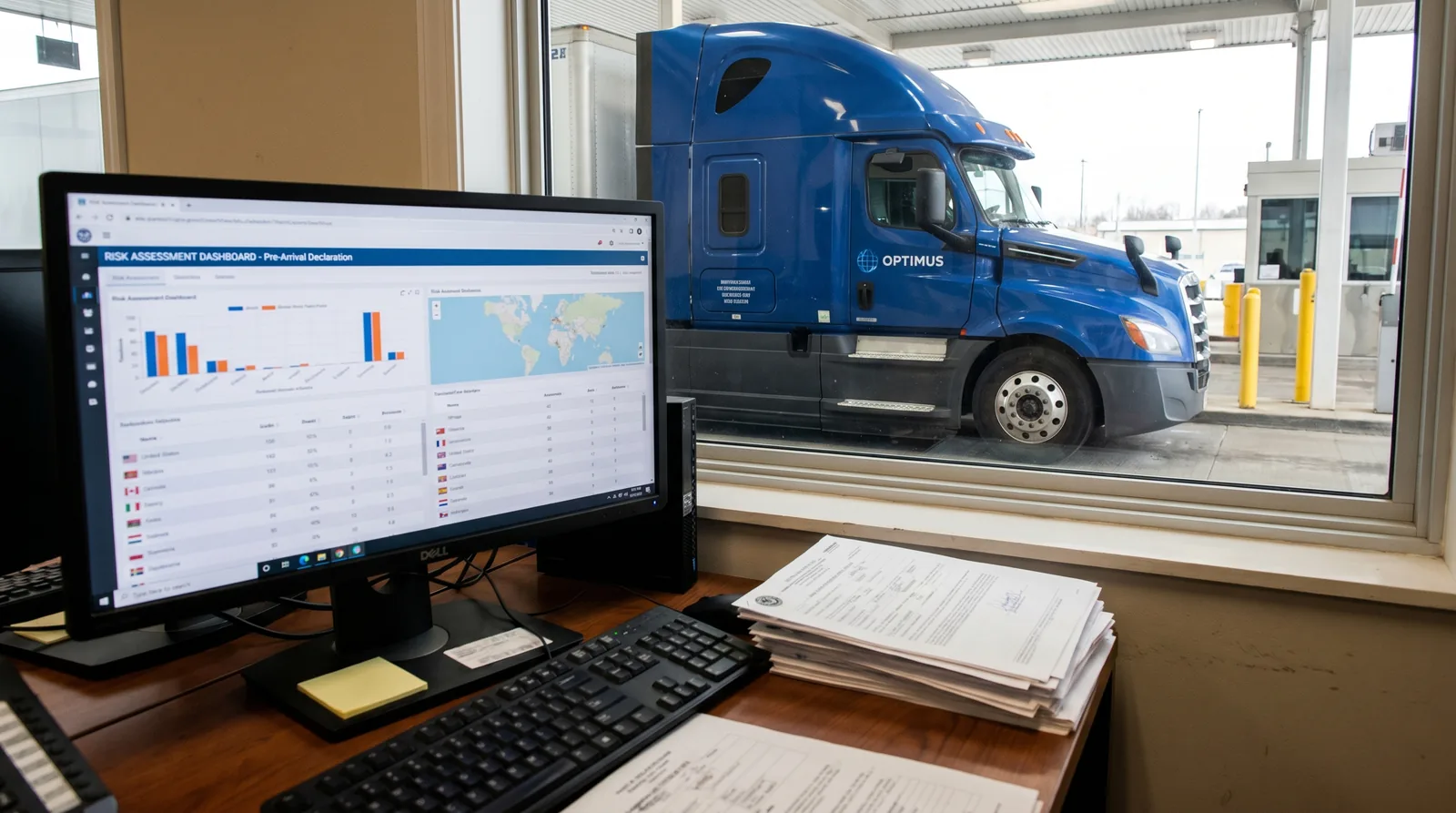
An ENS is a pre-arrival safety and security declaration in which consignment data is filed for risk analysis. It does not calculate duty and it does not replace an import declaration. The legal obligation sits with the carrier, and the deadline runs before the means of transport arrives at the place of control.
Who actually files the ENS
The legal responsibility rests with the carrier, meaning the operator of the means of transport entering the customs territory. In practice the filing is often done by a customs agent or a ferry operator acting under authority, but responsibility for the content does not disappear. So on every job we settle up front who files and who supplies the data, before the vehicle leaves the loading bay. The carrier role in the border process is covered in more depth in the GVMS system.
What data the declaration needs
The filing requires identification of the parties, vehicle details, ports of departure and arrival, and a goods description with package count, package type and gross weight. The description is the critical part: it has to be specific enough for risk analysis to work on. Generic wording such as "goods", "parts" or "gifts" is rejected or triggers a query, and a query means delay. We have collected the problem wordings in unacceptable goods descriptions in an ENS.
Timing: not a formality to sort out in the queue
The declaration must be lodged and accepted before the means of transport arrives, not while it is arriving. The required lead time depends on the mode and the route, so on road movements with a ferry crossing we work with slack: data is gathered when the job is booked and the filing goes in before the vehicle leaves base. A late or rejected filing means a lost sailing in practice, and with it the unloading slot on the other side.
The ENS against the other filings
The safety declaration is one of several parallel obligations and replaces none of them. The export declaration is filed separately in the country of despatch, the import declaration separately in the destination country, and at the UK border there is also the GMR tying together every declaration for one vehicle, described in the GMR. The data across those documents has to be consistent, because the systems compare it.
Both directions, two systems
Safety and security filings apply not only on entry to the United Kingdom but also on import from the islands into the EU customs territory, which runs its own system. Businesses trading both ways therefore handle two independent data flows. We set out that two-way picture in safety declarations in both directions. Requirements on the UK side were introduced in stages, so we always check the current position at source rather than relying on memory.
What we do at OPTIMUS
On movements to the islands we handle safety declarations as part of the job, alongside the export declaration, the import declaration and the border reference. The driver leaves with a complete set of numbers, not a promise that paperwork will follow en route. We collect data from the consignor on a single form to avoid a chain of emails, and on regular work we save it as a template for the next shipment. The scope of formalities is on our customs clearance page.
Errors in the data: who carries the consequence
A safety declaration rests on data the carrier does not usually create: goods description, weight and party details come from the consignor. Responsibility for the filing, however, stays with the carrier, so a gap between the commercial documents and the declaration lands on the carrier first and only afterwards becomes a dispute between the parties. In practice that means three things. First, we collect filing data in writing rather than over the phone. Second, we check the goods description for whether it can support risk analysis, not merely whether it reads sensibly. Third, if the load changes after filing, the declaration is amended rather than left in the hope the difference goes unnoticed. Border systems compare data from several sources, and a mismatch between the declaration and the customs entry is one of the most common reasons a vehicle is directed for inspection.
Sources
Shipping to the islands and want the declarations closed before the vehicle rolls? Describe the consignment in our quote form and we will prepare the filings alongside the transport. The full picture of the lane is on our transport to the United Kingdom page.