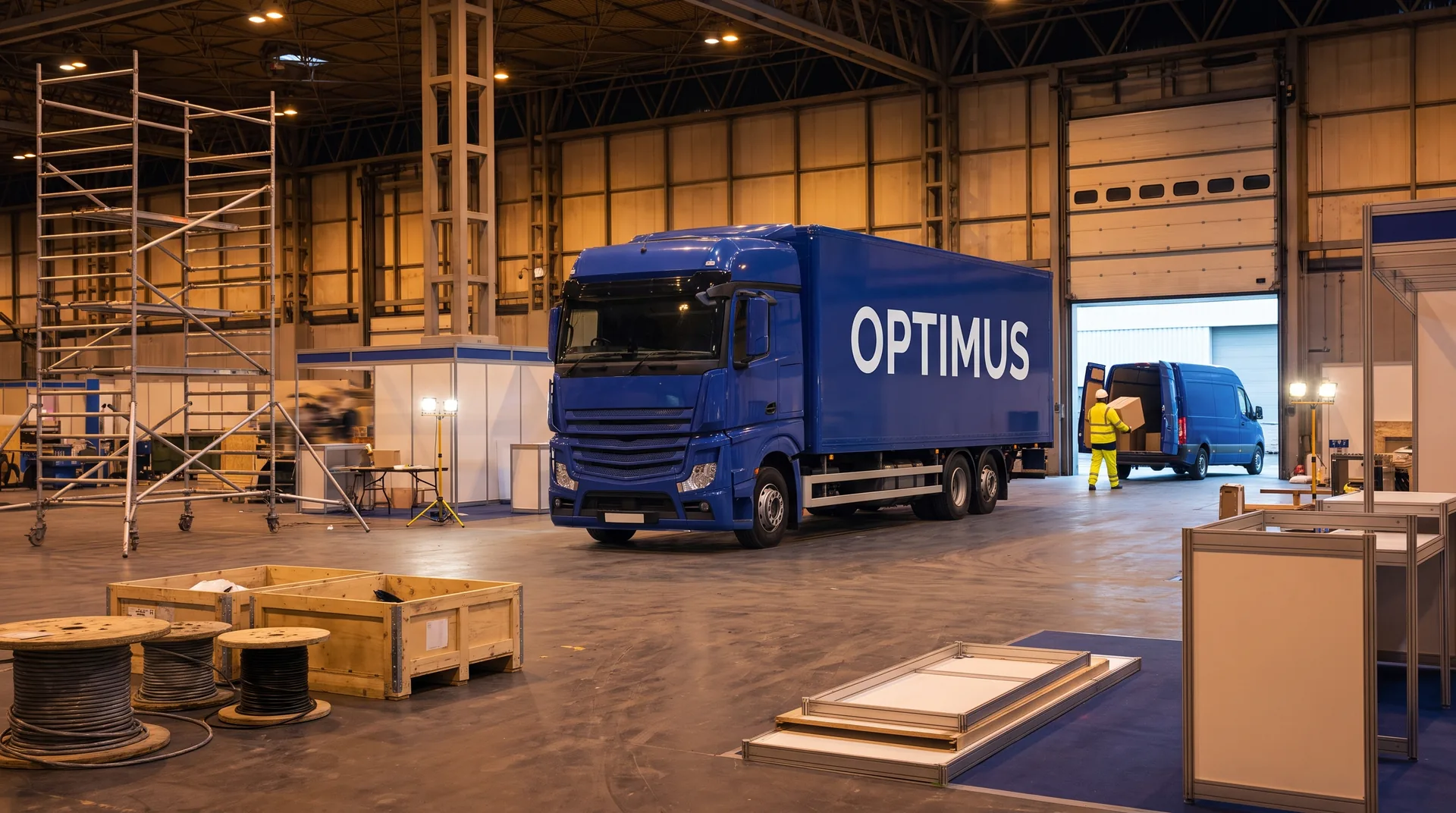
The Kent Event Centre stands on the Kent Showground at Detling near Maidstone, postcode ME14 3JF, just off the A249 dual carriageway. It is run by the Kent County Agricultural Society. The venue publishes 7,000 sqm of covered space across several halls, over 200 acres of outdoor ground and a concrete road network throughout the site. For a load coming from Poland it is one of the few venues that sits directly on the route from the crossing.
Two miles from the motorway, but only from one direction
The venue publishes its directions very precisely, and they are worth reading literally, because they differ by approach. From the M20 you leave at junction 7 towards Sittingbourne and Sheerness, join the A249 and follow it for about two miles; the venue is signposted on the left after the brow of the hill. From the M2 you leave at junction 5 towards Maidstone and follow the A249 for about five miles, but the venue warns that from this direction you cannot cross the carriageway: you have to continue to the Detling Hill roundabout and come back in as described from the M20 side.
That is not a detail. With an articulated vehicle, turning on a dual carriageway is not a matter of driver judgement but of available geometry. A driver who does not know this will pull up at a fence and see the site on the other side of the road.
The road you must not take
The venue publishes a warning worth copying into the transport order: access via Scragged Oak Road no longer works, and that route leads to a locked gate. Car satnav will still offer it, because geometrically it is shorter.
The outcome is always the same: the vehicle turns into a local road, reaches the closure and has to reverse out or find somewhere to turn on a narrow stretch. With a trailer that costs an hour and the patience of site staff waiting at a different entrance. So on a first run to this venue we put not only the postcode into the order but also the instruction not to use that road. We describe the same satnav failure mode at Telford International Centre, where the venue publishes two postcodes for two different gates.
Three halls, three different doors
The venue describes its main spaces in enough detail to show how they differ for unloading.
- The Brachers Building is the largest hall, over 3,000 sqm at 73 by 42 metres and 6 metres high, with 5 metre cargo doors allowing direct loading and flat outdoor space around it.
- The John Hendry Pavilion offers 1,752 sqm at 73 by 24 metres and 4 metres high, and its three cargo doors are 2.95 metres. That is over two metres less than the hall next door, so the same exhibit fits one hall and not the other.
- The Clive Emson Hall has 1,700 sqm at 48 by 36 metres, a 6 metre height and multiple 5 metre cargo doors, but the venue adds one fact that changes how you work: the floor is fully carpeted and the walls are lined with marquee style draping. A forklift carrying a heavy load does not run on carpet the way it runs on concrete, and point loading from the wheels leaves a mark.
The practical conclusion: at this venue the hall name goes into the order, not just the address. The height of the tallest item is compared against the doors of that specific hall before the vehicle type is fixed. We gather the rules in the article on venue access limits, and the choice of equipment for a heavy exhibit in the piece on a heavy exhibit on a stand.
Concrete instead of grass
Against other agricultural grounds Detling is unusual. The venue states hard standing around all its exhibition halls and concrete road infrastructure throughout the showground, which it says lets visitors reach all areas. Across over 200 acres and six entrances that is a real difference from venues where a vehicle bogs down a dozen metres short of the stand after rain, as it can at the Bath & West Showground near Shepton Mallet.
It does not mean the ground stops being a topic. It only shifts the question from "can I get there" to "where exactly does the plot sit relative to a concrete road". The venue publishes no names or numbers for its individual gates, so the nominated entrance comes from the organiser materials rather than from the site description.
Restrictions and zones
No charging clean air zone applies in Kent. The British list of charging zones covers Bath, Birmingham, Bradford, Bristol, Portsmouth, Sheffield and Tyneside, with the London LEZ and ULEZ operating separately. The approach from Dover and Folkestone by the M20, M2 and A249 does not enter Greater London, so the London emission requirements do not arise on this route. The venue publishes no weight or height limits on the approach.
What to settle before arrival
- The hall name or the outdoor pitch number.
- The door height and width of that hall against the tallest item in the load.
- The nominated entrance among the six site gates.
- Whether the stand is in the Clive Emson Hall, because carpet changes how a heavy load is brought in.
- How the vehicle is booked in and where passes are collected.
- Where the vehicle waits after unloading.
What we do at our end
We collect stands and exhibits in Poland, and from exhibitors in Czechia, Slovakia, Austria and Hungary we gather the load through our hub. At the Kielce base, about 4 km from the fairground and open around the clock, we assemble a stand into one consignment before departure. A groupage vehicle waits for the next scheduled line departure. Clearances run in cooperation with the customs agencies we work with regularly on both sides. Because the venue sits close to the crossing, a dedicated load can reach it without a cross-dock; on groupage the load still normally passes through our warehouse in Milton Keynes, because that is where consignments are split by address. We commit to an hour at the gate rather than an hour of unloading.
Groupage or a dedicated vehicle
The threshold runs at roughly a third of a trailer, about twelve pallets. At Detling geography adds an argument: the venue sits on the route from the crossing, so a dedicated vehicle reaches it faster than anywhere else in England, with no detour and no wait for a transhipment. For a stand of panels and printed material groupage still works out cheaper. We break the decision down in the article on choosing between FTL and groupage.
Sources
- Kent Event Centre: directions from the M20 and M2 and the Scragged Oak Road warning
- Kent Event Centre: the halls and rooms of the venue
- Kent Event Centre: outdoor space, roads and entrances
- GOV.UK: list of British charging clean air zones
Exhibiting at Detling? Send the hall name, the height of the tallest item and the build-up window through the quotation form and we will match the vehicle to the door and plan the route away from Scragged Oak Road. See also the exhibition logistics page.