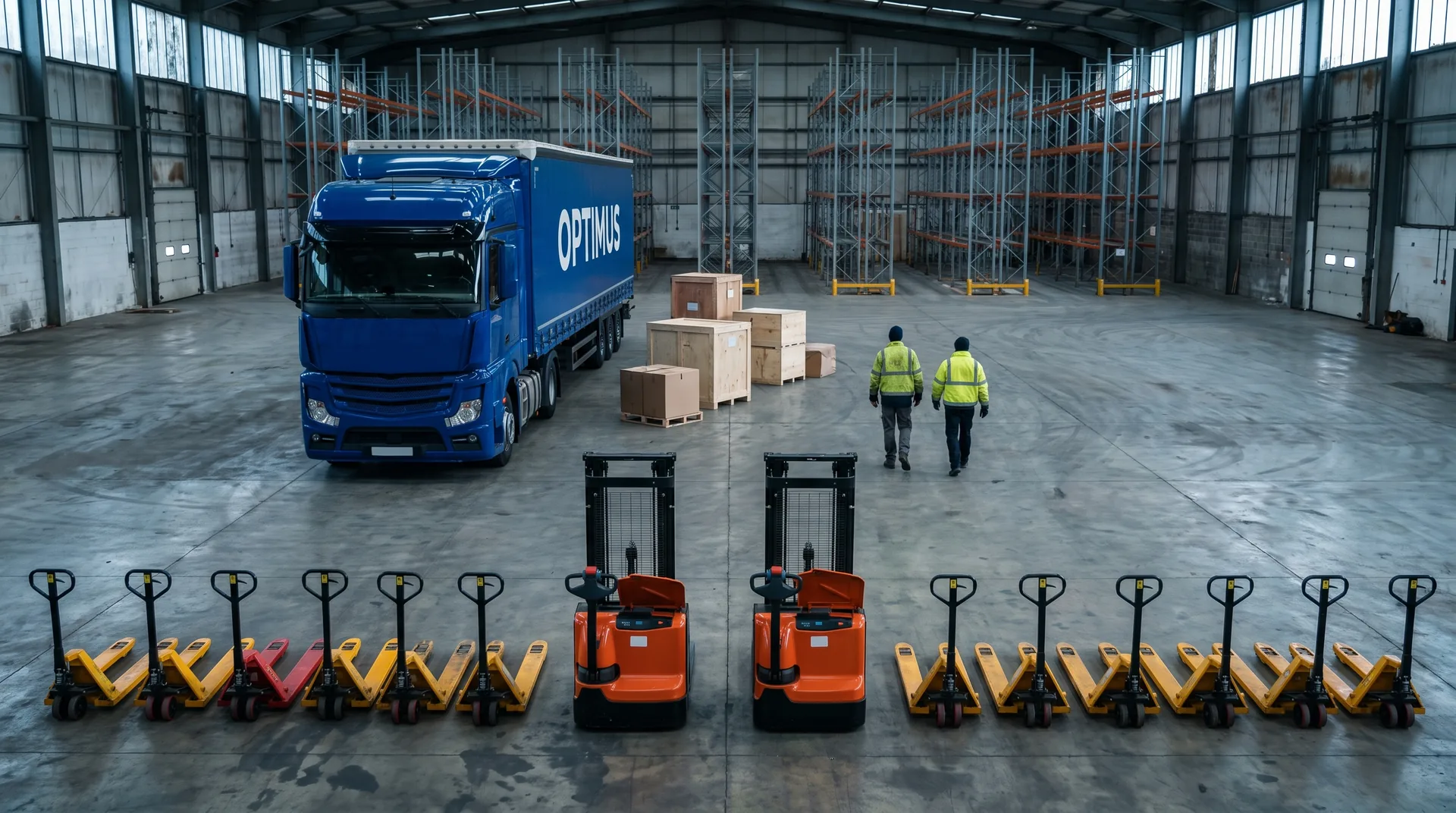
Pallet trucks and stackers leave British warehouse and factory clearance auctions in bulk. In size terms this is pure groupage: a dozen or more units fit onto one trailer alongside other goods from the same sale. Only two things upset the plan, the stacker mast and the battery. The height with the mast fully lowered, and the cell type, are settled before loading rather than on the ramp on collection day.
Why there is so much of this equipment
A warehouse changes tenant, a plant winds down a line, a chain closes a distribution point or a company ceases trading, and the entire contents of the building go under the hammer on one day. Handling trucks are a crowded category in such sales, because every building holds several or a dozen of them. The insolvency disposal market is described more broadly in the article on John Pye auctions and equipment from insolvency disposals.
That sales structure has a convenient side effect for haulage. The kit stands inside a building rather than on a muddy yard, so collection is quick, dry and under cover. It also happens that racking, packing benches, tool cabinets and scales come with the trucks, and those items fill the remaining space on the trailer and bring down the cost falling on each individual item.
The stacker mast, the only real dimensional problem
Hand pallet trucks and powered pallet trucks fit in any outfit, being low and flat. A stacker is different, because it carries a vertical mast, and even at rest that mast stands above the operator position. Telescopic and multi-section masts differ in their collapsed height, while catalogues mostly quote lift height, which is a working figure. For haulage only the lowered dimension counts, and it is measured on site.
- The mast fully lowered rather than halted mid-stroke, because a mast left mid-stroke will settle by itself within a few dozen miles anyway.
- A mechanical mast lock or a strop around the frame, where the manufacturer provides for one, so the sections do not work on rough surfaces.
- Forks lowered onto the trailer floor, drawn in and not projecting beyond the outline of the truck.
- Lift chains with no slack, so they do not knock against the channels while travelling.
- The operator platform folded and the tiller arm raised and lashed, because lying flat it tends to catch on the neighbouring consignment.
If the lowered mast still eats into the available height, the stacker is placed where the trailer offers most room, or a different outfit is chosen. That decision belongs to the quotation stage, so it pays to state the collapsed height straight away, as described in the article on what to provide for a quote before a UK auction.
Batteries: traction cells and lithium-ion packs
Electrically powered kit has to be discussed before loading, because the cell type governs both the method of carriage and the paperwork involved. This is not a polite enquiry but a condition of accepting the consignment.
- Cell type: a classic lead-acid traction battery, a gel cell or a lithium-ion pack.
- Whether the battery sits in the truck or has been removed and stands beside it as a separate item.
- State of charge, and whether the pack shows damage, swelling or leakage.
- How the terminals are protected and how the battery itself is retained in its compartment.
- Whether a rectifier or charger travels with the set, since that is always a separate cargo and customs item.
Lithium-ion packs fall under separate dangerous goods rules and need to be agreed in advance. If you cannot answer the questions above from the auction listing, ask for a photograph of the battery compartment at viewing. That single photograph can save a day standing on the yard, which the article on collection deadlines and storage charges puts a price on.
Polyurethane wheels and the trailer floor
A warehouse truck runs on small polyurethane wheels, and that changes the securing job more than it seems. Such kit does not deflect the way a machine on tyres does, but it will happily roll along a smooth trailer floor at the slightest tilt, because rolling resistance is negligible. Chocks under the rollers are therefore compulsory, and lashings go crosswise to the chassis frame or to designated transport eyes.
Small hand trucks are more convenient palletised: several to a pallet, forks facing inwards, the whole lot wrapped and strapped. They then travel like an ordinary pallet and slot into any gap between larger items. The general principles of lashing selection are covered in the article on cargo securing under EN 12195, and what the moment of collection from a building actually looks like is explained in the article on loading a machine at the auction yard.
Loading, transhipment and what we do not do
At the auction the kit is usually presented by the yard's own forklift, or it drives up the building ramp under its own power if it is serviceable and charged. At the base in Kielce we have a ramp, forklifts and round-the-clock working, so transhipment does not depend on whether the consignee has anything to unload with. Groupage kit waits for the next scheduled line departure and passes through two transhipments on the way, at the warehouse in Milton Keynes and in Kielce. Above roughly twelve pallets a dedicated vehicle usually works out better.
It is also worth being clear about what we do not provide. We do not carry out statutory lifting inspections or acceptance testing, we do not pronounce on a truck's mechanical condition and we do not declare it fit for work. Putting the equipment into service in Poland is the buyer's business, as is assembling the technical documentation described in the article on importing used machinery from the United Kingdom. We carry the goods and present them for clearance in cooperation with our regular customs agencies.
Sources
- HSE: health and safety in transport and warehousing
- GOV.UK: moving dangerous goods
- UNECE: the ADR agreement and dangerous goods rules
Tell us how many units you bought, the height of the lowered mast and what sits in the battery compartment, and we will work out the rest through the transport quotation form. Entries and paperwork are covered on the customs clearance page, and collection slots from the building are agreed with the operations team.