A reversible plough and a cultivator are mounted implements, so they almost never justify a dedicated run out of the United Kingdom. The sensible move is to add them to the haulage of a tractor bought at the same sale: they take a strip of trailer floor beside the machine, travel on the same outfit and are priced as a part load. Before you bid, you need the transport dimension and a plan for lifting kit that has no wheels of its own.
Reversible ploughs: furrows translate into length
An auction catalogue describes a plough by the number of furrows rather than by its dimensions, and converting one into the other is your job. A reversible plough carries two sets of bodies on a shared frame and rotates about its longitudinal axis, so in the transport position the frame sits at an angle and the bodies stick out sideways. The longer the frame, the more floor the plough eats along the side rave, and the greater the chance it will overhang the trailer. Auction photographs show the furrow count and the condition of the shares, but the spacing and reach come from the manufacturer's data sheet.
- Check whether the depth wheel can be removed or swung inboard for travel.
- Establish whether the frame is split — high furrow counts are often carried in two sections.
- Ask the yard whether the plough stands on transport legs or lies with the bodies buried in soil.
- Request a photograph of the nameplate: without the model you cannot size the load before collection.
Cultivators and the lock on folded wings
Wide cultivators fold hydraulically for travel, but hydraulics on their own are not a restraint. The manufacturer provides a mechanical lock for folded wings: pins, catches or safety collars. If the machine has stood in the yard for weeks, the rams will have crept down and the wings must be lifted before the lock can be engaged. Without it a wing will drop open in motion, and on a folded cultivator that means a sudden gain in the width of the outfit while travelling. At collection we always ask to be shown the locking points before anything goes on the trailer.
- Discs, tines and crumbler rollers must be tied so that they cannot rotate in transit.
- A missing locking pin is a dealer order — you will not find one in an auction yard.
- On a cultivator with a rear roller, confirm the roller is bolted on rather than merely resting.
Cutting edges, or guards for the neighbour on the trailer
Shares, mouldboards, discs and tines are hard and sharp, and a part load by definition travels beside other goods. A hand's width of slack in a strap is enough for a share edge to cut through wrapping, a crate or the tyre of the machine next door. So before securing we fit timber, board or heavy rubber over every cutting edge, and we face the implement outwards towards the rave rather than into the middle of the floor. It works the other way round too: a strap tensioned straight over a share will chafe through within an hour of driving, which is why corner protectors go underneath. The rules on lashing choice and count are set out in our piece on cargo securing under EN 12195.
Lifting kit that has no wheels
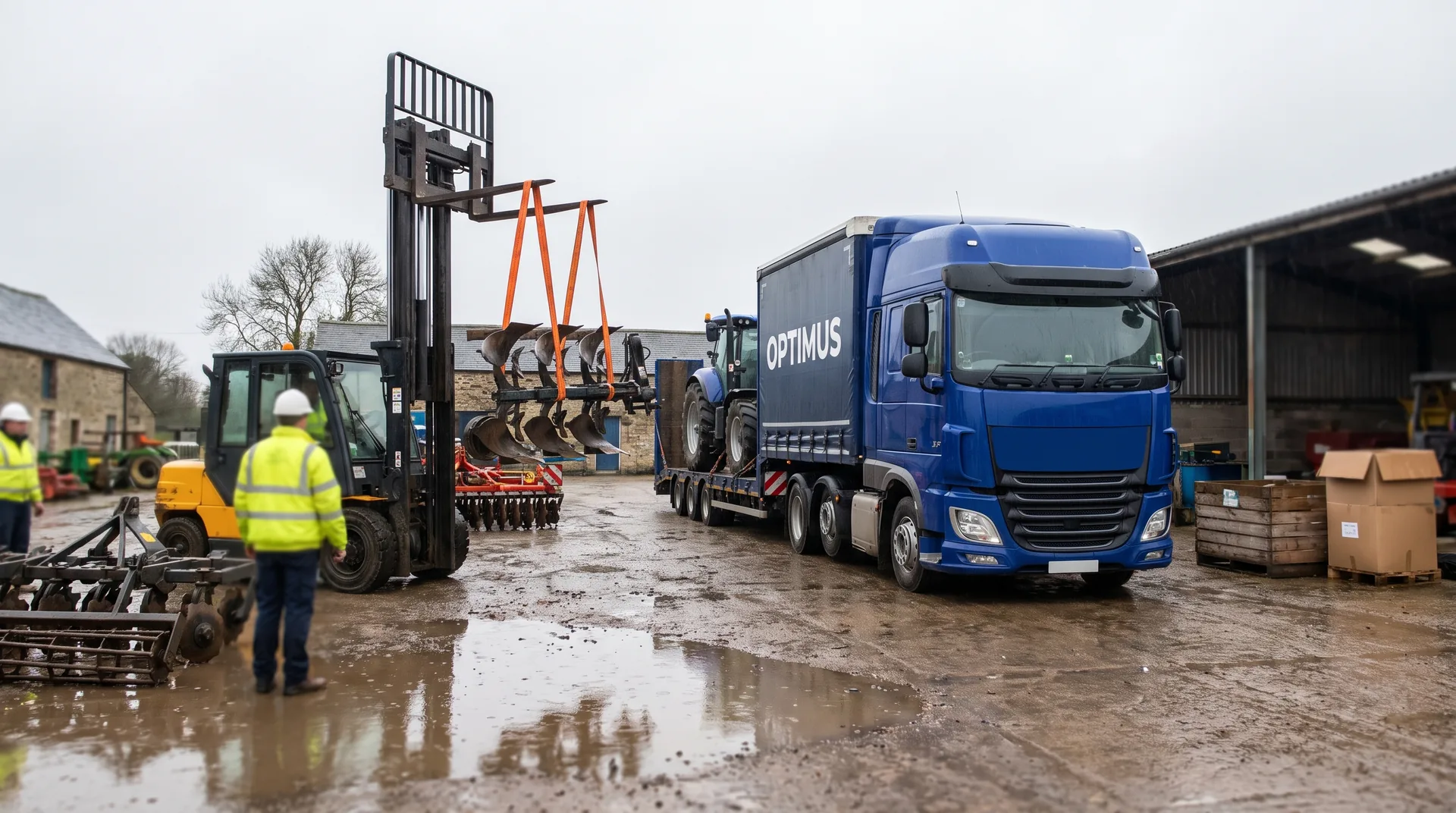
A plough or cultivator will not walk onto a trailer, so the yard needs a telehandler, a forklift of suitable capacity or a lorry-mounted crane. Some makers mark sling points on the frame; where they are absent you lift by the main frame, never by working parts and never by hydraulic hoses. Finding out in advance what the site actually keeps on the yard saves the most trouble, and we gathered the detail in our guide to loading a machine at the auction yard. Where a tractor travels in the same movement the order is obvious: the machine drives on under its own power first, then the implement fills the space fore or aft of it.
- Confirm who operates the lifting kit and what hours it is available.
- Ask for the implement weight from the data sheet — the telehandler is chosen from it.
- Plan the trailer layout before the tractor drives on, because shunting it later costs time.
Soil in the bodies and inside box-section frames
Tillage kit works in the ground, so on entry to the European Union it faces border plant health control. On a plough, soil packs onto the mouldboards and into the angles between body and frame; on a cultivator it sits between the discs and inside box-section frames, and those are the worst, because wash water goes in and never comes out. Cleaning an implement takes longer than cleaning a tractor, even though the machine is simpler, and it is best organised while the kit is still in the United Kingdom. The requirements, notifications and order of steps are covered in the separate article on farm machinery auctions in the United Kingdom, so there is no point repeating them here.
Implements as their own customs line
A package purchase — tractor plus plough plus cultivator from one dispersal sale — tends to confuse the paperwork stage. Each machine carries its own value from the invoice or the sale confirmation and its own line in the declaration, even though it physically travels on the same floor as the tractor. Clearances are handled in cooperation with established customs agencies on both sides, but the buyer assembles the file; what belongs in it is explained in our note on documents for a machine bought at auction. We do not value machinery and we do not repair it — we move it and make sure it arrives in the condition in which it was collected.
Sources
- PIORiN: phytosanitary conditions for importing used agricultural and forestry machinery into the European Union
- GOV.UK: securing loads on HGVs and goods vehicles
- EUR-Lex: implementing regulation (EU) 2019/2072 on protective measures against pests
Spotted a plough or cultivator on the same list as a tractor? Send the model and the lot number through our haulage quote form and we will price the whole package on one outfit. Questions about collection order go to the OPTIMUS TRANSPORT team, and the scope of agency work is described on our Poland and United Kingdom customs clearance page.