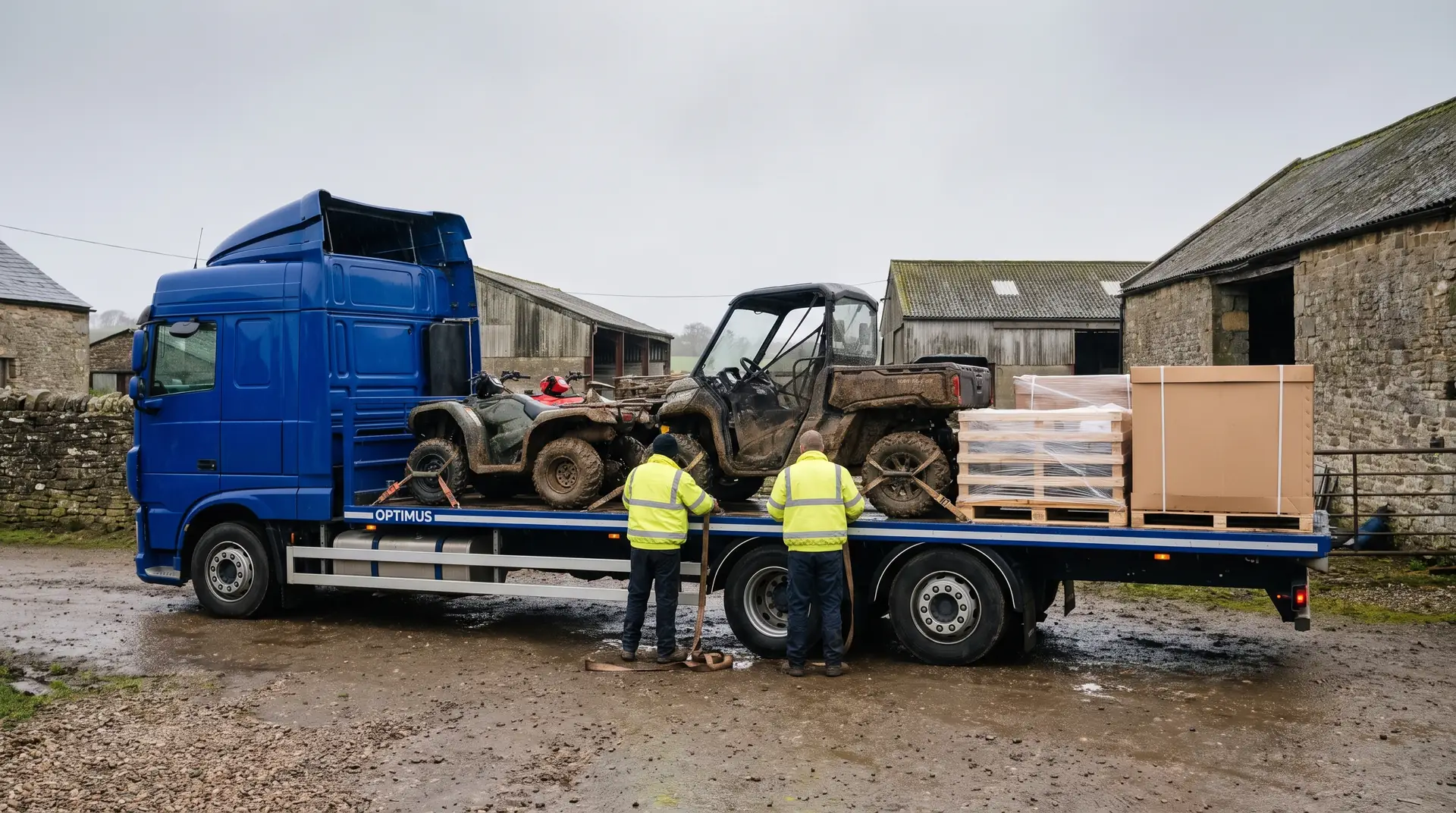
A quad bike and a side-by-side utility vehicle are basic kit on a British farm, so agricultural auctions offer plenty of them. In size terms this is groupage cargo: several units stand on one vehicle alongside other goods from the same yard. The difficulty lies elsewhere. Registration status in Poland depends on the vehicle type and has to be settled before bidding, because it decides whether the machine will ever be allowed on the road.
What actually comes off British farm auctions
Two families of machine are mixed in the catalogue. The first is the classic quad bike with motorcycle handlebars, a straddle seat and a roll hoop, used around a holding for checking stock, carrying feed and pulling a light trailer. The second is the two-seat and four-seat vehicle with automotive steering, a cargo bed at the rear and a passenger seat beside the driver, commonly called a side-by-side. Working versions carry a protective frame and increasingly a full cab with screen, roof and heater.
The history of such kit is visible at a glance. Examples from livestock farms have a worn bench, bent guards and mud in every crevice. Units from parks, leisure sites and grounds maintenance firms are often less tired but more often stripped of attachments, because those sell separately. An auction listing describes that condition very briefly, so viewing before collection genuinely pays, as the article on inspecting a machine before collection explains.
Settle the vehicle status before bidding, not after
This is the commonest source of disappointment. A quad or utility vehicle may in Britain be agricultural kit moving on roads under local rules, or a purely off-road machine that never held any road approval at all. What you actually bought, and what paperwork exists for it, determines the route it takes later in Poland. You check this before raising your hand, not after paying the auction invoice.
- Whether the lot carries any vehicle document at all, or only the listing and the invoice.
- Whether the identification number on the frame matches the lot description and is still legible.
- Whether the nameplate is in place or was torn off with a damaged guard.
- Whether the vehicle was ever registered for road use or only ever ran on the holding.
Let us be plain about it: we do not carry out vehicle registration in Poland and we do not advise on it. We do the haulage and the customs entries in cooperation with our regular customs agencies, and the buyer assembles the paperwork needed afterwards. What should leave the yard with the vehicle is described in the article on documents for a machine bought at auction.
Lash to the frame, not to the roll bars
A quad looks unassuming, yet it is a load on soft suspension and low-pressure tyres, exactly the sort that works itself loose. Lashings go to designated frame points or to load-bearing members named by the manufacturer. Not to the protective roll structure, which is there to absorb energy in a rollover rather than to carry lashing forces. Not to wishbones or steering components, where a lashing loads parts that are meant to move.
A separate argument surrounds lashing over the tyres. Throwing a strap across a wheel and pulling it to the floor is quick and effective, because it acts at the lowest point and limits suspension travel. It does, however, need a strap of suitable character, correct placement across the tread and nothing chafing on the knobbles. Frame lashing behaves more predictably when several units stand side by side. The selection criteria are set out in the article on cargo securing under EN 12195.
One thing is common to both methods: knobbly tyres deflect under tension, the deflection settles over the first few miles and the lashings slacken. The driver corrects the tension at the first stop, and that is not a formality but the real condition for the vehicle arriving as it was left.
Fuel, battery and charger
The fuel tank travels drained, as with any combustion-engined lot from auction. The battery is disconnected and its terminals protected, because the vehicle stands tightly among other consignments and an accidental short inside a closed trailer has no good ending. Keys, where any exist, travel separately in an envelope marked with the lot number.
Battery-electric versions raise one further question: where is the charger. Very often it stays in the farm store and does not appear in the lot, and without it the vehicle simply stands after delivery. If the charger exists, declare it as a separate item so that it travels on the same vehicle and appears on the same entry.
Mud on the tyres is not a cosmetic issue
Machines that run over pasture, stubble and a muddy track bring soil in the tread, in the mudguards, under the cargo bed and in every recess of the chassis. Grass wound around a half-shaft and turf pressed into the guards are the places most often forgotten. Equipment used agriculturally is subject to border phytosanitary control on entry to the European Union, and the whole procedure is set out in the article on British farm machinery auctions. Here a practical rule suffices: a quad is washed raised or with the mudguards removed, and the wash is planned on the British side before loading, not in a queue at the border.
Attachments are separate cargo and customs items
A winch, a snow plough, a mounted sprayer, a flail mower, a trailer and a set of spare wheels are not accessories to the quad but distinct items on the consignment note and distinct lines on the entry. Treating them as fittings can rebound at clearance, because classification follows what is actually travelling. How to arrive at the right classification is explained in the article on the CN and HS tariff code.
From a haulage point of view attachments are welcome, because they palletise well and slide in between vehicles. Several quads with their attachments are still groupage cargo, waiting for the next scheduled line departure and passing through two transhipments on the way, in Milton Keynes and in Kielce. Only above roughly twelve pallets does the conversation turn to a dedicated vehicle.
Sources
- GOV.UK: load securing guidance for vehicle operators
- PIORiN: phytosanitary conditions for agricultural used machinery
- GOV.UK: exporting goods from the United Kingdom
Send us the lot numbers, the yard address and whether attachments travel with the set, and we will price the movement through the transport quotation form. Customs entries are covered on the customs clearance page, and unusual combinations are settled fastest with the operations team.