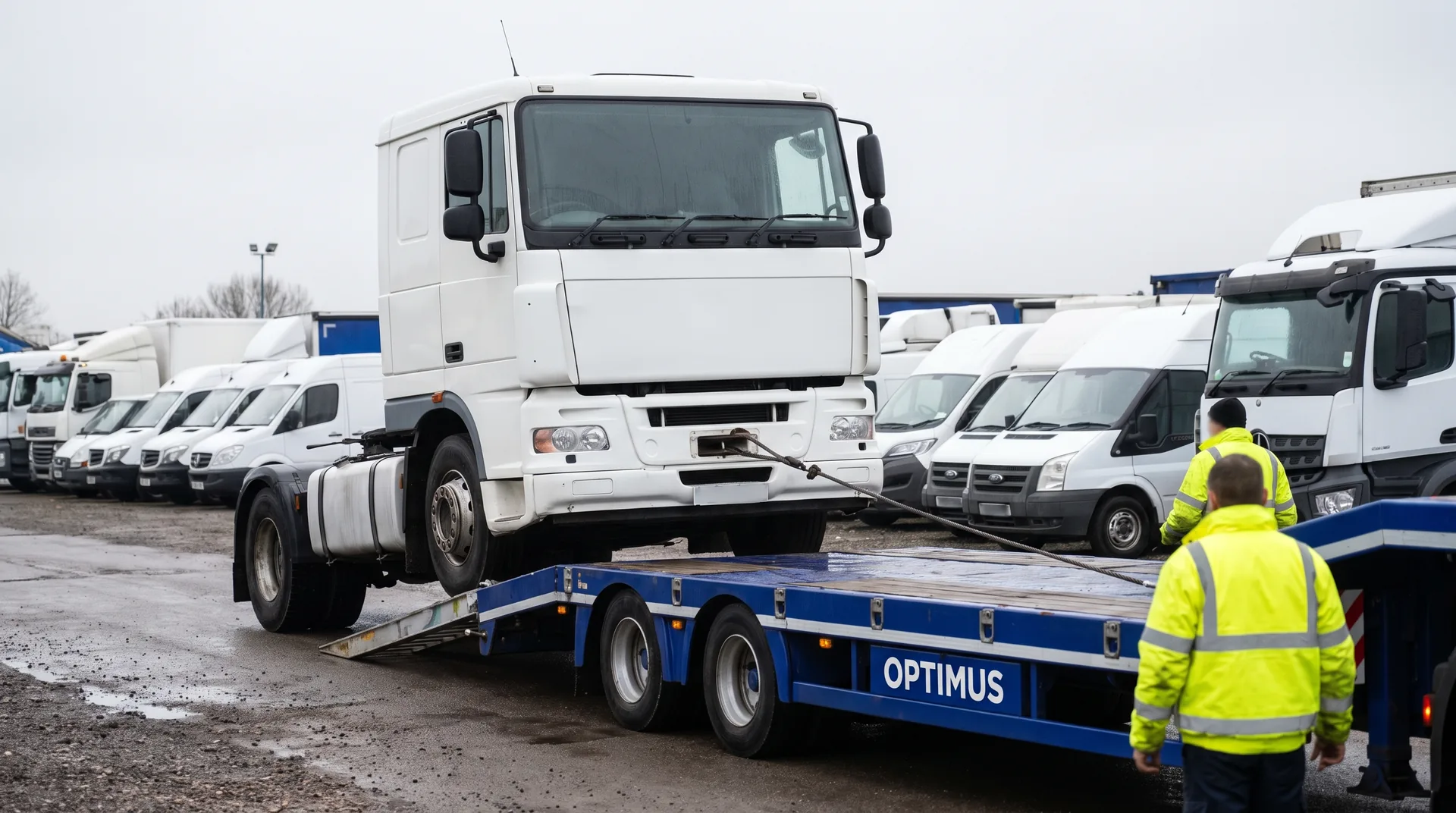
A sound tractor unit with a valid test can return from the United Kingdom on its own wheels, but the buyer organises that, not us. Without a valid test, or with a fault that rules out driving, the vehicle travels as cargo on a transporter. That second role is the one we cover. Before bidding, work out what right-hand drive costs you on resale in Poland.
Vehicle or cargo
With a tractor unit that is not a rhetorical question, because the whole costing follows from the answer. If the vehicle starts, brakes properly, has complete paperwork and a valid test, it can in principle move itself, and carrying it only adds weight to the bill. If the test has lapsed, the paperwork is short, or the vehicle is standing after an engine or gearbox failure, driving is out and the transporter is in.
Tractor lots reach auction mostly from hauliers replacing fleets and from insolvency disposals, as described in Wilsons Auctions machinery and vehicles from the UK and Ireland. It is worth establishing how long the unit has stood in the yard, because a long stand brings back the same set of problems: air in the fuel system, dead batteries and seized brake discs.
Right-hand drive and a price that looks like a bargain
British tractor units are often surprisingly cheap, and that is rarely an accident. Right-hand drive narrows the pool of Polish buyers to operators running traffic to the islands, so resale takes longer and ends at a lower figure than a left-hand drive unit of the same mileage. Add the differences in specification and in vehicle software that are ordinary on the British market but generate questions in a Polish workshop.
So the pre-sale calculation records not only the hammer price and the cost of bringing the vehicle over, but the realistic time and price of selling it at home. We do not value vehicles and we do not resell them; we quote the movement and nothing more. Establishing a value for declaration purposes is a separate matter, covered in the customs value of a used machine bought at auction.
Roof fairing and cab height
The first dimensional problem when a tractor unit goes onto a transporter is neither weight nor length, but height. A road tractor is tall in itself, and a cab with a roof fairing and side deflectors adds a great deal more. Add the deck height of the transporter and it quickly turns out that a vehicle which fits comfortably on its own wheels no longer fits as cargo.
Hence the practice of taking the fairing off. Many designs allow it to be unbolted or folded without disturbing the cab skin, after which the fairing travels separately, strapped flat beside the vehicle. That is extra work in the yard and it has to be planned rather than discovered at loading. Where removing the fairing is not an option, what remains is a lower deck or a permit, and that route is set out in oversized transport on the UK route, permits and escort.
Fifth wheel, plate and tanks
The fifth wheel and its coupling plate stay on the frame but need tidying. The release handle is locked, the jaw is set closed, and the plate is cleaned of grease enough that it does not foul the deck and the lashings. A plate tilted rearwards can also raise the rear outline of the vehicle, so we check its position before measuring height.
- fuel tanks: contents kept to a minimum, caps and mounting straps checked for security;
- AdBlue tank: level and closure checked, because a leak from it leaves a lasting deposit on the trailer floor;
- batteries in the box under the cab: terminal disconnected and the box confirmed to latch shut;
- trailer service lines: coiled and tied so nothing hangs outside the outline.
Lashing a unit standing on its own tyres
The tractor rides on its own rubber, and that rubber is the biggest variable here. A tyre deflects under lashing tension, so a strap tightened in the yard is looser after fifty miles than it was. Add leaf and air suspension, which drops the frame as pressure bleeds off and changes the geometry again. Tension therefore has to be corrected after the first few miles, and that is not a question of diligence but of how the vehicle behaves.
We lash through the frame points the manufacturer provides, supplemented by lashings over the drive axle wheels. Chocks go under both axles, not just one. The force calculation and the choice of straps are set out in cargo securing to EN 12195, and what can usefully be checked in the yard before loading is collected in inspecting a machine before collection from the auction yard.
Carrying against driving: what to compare
Setting the two routes side by side works out differently from what intuition suggests. On the driving side you have fuel for the whole distance, the channel crossing, insurance for the journey, a driver's wages and overnight stay, and above all risk: a breakdown on the road in a vehicle just bought from a yard can cost more than the entire movement. On the transporter side you have one rate and a predictable date, but also the cost of equipment carrying a single item.
The third factor people forget is time in the yard. Storage charges accrue from the collection deadline whichever route you choose, and they can overturn the arithmetic; they are collected in auction yard collection deadlines and storage charges. To repeat plainly: we do not offer a driven delivery, so if you choose that route you arrange it outside us.
Paperwork and number plates
A unit released from the yard comes with its sale document, the British registration document and keys, and the number plates are often taken off at release. For movement as cargo the sale paperwork and vehicle identification, including a legible chassis number on the frame, are what matter. We do not register vehicles or arrange testing in Poland. Declarations are prepared in cooperation with established customs agencies on both sides, and transhipments en route take place at the Milton Keynes warehouse and the Kielce base.
Sources
- GOV.UK: carrying out international road haulage
- GOV.UK: roadside checks for commercial vehicles
- GDDKiA: abnormal load movements and permits in Poland
Send the unit type, the test status and a photograph of the cab with its fairing, and we will tell you whether it goes onto a transporter without dismantling. Begin with a quote for moving a vehicle from the United Kingdom or go straight to the operations team, and we will arrange the border side through customs clearance.