The temptation makes sense: the trailer is travelling empty anyway, so why not drop oddments from the same sale into the body. The catch is that it changes what the consignment is. An empty trailer is one load with one value and one line in the declaration. Loaded, it becomes several loads, because the body and its contents are treated separately, each with its own description and its own value.
Four types of trailer, four different headaches
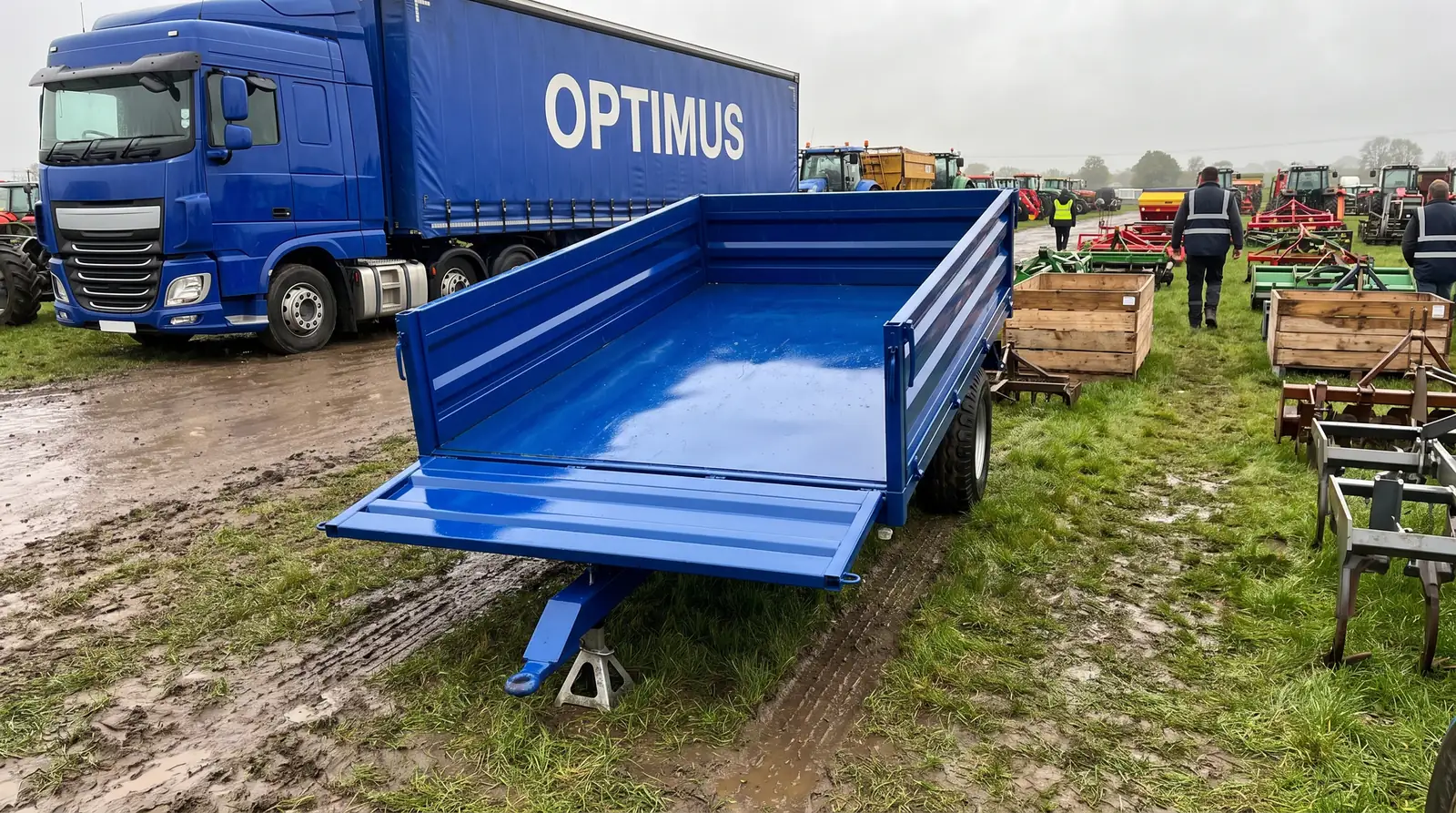
British farm dispersal sales throw up four types most often, and each behaves differently on a trailer. A tipper has a rigid body, a ram and a tailgate, so its issues are height and securing the door. A grain trailer is light and tall, which makes it easy to overload from above and hard to keep low. A flatbed is low and obliging to carry, but it invites you to stand something on it. A bale trailer is often the longest thing in the sale and it usually decides which vehicle goes out.
- Tipper: check whether the tailgate catches actually work or whether hinges and gravity hold it.
- Grain trailer: ask about the skin, because thin sheet dislikes lashings without padding.
- Flatbed: count the lashing points on the chassis before assuming it will be easy to strap.
- Bale trailer: take the length from the data sheet, not from the yard staff's estimate.
Sides, extensions and the height of the whole outfit
A trailer standing on a low loader starts at deck height, so its own sides add to the height of the tractor unit and semi-trailer beneath. Grain or silage extensions can push the outfit to a figure where the route needs checking for clearances and possibly a permit. Wherever possible we therefore take the extensions off and lay them flat inside the body, and folding sides are folded and held with their catches rather than with string. Where removal is not an option the situation has to be worked out in advance, and the rules and the permit route are described in our piece on oversized transport to the United Kingdom.
Drawbar, parking brake and chocks
A trailer riding on a trailer stands on its own wheels, and that is its weakness: the wheels turn and the suspension works. The drawbar support must be wound down and pinned, because a drawbar hanging in the air strikes the deck at every bump. We apply the parking brake but never treat it as restraint — after hours of driving, hydraulics and linkages let go. Wheels are chocked on both sides, and the trailer itself is lashed to the points the manufacturer marked on the chassis, never to side catches or mudguards. How many lashings and at what angle follows from the principles gathered in our article on cargo securing under EN 12195.
Towing round a yard is not the same as the crossing
In the auction yard a trailer can usually be pulled a short distance to the loading point by tractor or telehandler, and that is ordinary practice. But for the whole journey from the United Kingdom to Poland the trailer travels as cargo on a vehicle, not on a hitch, and we do not tow it behind the outfit. It goes aboard up ramps behind a tractor or a winch, or is lifted by the site's own kit — what is realistically available is set out in our guide to loading a machine at the auction yard. We do not register trailers in Poland and we do not arrange roadworthiness testing.
Soil, manure and silage in the body
On this kind of machine the body is where field material collects: a layer of soil left by beet or potatoes on the floor, dried silage in the corners and under the capping rails, manure on the tailgate and the mudguards. It is equipment that works in the ground, so on entry to the European Union it faces border plant health control. Washing a trailer is at least rewarding, because the body can be rinsed from a lifting platform and everything runs out through the open tailgate. The chassis above the axles and the gap between the side and the skin are the harder parts. The requirements and the order of notifications are covered in a separate article on farm machinery auctions in the United Kingdom.
What to check in the paperwork before bidding
Farm trailers in the United Kingdom are sometimes registered and very often are not, and the catalogue rarely settles the question. Before bidding, establish whether the lot comes with any identity document, whether the chassis carries a legible number and whether the plate survives at all. Without that, identification at clearance becomes laborious, as we explained in our note on serial numbers and nameplates. Customs value comes from the sale confirmation rather than from a new machine price list, which is explained in the article on the customs value of a used machine from auction.
Sources
- GDDKiA: abnormal load movements and permits in Poland
- GOV.UK: load securing guidance for vehicle operators
- PIORiN: phytosanitary conditions for importing used farm machinery into the European Union
Bringing a trailer over and wondering whether to fill it with oddments from the same sale? Describe the contents in our haulage quote form and we will tell you what it changes in the declaration. Collection dates are agreed through the OPTIMUS TRANSPORT team, and the clearance route is explained on our Poland and United Kingdom customs clearance page.