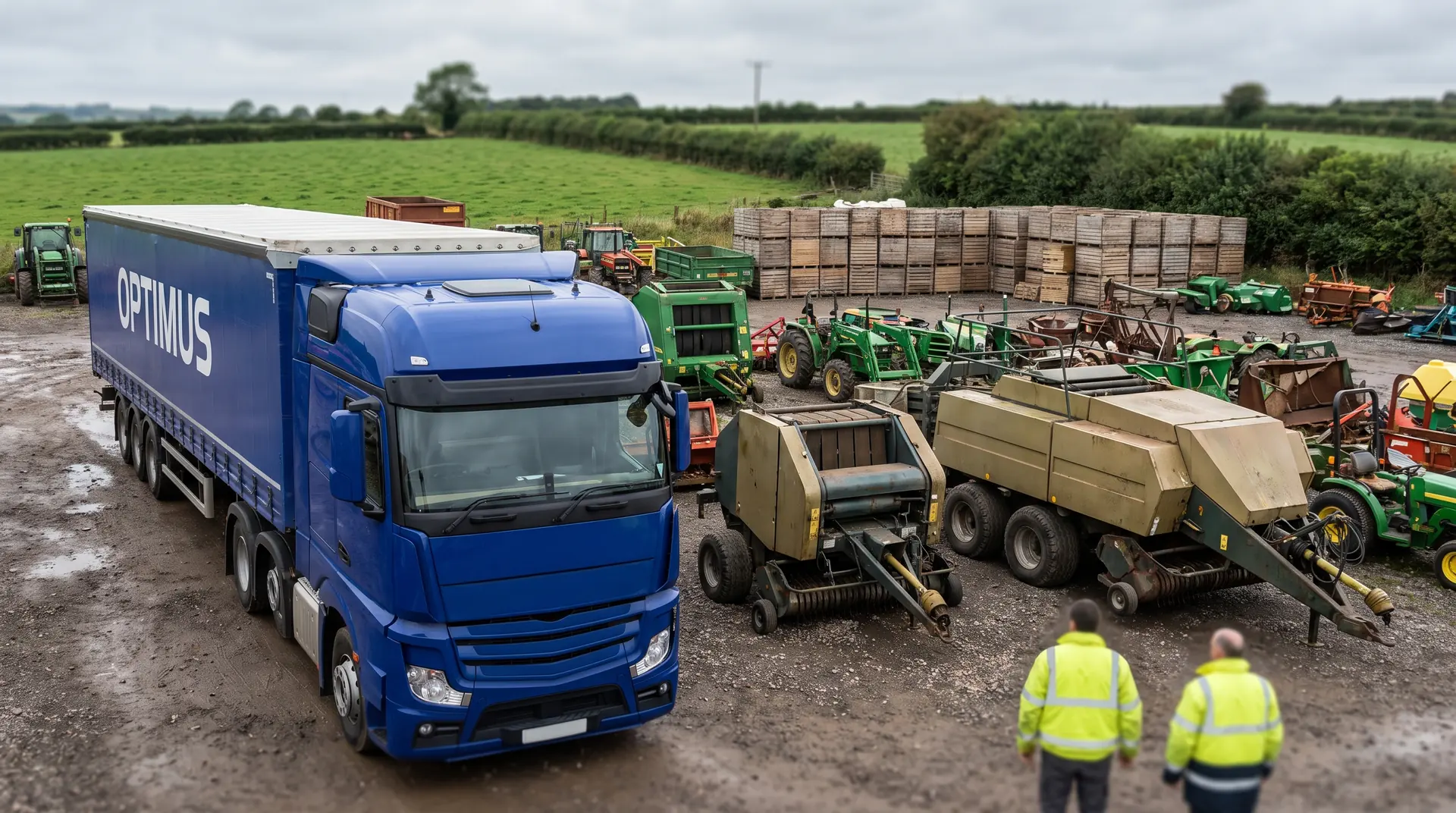
To a haulier a round baler and a square baler are two different shapes. The round machine is short and tall, rests on its drawbar and jack, and carries its weight over the axle. The square machine is long and low, and in the big square sizes it becomes an abnormal load. British sales are full of this category, because the islands run on grass and silage and there is simply a lot of hay equipment about.
Two designs, two ways of standing on a deck
A round baler has a compact outline and a tailgate that hinges high. On a deck it uses little length, but it can raise the overall height of the outfit more than the sale catalogue suggests, because the catalogue figure is usually taken with the tailgate closed and the tyres correctly inflated. A square baler lies long and flat, so height is rarely the problem, yet it uses up deck length far quicker.
Big square balers, the ones built for large rectangular bales, go past ordinary load dimensions, and at that point the conversation moves to permits and routeing. The basics of that regime are set out in our article on oversized transport, STGO permits and escorts. We always take the dimension in transport configuration, with everything folded that folds, never from the manufacturer's brochure.
Drawbar, jack and the points a strap may go on
A baler has no drive of its own, so it goes onto the deck pulled or pushed up ramps, and less often lifted by crane. The drawbar matters twice over: during winching it takes the whole pulling force, and once the machine is positioned it decides where the centre of gravity falls relative to the trailer axles. The jack has to be wound down and secured, because left loose it hammers the deck for the whole journey.
- the baler wheels are chocked, but a chock is not a lashing and will not hold the machine under braking;
- straps go on the manufacturer's points on the frame, never on guards, the ladder or hydraulic hoses;
- the drawbar is tied down separately so that it cannot work vertically over rough surfaces.
The forces and the number of lashings follow from mass and friction rather than from a glance at the load; the method is written up in our article on cargo securing to EN 12195.
Tailgate, wrapper and the net feeder
On a round baler the biggest risk in transit is the tailgate. Hydraulics open it, and hydraulics disconnected from a tractor can behave unpredictably, so the gate is closed and held mechanically, with an isolating valve or a ram lock depending on the design. Combination baler wrappers add a wrapping arm and a table which have to be folded and immobilised, because in the working position they stand outside the machine outline.
The net and twine feeder looks like a detail and can cost a stop on the hard shoulder. Rolls of netwrap left in their cradle unwind in the airflow and wrap themselves round the wheels. We take them out and pack them separately, and if they travel with the machine they go on the list of loose items, along with the operator manual and the keys. What else belongs on that list is covered in our guide to documents for a machine bought at auction.
Twine and straw in the chamber: the border angle, briefly
A baler does not dig, so it carries little soil, but after a season the chamber is packed with compressed straw, hay and cut twine ends. That plant material is exactly what officials look at when the machine enters the European Union, and it is why a baler cannot be cleaned superficially. The tailgate has to be opened, the residue pulled out of the chamber and from behind the rollers, and only then does washing begin.
Who organises that, and in what order, depends on the site: some auction houses have a wash bay, others have none at all and the machine has to be moved a short distance first. The border procedure itself for agricultural equipment is described separately — we set it out in our guide to farm machinery auctions in the UK, and it is worth reading before you bid rather than after.
Will the baler travel with a tractor from the same sale
The question comes up often, because it is easy to buy a tractor and a baler at one sale. The answer is that it depends. A mid-size round baler shares a deck with a tractor without difficulty, provided the combined length and the axle loadings work out. A big square baler does not — it fills an outfit on its own and needs a dedicated vehicle.
It is worth separating this from groupage straight away. A baler is not groupage: the threshold above which we send a dedicated vehicle instead of a groupage one is around twelve pallets, and every baler sits far beyond it. A groupage vehicle waits for the next scheduled line departure and passes two transhipments on the way, which suits nothing in this class. We do not service or inspect the equipment you buy — we collect it, secure it and carry it.
Sources
- EUR-Lex: Implementing Regulation (EU) 2019/2072 on protective measures against plant pests
- GOV.UK: load securing guidance for vehicle operators
- GOV.UK: rules for exporting goods from the United Kingdom
If you have a lot number for a baler in a British catalogue, send it with the model and a note on whether the machine has a wrapper, using our haulage quote form. We will check whether it makes sense to pair it with a tractor from the same sale. Import paperwork is prepared through our customs clearance service, and the details can be settled by contacting the operations team.