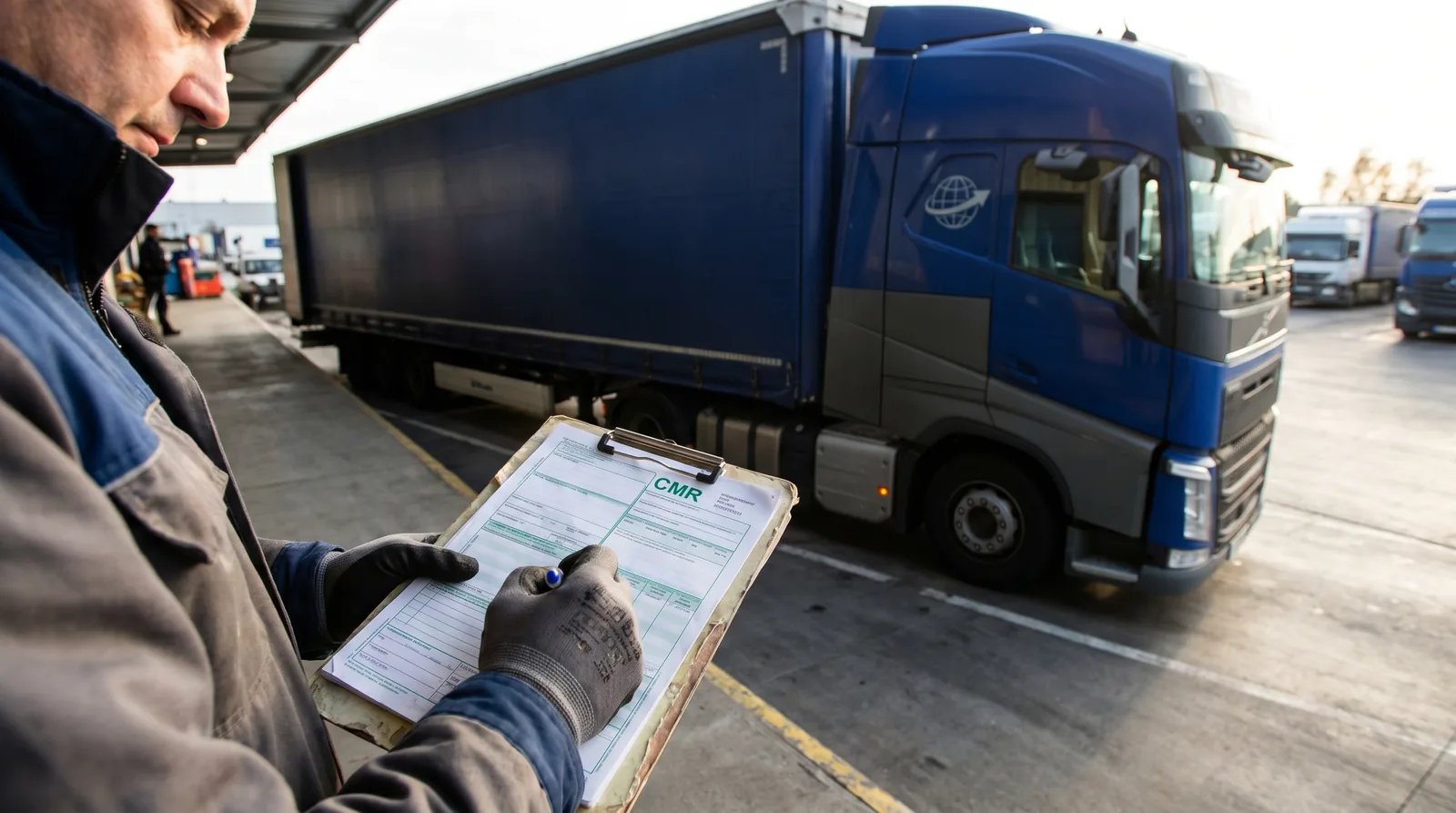
A CMR consignment note is evidence of the contract of carriage and the basis for later claims. It is issued in at least three copies, showing the sender, the consignee, the place and date of loading, the place of delivery, the description and weight of the goods, accompanying documents and the carrier's details. Boxes 18 and 24 matter most: reservations and proof of delivery.
Who fills it in, and how many copies you really need
Formally the sender is responsible for issuing the note; in practice the carrier often completes it from the sender's data and the sender signs. There are three copies: the first for the sender, the second travelling with the goods to the consignee, the third staying with the carrier. On UK traffic four and five copy sets are common, because extra copies go to the principal and the customs agent. It is worth making sure all copies are filled in identically, because discrepancies between copies are the first thing raised in a dispute.
The boxes people complete on autopilot, and the ones that decide
- Boxes 1, 2 and 3: sender, consignee and place of delivery. The consignee address must be the actual unloading address, not the registered office, which is a frequent source of confusion in the UK.
- Box 4: place and date of loading. The date matters for counting deadlines and for consistency with customs documents.
- Box 5: documents attached, that is invoice, packing list, certificates, customs declaration reference.
- Boxes 6 to 12: marks and numbers, number and type of packages, description of goods, gross weight and volume. Most shortage disputes are born here.
- Box 13: sender's instructions, including delivery terms and customs directions.
- Box 18: the carrier's reservations and observations on taking over the goods.
- Boxes 21, 22, 23: place and date of issue, signatures of sender and carrier.
- Box 24: the consignee's proof of delivery, with date, time, signature and stamp.
Box 18: one sentence worth more than the rest of the document
A carrier taking over goods should check what it is taking and enter reservations if something does not add up. Absence of reservations creates a presumption that the goods and packaging were in good condition and that the number and marks matched the note. That presumption works against the carrier who signed without comment and later argues the pallets were already leaning at loading. A reservation must be specific: not "goods damaged" but, for example, "pallet 3, carton scuffed, wrap torn at the corner". Reservations matter on the consignee side too, in box 24, covered in our text on the claim and damage report.
The most expensive common mistakes
First, a gross weight invented or copied from the previous job. A gap between the note and reality hurts twice: at a roadside check and in a claim calculated from weight. The consequences are covered in our text on misdeclared weight. Second, a vague goods description, which since Brexit carries customs consequences, because the data on the note must be reconcilable with the declaration. Third, an empty box 24: a delivery with no legible proof of receipt showing date and time is worth as much as the driver's recollection in a dispute over waiting time or shortage. Fourth, corrections made in pen without initials, which undermine the credibility of the whole document in a claim.
CMR on groupage: one note or several
On a groupage vehicle a dozen or more consignments travel from different senders to different consignees. Each sender to consignee relationship is a separate contract of carriage and a separate consignment note, not a line on a shared document. This matters in practice when settling damage, because the liability limit is calculated from the weight of the specific consignment, not the whole vehicle. We develop the subject in our text on consolidation to the UK and the number of consignment notes, and the carriage itself is described on the groupage LTL page.
CMR and customs documents after Brexit
A consignment note does not replace a customs declaration and never did, but since Brexit their consistency is checked. The goods description, package count and weight on the note must match the export and import declarations, because discrepancies signal to border authorities that a check is worthwhile. Add to that the documents listed in box 5. The full export document set is covered in our text on documents for export to the UK, and an incomplete packing list is a frequent trigger for inspection, shown in our article on an incomplete packing list. Where a delivery reaches an end client without revealing the original supplier, the rule bites harder still: commercial and delivery paperwork can be neutralised, customs declarations never, which we set out in document neutralisation on deliveries to an end client.
The electronic version and practice
The electronic consignment note is increasingly used, but in international carriage its acceptability depends on whether both states joined the relevant protocol and whether enforcement bodies along the route will accept it. On the UK route paper is therefore still safer, and we treat the electronic document as a supplement rather than a substitute. Whatever the format, the principle holds: what is written down is evidence, what is remembered is not.
Sources
Want carriage to the United Kingdom with documentation run properly from loading onwards? Describe the load through the quote form and we will arrange the transport together with the consignment note and customs. The full text of the convention is on our CMR Convention page, and liability limits in the article on carrier liability.