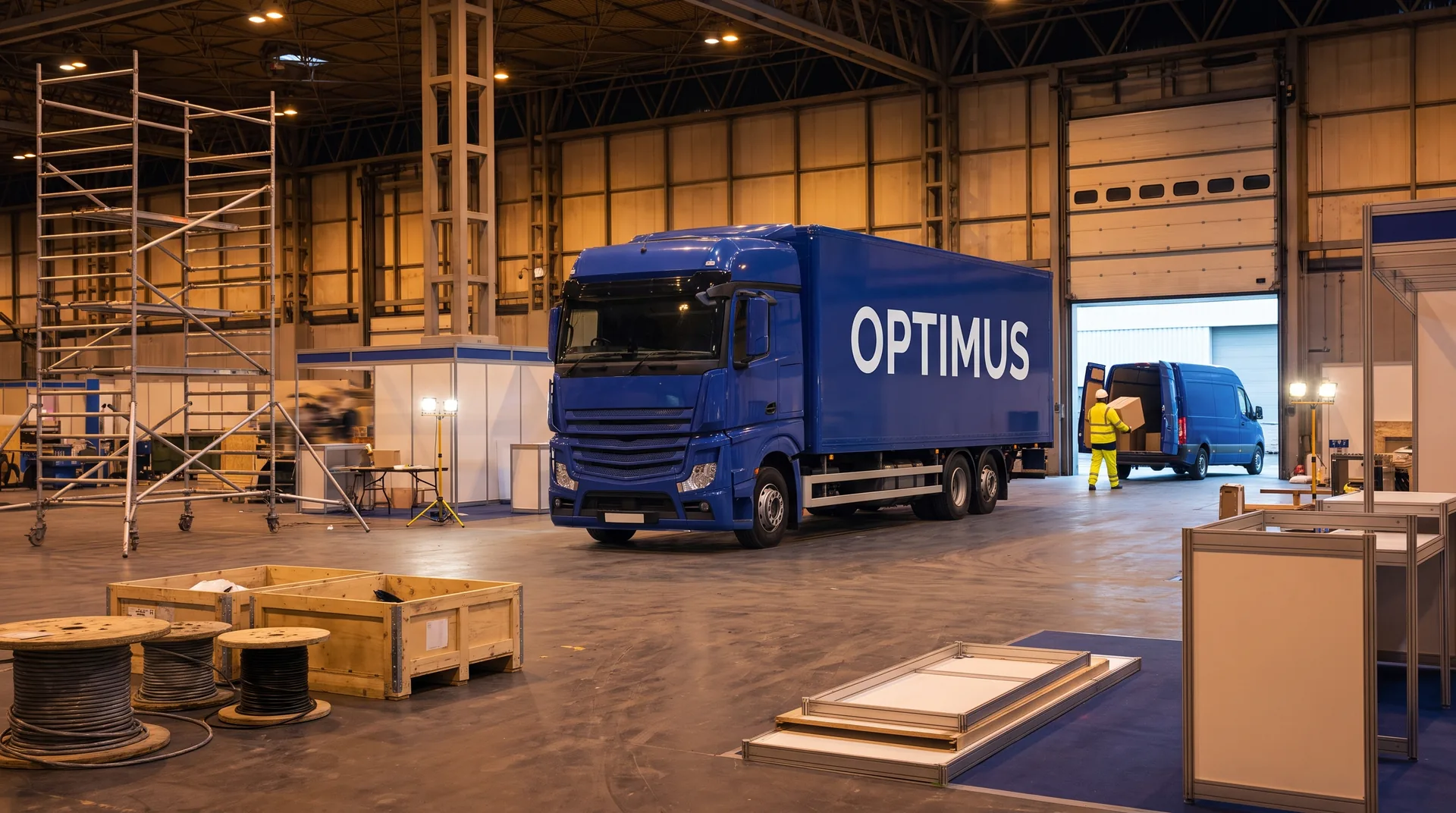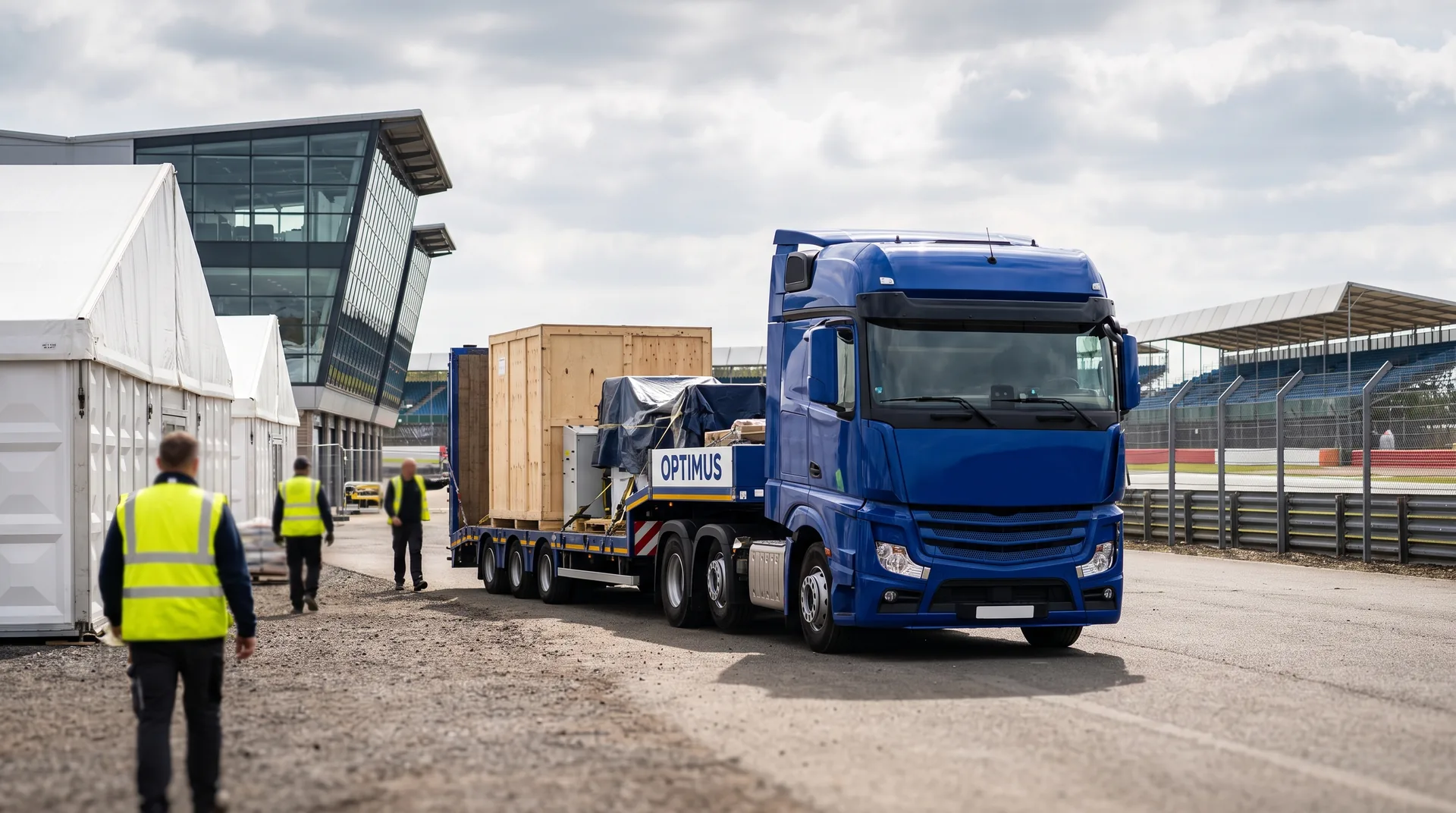
Silverstone lies in Northamptonshire on the A43, between the M1 to the north and the M40 to the south, and it is not an exhibition hall in the ordinary sense. It is a racing circuit with conference and exhibition facilities, where vehicles enter five large halls, and forty pit garages take vehicles through rear roller doors. We carry stands and exhibits here from Poland, assemble them in Kielce before departure and collect them once the event closes.
One approach road carries everything
Silverstone has two natural approach directions and both end on the same road. From the north you come down the M1 and then the A43. From the south you come up the M40 and, again, the A43. The A5 and A413 also serve the area, but the A43 is the artery through which everything arrives: exhibitor lorries, build crews and the public. The venue itself warns on its website about roadworks between Towcester and Silverstone that add time to the journey.
For a carrier this produces a simple rule: at a large event, the slack you need is not on the run from Poland but on the last dozen or so kilometres. Anyone booking an entry hour and then meeting the flow of traffic coming off the A43 loses the time exactly there. This is precisely the case where a buffer near the venue converts the risk of being late into a planned stop; we describe the mechanism in the article on a buffer warehouse next to a fairground.
What is different about a venue built around a circuit
An ordinary exhibition hall has a manoeuvring yard, doors in one wall and an approach road designed for lorries. Silverstone has a six kilometre circuit, over six hundred acres of ground and an internal road network built to run a motor race. The exhibition side amounts to about twelve and a half thousand square metres of conference and exhibition space, including five large adaptable halls to which the venue allows vehicle access, plus a dozen or so smaller rooms.
The pit garages are a category of their own. There are forty of them, together about six thousand square metres, and the venue states that all of them have HGV access through rear roller doors, with three-phase power. That arrangement is unusual among English venues and very convenient for technical displays: a vehicle pulls up to a specific garage rather than to one shared hall entrance, so several stands unload in parallel instead of queueing.
The third part of the site is open ground: paddock, grass and woodland. The venue describes it qualitatively, without a split between hard surface and soft, so for an outdoor display the ground under a specific pitch has to be confirmed with the organiser. A heavy exhibit on grass is a different operation from the same exhibit on a hard slab, which we cover in the article on unloading an oversized exhibit.
A constraint you find nowhere else: traffic on the circuit
At a venue with a racing circuit, parts of the internal road network can be unavailable while cars are running. That constraint comes neither from traffic law nor from weight limits, but from what the place is. So at Silverstone the access question is asked differently from elsewhere: not only when you may enter the site, but by which route you cross it on that particular day and who is directing movements. The answer comes from the show organiser, because it depends on the programme rather than on the venue.
Clean air zones and the approach
The Silverstone area has no charging clean air zone, and neither does any town on the M1 or M40 approach to the A43. The British list of charging zones covers Bath, Birmingham, Bradford, Bristol, Portsmouth, Sheffield and Tyneside, with separate rules in London. If the same run later touches London or central Birmingham we check that separately; the rules are gathered in the article on UK clean air zones.
What to settle before arrival
To the organiser: which hall or which garage, how vehicles are booked in and where passes are collected, whether a vehicle may enter for this stand, what the route across the site is on build-up day, and who supplies the unloading equipment. To the venue: where the vehicle waits before entry. We do not quote hours or dates, because the organiser sets them separately for each edition. Who is responsible for what on site is set out in the article on responsibilities at a trade fair.
What we do at our end
We collect the load in Poland, and from exhibitors in Czechia, Slovakia, Austria and Hungary we gather it through our hub. The Kielce base sits about 4 km from the fairground, a few minutes away, works around the clock and serves as the place where a stand is assembled into one consignment before departure. A groupage vehicle waits for the next scheduled line departure. On the British side the load usually goes through a cross-dock in Milton Keynes, which is close to Silverstone, so the final run can be set to a specific hour at the gate. On site we deliver to the handover point and the venue equipment takes over. After breakdown the stand returns to Poland or waits for the next show.
Groupage or a dedicated vehicle
The threshold is the usual one: roughly a third of a trailer, about twelve pallets. Silverstone adds an argument of its own, though. If the display includes a vehicle or a machine destined for a pit garage, a dedicated truck wins regardless of volume, because that kind of exhibit does not split into consignments and does not tolerate transhipment. For a stand made of panels, graphics and brochures, groupage is usually enough.
Sources
- Silverstone: venue hire, halls, pit garages and directions
- GOV.UK: list of British charging clean air zones
Have a stand or an exhibit for an event at Silverstone? Send the item list with dimensions and weights, together with the organiser materials, through the quotation form and we will match the vehicle to the route and to the entry. See also the exhibition logistics page.