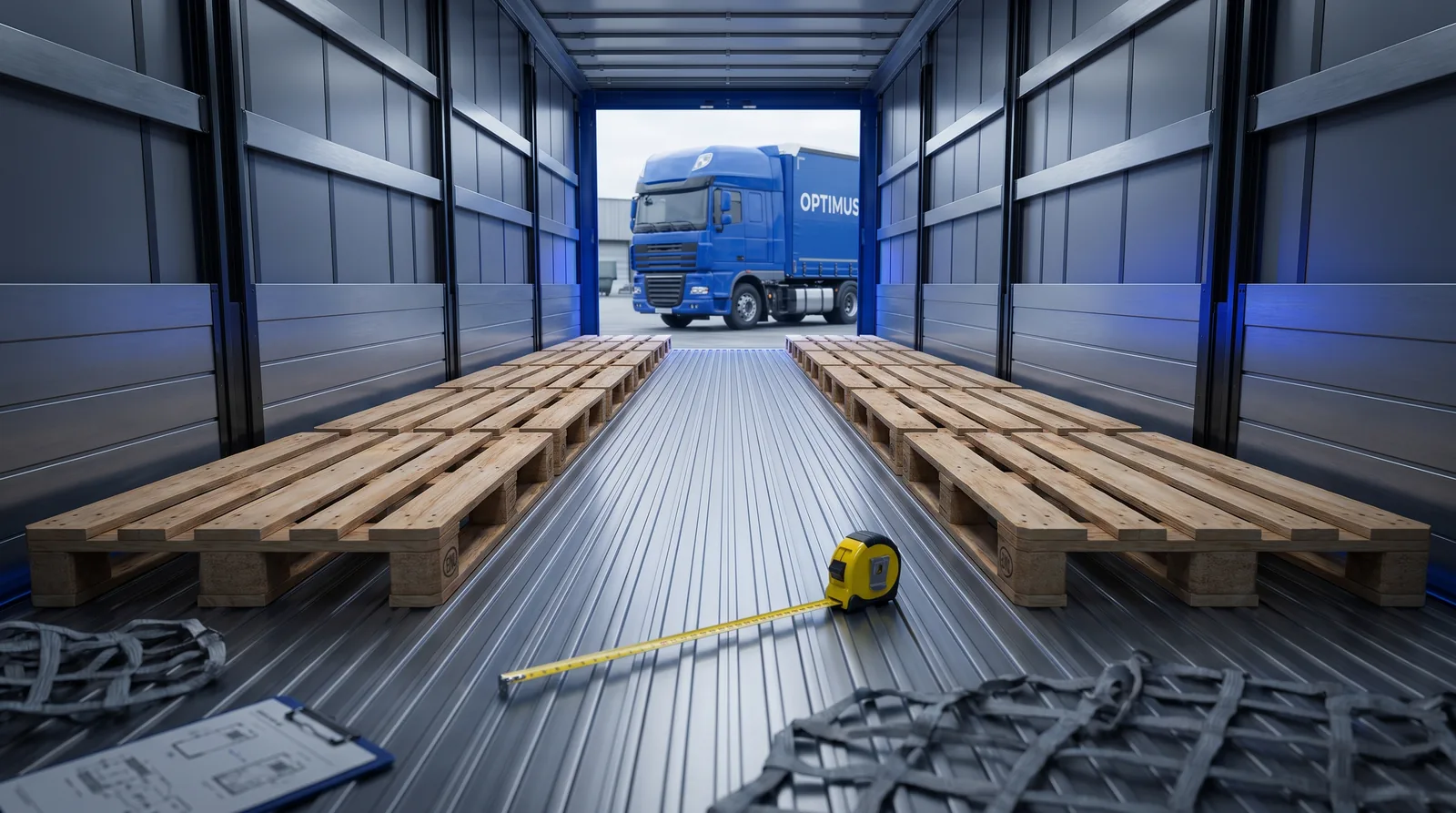
A standard 13.6 m trailer takes 33 EUR pallets (1200 by 800 mm) or 26 industrial pallets (1200 by 1000 mm) in a single layer. A EUR pallet occupies 0.4 loading metres, an industrial one 0.5. With stackable goods the capacity can double, as long as packaging strength and the total cargo weight allow it.
Where do 33 EUR pallets on a trailer come from?
The interior of a standard trailer is about 13.6 m long and 2.45 to 2.48 m wide. A EUR pallet sits across the vehicle two abreast (twice 1.2 m) or lengthwise three abreast (three times 0.8 m); in practice both patterns are mixed, giving 33 positions on the floor. An industrial pallet is wider, so it fits two per row on a metre of length, hence 26. These are boundary values for evenly palletised goods with no overhang: cargo protruding beyond the pallet footprint steals space from its neighbours and changes the whole arithmetic.
Table: pallets, dimensions and vehicle space
| Pallet type | Base dimensions | Pieces on a 13.6 m trailer | LDM per piece |
|---|---|---|---|
| EUR (EPAL) | 1200 by 800 mm | 33 | 0.4 |
| Industrial | 1200 by 1000 mm | 26 | 0.5 |
| Half pallet | 800 by 600 mm | 66 | 0.2 |
| Non-standard pallet | as measured | from the LDM conversion | width times length divided by 2.4 |
LDM, the loading metre, is the universal currency of vehicle space: multiply the pallet count by the value in the last column and you know how much floor your shipment takes. The full calculation is explained in our article on pallets and loading metres, and our pallet and LDM calculator does the quick maths.
When does stacking double the capacity?
Stacking works when three conditions hold at once: the goods on the bottom pallet have a flat, load-bearing top, the packaging withstands the second layer's pressure, and the combined height of both pallets fits the vehicle. Then 33 pallet positions can take 66 EUR pallets. In practice centimetres and kilograms decide: two pallets of 1.2 m each fit a mega trailer with its three metres of space, but not every standard tautliner; the differences between trailer builds are covered in our article on trailer types for the UK.
How do you calculate the space for your shipment step by step?
- Count the pallets of each type and check that no goods protrude beyond the base footprint.
- Multiply the pallet count by the LDM per piece from the table above.
- Assess stackability: flat top, load-bearing packaging, combined height within the vehicle limit.
- Total the gross weight; cargo mass often becomes the limit before the floor does.
- Enter the result in the quote form; we recalculate and confirm everything with the offer.
Why do these numbers matter for the quote?
In groupage you pay for occupied space, so the difference between 0.4 and 0.5 LDM per pallet is real money on every shipment, and stackability can halve the unit cost. The break-even point of a full vehicle sits where the LDM total approaches a complete trailer; when to book FTL instead of groupage is explained in FTL or LTL, and the freight price components in what builds the price of pallet transport to England.
Traps in pallet arithmetic
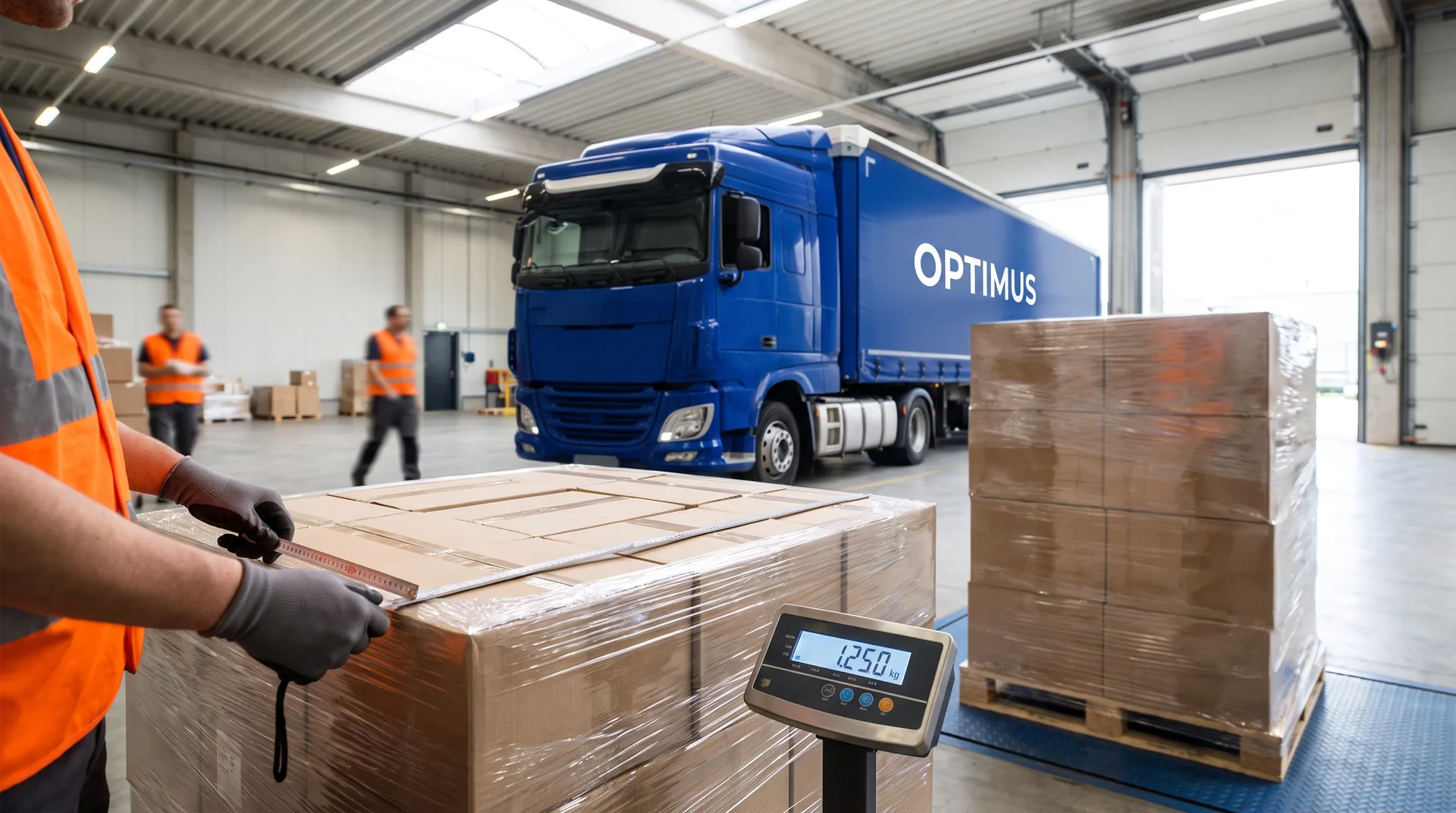
A few things regularly spoil the perfect maths. First, overhang: a carton protruding two centimetres beyond the pallet footprint pushes the unit into a bigger space category and risks scuffing in tight stowage. Second, concentrated weight: a pallet of steel moulds can weigh as much as ten pallets of clothing, so the truck leaves with empty floor because it ran out of mass. Third, undersized or damaged pallets: a broken board rules out stacking and gets questioned at delivery in England. Fourth, the gap between declaration and reality: if the booking says 120 cm of height and 145 cm turns up at the ramp, the load may not fit the planned layout. That is why at a first cooperation we ask for photos of packed pallets: one side shot and one from above settle more than long correspondence. For standing flows we standardise packaging with the client once, and every later shipment counts itself; the whole process from booking to delivery is described in transport to England step by step.
Working with unusual pallets or goods that are hard to convert? Send the dimensions through the quote form and we will calculate the vehicle space for you and suggest the cheapest sensible layout.