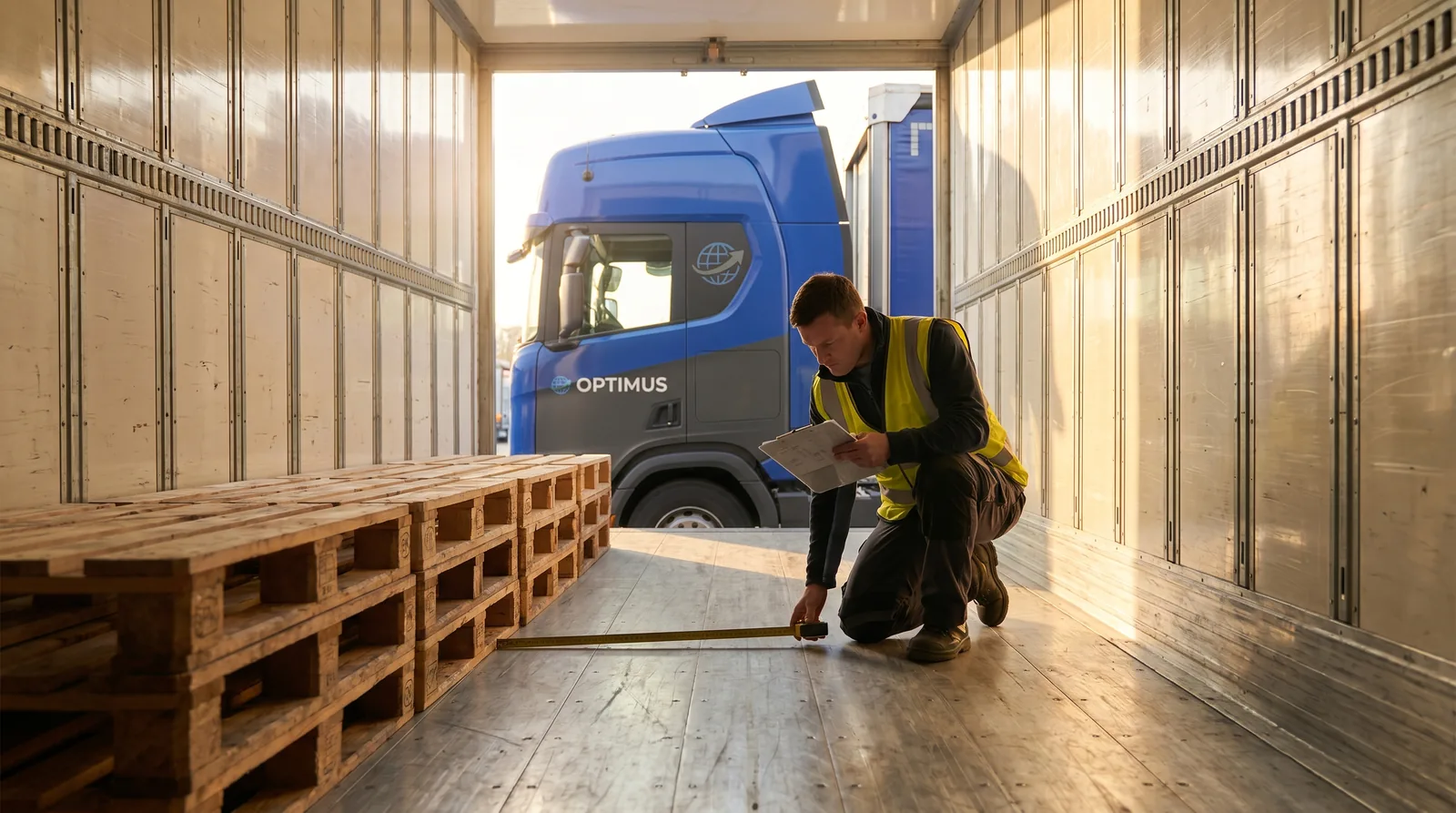
A standard curtainsider offers around 13.6 loading metres across a width of 2.45 metres. A euro pallet takes 0.4 loading metres and an industrial pallet 0.5. That gives roughly 33 euro pallets or 26 industrial pallets on the floor, and correspondingly more where stacking is allowed.
Calculating loading metres step by step
Start from the footprint, not from the pallet name, and watch which way round the pallet stands. Divide the trailer width, 2.4 metres, by the pallet side that runs across the trailer to find how many fit in a row. Then divide the other side, the depth measured along the trailer, by that number. A euro pallet stands with its 0.8 metre side across, so three fit in a row, and its 1.2 metre depth divided by three gives 0.4 loading metres. An industrial pallet stands with its 1.2 metre side across, so two fit in a row, and its 1.0 metre depth divided by two gives 0.5 loading metres. The same arithmetic works for non-standard loads: you count the footprint that actually blocks the floor.
How many pallets a trailer holds
- Euro pallets: around 33 on the floor, loaded three across.
- Industrial pallets: around 26 on the floor, loaded two across.
- Stacking increases those figures, but only where goods and packaging take it and the consignor has confirmed it in writing.
- A mega trailer offers more internal height, which helps with light, tall loads, but does not change the number of floor positions.
Variants and real limits are set out in how many pallets fit on a trailer, and trailer selection in tautliner, mega or curtainsider.
Weight has its own ceiling
Space usually runs out before payload does, but not always. With dense goods such as liquids, metals or building materials a trailer reaches its permitted gross weight at little more than a dozen pallets. At that point the loading metre calculation stops mattering and weight plus axle distribution becomes the limit. The consequences of getting that wrong are covered in misdeclared weight and axle overload.
Stacking: when it is genuinely allowed
Stacking can halve the transport cost, but only where the bottom layer takes the load. That depends on packaging design, how flat the top of the pallet is and how stable the wrapping is. The consignor should state stackability explicitly, because the driver does not guess. If the goods will not take weight, the pallet is charged as a full floor-to-roof position. The practice is described in pallet stacking.
What else affects the space used
Cartons overhanging the pallet increase the real footprint and prevent the next pallet standing alongside. A pallet taller than the trailer interior forces a different vehicle. Long items such as profiles or windows block a strip of floor along the whole trailer. We calculate all of these by real footprint, which is why quotes ask for dimensions after packing rather than the dimensions of the product. How to prepare a pallet so it takes no more room than it should is covered in how to prepare a pallet for the UK.
Why a shipper should know this
Because it lets you decide knowingly between groupage and a full vehicle. Once a load approaches half a trailer it is worth comparing the two, which we set out in FTL or LTL. Single pallets travel with us as groupage, and full sets on a dedicated vehicle. Knowing your loading metres also makes carrier quotes comparable, because you know exactly what you are paying for.
How to read a quote based on loading metres
Groupage pricing almost always works on a chargeable weight: actual weight is compared with the floor space occupied and the higher figure is charged. So two consignments of the same weight can cost differently if one is dense and the other bulky. When comparing offers it is worth checking three things: how the carrier treats a non-stackable pallet, whether overhang is added to the occupied footprint, and how a long item blocking a strip of floor along the trailer is charged. Those three items account for most of the difference between apparently identical quotes. It is also worth giving dimensions after packing rather than product dimensions, because film, corner protection and layer boards can add the few centimetres that push a pallet into a higher bracket. More on reading offers in how to read a carrier quote.
Have a pallet list and want to know how much space it takes? Send dimensions, weights and stackability through our quote form and we will do the arithmetic and propose the cheapest way to move it to the islands.