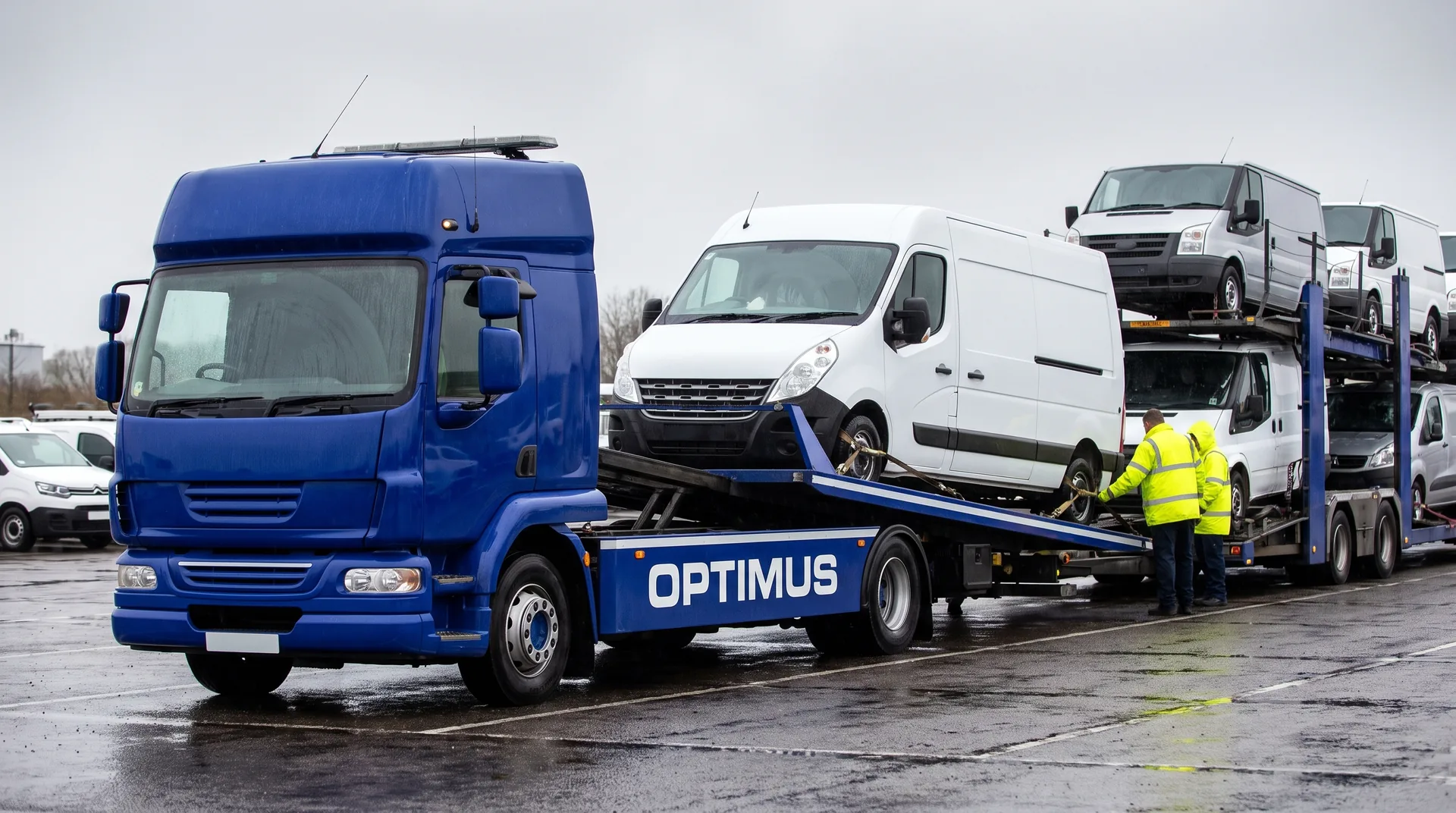
A light commercial vehicle from a British auction is the simplest case in this series: a single vehicle sits on a recovery truck, several units ride on a vehicle transporter. We move it as cargo. We do not offer driving it home on its own wheels, and the buyer arranges that separately if it makes sense. Before bidding, work out one figure: what right-hand drive costs you on resale in Poland.
What is actually standing in the yard
Three quite different objects hide behind the phrase light commercial vehicle. A panel van, a closed box on the vehicle frame, is the easiest to move because its outline ends roughly where the bodywork ends. A chassis cab with a load bed, open or sheeted, is often wider than the cab and has drop sides that must be closed and latched. The third group is refrigerated bodies with a tail lift, and those cause the most trouble: the roof-mounted unit adds height, and the lift shifts mass behind the rear axle.
The catalogue entry normally gives the year, the mileage and the body type, but rarely the overall height in the state the vehicle is standing. For haulage that height matters more than the mileage, because it decides whether the vehicle fits a double-deck transporter or has to travel low and alone. How lots are described is set out in UK vehicle auctions and buying and exporting through BCA and Manheim.
Right-hand drive: do the arithmetic before you bid
This is the point easiest to forget in the heat of a sale. A British van is cheap for a reason: Polish buyers pay less for right-hand drive because it narrows the pool of purchasers and makes the driver work harder when overtaking and at most loading bays. That discount belongs on the resale side of your calculation before the hammer falls, not after the vehicle is already standing in Poland looking for a buyer.
Run the sums in order: hammer price, platform fees, collection from the yard, haulage, clearance, and only then the realistic sale price at home. If what remains after the right-hand drive discount is less than the cost of moving the vehicle, you have bought a problem rather than a bargain. What details produce a firm haulage price is listed in a transport quote before a UK auction and what to provide.
Runner or non-runner
That single line in the lot description changes the equipment and the price more than anything else. A runner that starts, steers and brakes drives up the ramps under its own power in minutes. A vehicle described as non-starting, with a failed starter motor or a flat battery, needs a winch and a recovery truck with ramps of adequate length, which is a different vehicle at a different rate.
- the fact that a vehicle will not start must reach us before we send a vehicle for it, not on arrival;
- a seized parking brake on an unpowered vehicle can stop the winch job outright, so we ask about it;
- tyres that have visibly lost pressure change the geometry of the pull and damage the ramps;
- body damage and fluid leaks are declared in advance, as with Copart UK damaged vehicles and the transport they need.
Lashing: towing eyes and straps over the tyres
A van is never secured by its bumper, its side step or any part of the body. We use the factory towing eyes and the transport lugs in the frame, and where those do not exist we run straps over the wheels, pressing the tyre into the deck. The second method has the advantage of restraining the mass of the vehicle rather than its suspension, so it does not go slack as springs and dampers extend during the journey.
Add chocks at the wheels, the parking brake set or released depending on the lashing method chosen, and a tension check after the first leg. The rules for choosing straps, their number and the force calculation are covered separately in cargo securing to EN 12195. Getting the vehicle onto the deck at all, and the choice between ramps and winch, is covered in loading at the auction yard by trailer, ramp, crane or recovery truck.
What to empty, disconnect and record
The vehicle goes onto the transporter empty. Loose items in the load space, tools left by the previous operator, pallets, pallet trucks and installation racking are either removed or secured separately as cargo, because under braking they move and punch through the bulkhead. A refrigerated body additionally needs a check that the unit is switched off and that its separate fuel tank, where fitted, is not full.
The battery stays connected only where the vehicle is to drive on under its own power and be secured immediately afterwards; otherwise the terminal comes off. Fuel in the tank is kept to the minimum needed. The condition of the vehicle is recorded separately at collection, because between release from the yard and unloading in Poland nobody else will do it. What that inspection looks like in practice is described in inspecting a machine before collection from the auction yard.
Paperwork, number plates and overall height
A vehicle bought at auction travels with its sale document, the British registration document and its keys, and the number plates are often removed while it is still in the yard. For a vehicle carried as cargo that is an administrative matter, since a vehicle without plates is not driving anywhere anyway, but the full set of papers is essential for later formalities in Poland and is far better checked before leaving the yard than afterwards. We do not register vehicles in Poland; we carry them and handle border declarations in cooperation with established customs agencies on both sides.
Finally, the figure that is easiest to overlook: the height of the vehicle with the tail lift folded against the rear frame and any roof structure fitted, added to the deck height of the transporter. That sum decides whether the vehicle fits a normal outfit or needs a low deck or a journey of its own. A fridge body with a roof-mounted unit can absorb the entire allowance, at which point the move stops being cheap and the question of driving it home returns.
Sources
- GOV.UK: load securing guidance for vehicle operators
- GOV.UK: exporting goods from the United Kingdom
- GOV.UK: the EORI number needed for declarations
Give us the lot number, the yard address and whether the vehicle starts, and we will set the collection and choose the equipment on that basis. Start with a quote for moving a vehicle from the United Kingdom, settle the detail through the operations team, and we will run the border side alongside customs clearance on the Poland to United Kingdom route.