A site dumper is one of the easier loads in this category: it is low, stocky and drives onto the deck on its own wheels. The difficulty lies elsewhere. It is sometimes classified as a dumper designed for off-highway use rather than as working machinery, and that governs the tariff heading and the rate of duty. The code is confirmed in the tariff in force on the day of declaration.
Carriage: easy, provided the yard is surfaced
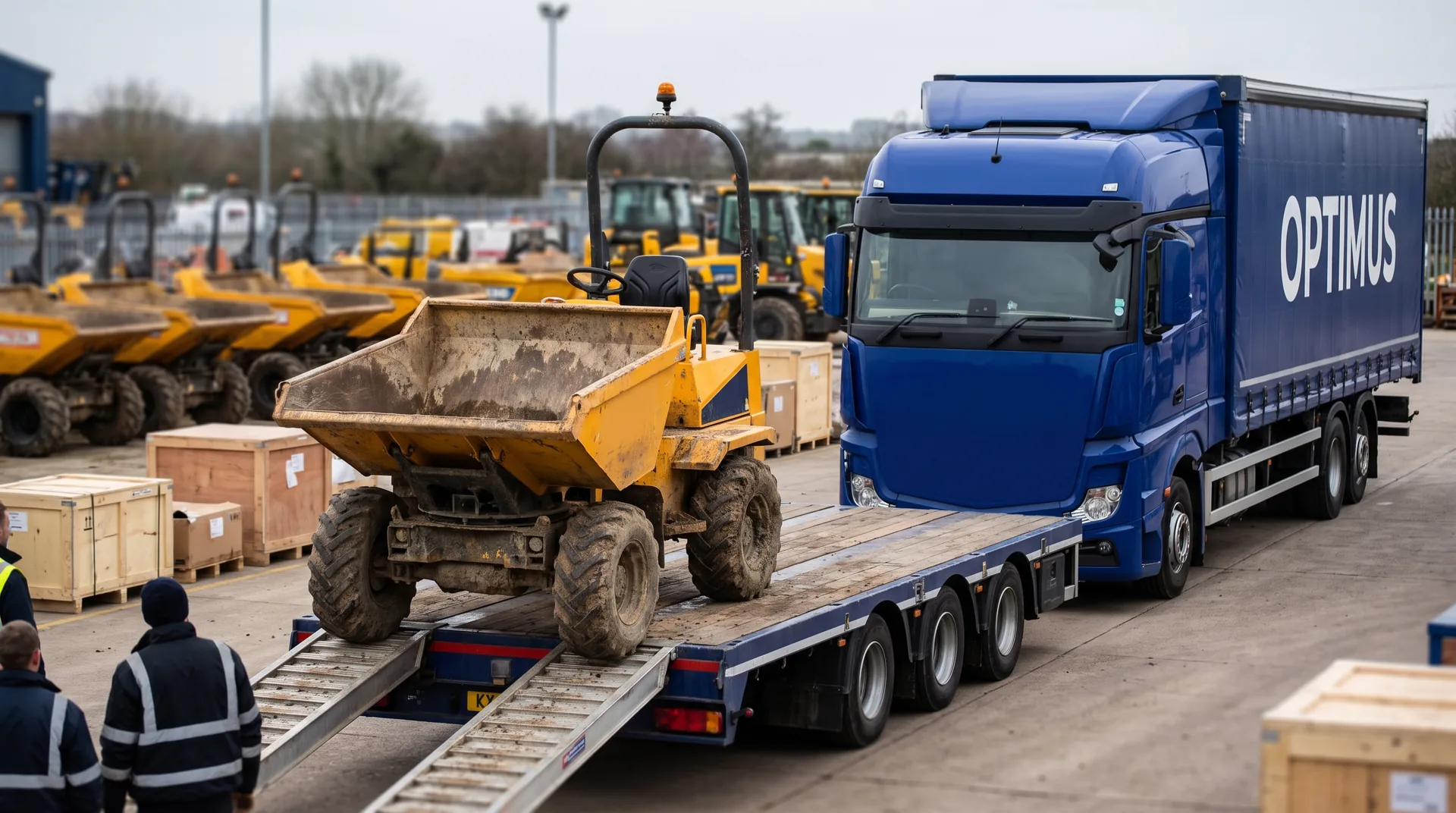
A dumper has a low centre of gravity, a short wheelbase and wide off-road tyres, so climbing the ramps is quick. Two details can still spoil the plan. The first is ground clearance: a dumper with a high mounted skip has parts underneath that catch the deck edge on a steep approach before the wheels reach the trailer. The second is the coarse off-road tread, which slips on wet steel more than its appearance suggests. Plates under the ramps and longer ramps solve both; we write about this at greater length under loading a machine at the auction yard.
Skip, articulation and swivel
- The skip comes fully down and is locked mechanically where a transport lock exists. The tipping ram is not a restraint.
- A swivel skip, on models that rotate sideways, returns to the axial position and is locked; turned, it changes the outline of the load.
- The frame articulation is locked as on an articulated loader; without the lock the machine jack-knifes on the deck under braking.
- A rotating seat and a foldable operator protective structure go to the transport position, because that is often the highest point of the machine.
- The skip is emptied and swept before the road. Leftover aggregate or concrete falls out of it along the whole route.
Lashing
Chocks go under every axle, lashings into the points the maker specifies, pulled diagonally. On a dumper it is tempting to strap over the skip rim because it is conveniently within reach; the skip is a moving part and does not hold the machine. Tension is checked after the first leg, because coarse off-road tyres deflect heavily under a strap. The rules for choosing lashings are collected in the article on cargo securing under EN 12195.
Classification: why this is not a detail
The trade description in the auction listing does not settle the code. The same equipment is sometimes described as construction machinery and classified as a dumper for off-highway use, and the difference feeds straight into the rate of duty and into which documents are needed at declaration. The code is not established from memory or from a previous clearance but from the tariff in force on the day of declaration, based on the description of the specific goods. Declarations are filed by the regular customs agencies we work with on both sides of the Channel; our part is the complete transport data and a loading list that matches the contents of the trailer. How an auction machine is documented is described in the piece on documents for a machine bought at auction, and how value is established in the article on the customs value of a used auction machine.
Fluids, fuel and battery
Hire fleet dumpers are often heavily used, and leaks on the tipping ram and in the steering circuit are typical. We check them before loading, particularly when the machine is to travel in groupage. The fuel level is agreed with the yard before collection, because fuel type, tank construction and contents decide whether the movement falls under dangerous goods rules. The battery is disconnected, the terminals protected, and the keys travel with the paperwork.
Soil, aggregate and the border
A dumper skip is dirty by definition, and off-road tread picks up soil better than any other tyre on a site. For equipment used for agricultural or forestry purposes, entry into the Union requires the phytosanitary conditions to be met: a notification in TRACES NT, a CHED-PP certificate and the importer entered in the register kept by the Polish plant health service; we describe the procedure under farm machinery auctions in the UK. Regardless of that, the skip has to be emptied and swept before loading, because aggregate spilling from a load onto the road is a transport problem, not a cosmetic one.
Groupage or a dedicated vehicle
Smaller dumpers fit into groupage and that is their natural mode: they leave auctions in batches after hire fleet disposals, so several travel together on a consolidated vehicle waiting for the next scheduled line departure. High capacity models take the deck entirely. The boundary runs roughly where a load occupies a third of the trailer, about twelve pallets. What to supply for a binding rate is listed in the piece on a transport quote before the auction.
Sources
- European Commission: calculation of customs duties and the tariff
- Access2Markets: tariff code and duty rate search
- GOV.UK: securing loads on HGVs and goods vehicles
Buying equipment at auction and want carriage and clearance in one place? Send the lot listing and the yard address through the quote form. See also customs clearance and groupage LTL. See also: a crusher from a UK auction.