Since 1 January 2024, prepacked food sold in Great Britain must show the name and a UK address of the responsible food business operator or, failing that, of a UK-established importer. The Not for EU mark is a separate rule: it applies to certain goods moved from Great Britain into Northern Ireland, not to exports into GB as such.
The UK FBO address: what changed after the transitional period
After Brexit, Great Britain carried over the EU rules on food information to consumers, but one element split: the address on the pack. During the transitional period the GB market still accepted EU addresses. That period is over: under the guidance published on gov.uk, from 1 January 2024 prepacked food placed on the market in England, Scotland and Wales must name an FBO with a UK address or, where the responsible operator is not established there, the name and address of a UK-based importer. An EU manufacturer address alone, sufficient for the EU market, no longer works for GB.
For an exporter shipping from Poland or elsewhere in the EU, this is a commercial decision before it is a design decision: who formally stands behind the product on the British market? In practice the label usually carries the address of the UK distributor, the retail chain or the exporter's own UK entity. Settle this in the contract before the packaging is printed, because the mistake surfaces at the worst possible moment: at goods-in of a retail distribution centre. A batch with a non-compliant label cannot be placed on the market and goes back at the supplier's cost. We describe intake controls and rejections in our article on deliveries to UK retail distribution centres.
Northern Ireland follows a different logic: under the Windsor Framework the EU food rules continue to apply there, so an EU operator address remains acceptable. One more reason to design the label for the actual market of sale rather than for "the UK" treated as a single block.
Not for EU: only GB to Northern Ireland, not every export
No labelling topic generates more confusion, so let us be precise. The Not for EU mark is not a condition of selling food in Great Britain, and a load travelling from Poland to a buyer in England, Scotland or Wales does not need it for that reason. The requirement comes from the Windsor Framework and attaches to movements from Great Britain into Northern Ireland under the Northern Ireland Retail Movement Scheme (NIRMS). The scheme lets retail food move from GB to shops in Northern Ireland without full sanitary certification, and the price of that simplification is the Not for EU label, designed to stop such goods travelling onward into the EU market.
The obligation arrived in phases: from 1 October 2023 it covered the first product groups, primarily meat and some dairy, with the scope extended in later stages. The product lists and dates have shifted more than once, so do not design packaging around half-remembered deadlines: check the current scope in the NIRMS guidance on gov.uk. The UK government has also consulted on extending the marking to goods sold across Great Britain; before committing to a large print run, verify the current legal position at the source.
The practical consequence for a supplier: if your UK customer also supplies stores in Northern Ireland, they may require the Not for EU mark on your products or on part of the run, even though the formal obligation sits with the link moving the goods from GB to NI. Ask the question explicitly at specification stage. Stickering a finished pallet in emergency mode costs far more than one extra line in the artwork.
English language and the mandatory particulars
Food information on products sold in Great Britain must appear in English. A multilingual label is allowed, but the English version must carry the full set of mandatory particulars: the name of the food, the ingredient list with allergens emphasised, the net quantity, date marking, storage conditions, the FBO details and, where the rules require it, the country of origin and the nutrition declaration. The full requirements and current exemptions are set out on gov.uk under "Food labelling and packaging" and in Food Standards Agency guidance; for every new product category, check them at the source instead of copying a competitor's label. Allergens carry their own regime, separate again for food prepacked for direct sale, and we cover it alongside the other mandatory particulars in food labelling for the UK market.
| Market of sale | Address on the label | Not for EU mark | Where to check |
|---|---|---|---|
| England, Scotland, Wales (GB) | FBO with a UK address, or a UK-established importer (from 1 January 2024) | not required for sale in GB itself | gov.uk: Food labelling and packaging |
| Northern Ireland | NI or EU operator address accepted (EU rules apply) | required for certain goods moved in from GB under NIRMS | gov.uk: NIRMS / Windsor Framework guidance |
| European Union | FBO with an EU address | not applicable | Regulation (EU) No 1169/2011 |
Before you print: an exporter's checklist
- Fix the label entity in the contract. Who acts as FBO or importer for the GB market and whose address goes on the pack? A commercial decision to be taken before printing, not after the first rejected delivery.
- Check the BTOM risk category. The label is one thing, border paperwork another: the risk category of the product drives certificates and inspection rates. We explain the model in BTOM and the SPS risk categories.
- Prepare for the border check. At a border control post the inspector compares the goods against the documents, and inconsistencies in batch marking can hold the vehicle. The process step by step: sanitary checks on a load at the UK border.
- Ask the buyer about retailer requirements. Beyond the consumer label, chains enforce logistics labelling: barcodes and SSCC numbers on cases and pallets. Details in re-labelling and GS1/SSCC codes for UK retail.
- Leave room for corrections in the UK. A labelling error found after clearance does not have to mean sending the goods back across the Channel: repacking and relabelling can be done in a UK warehouse before the batch is placed on the market.
How we run this
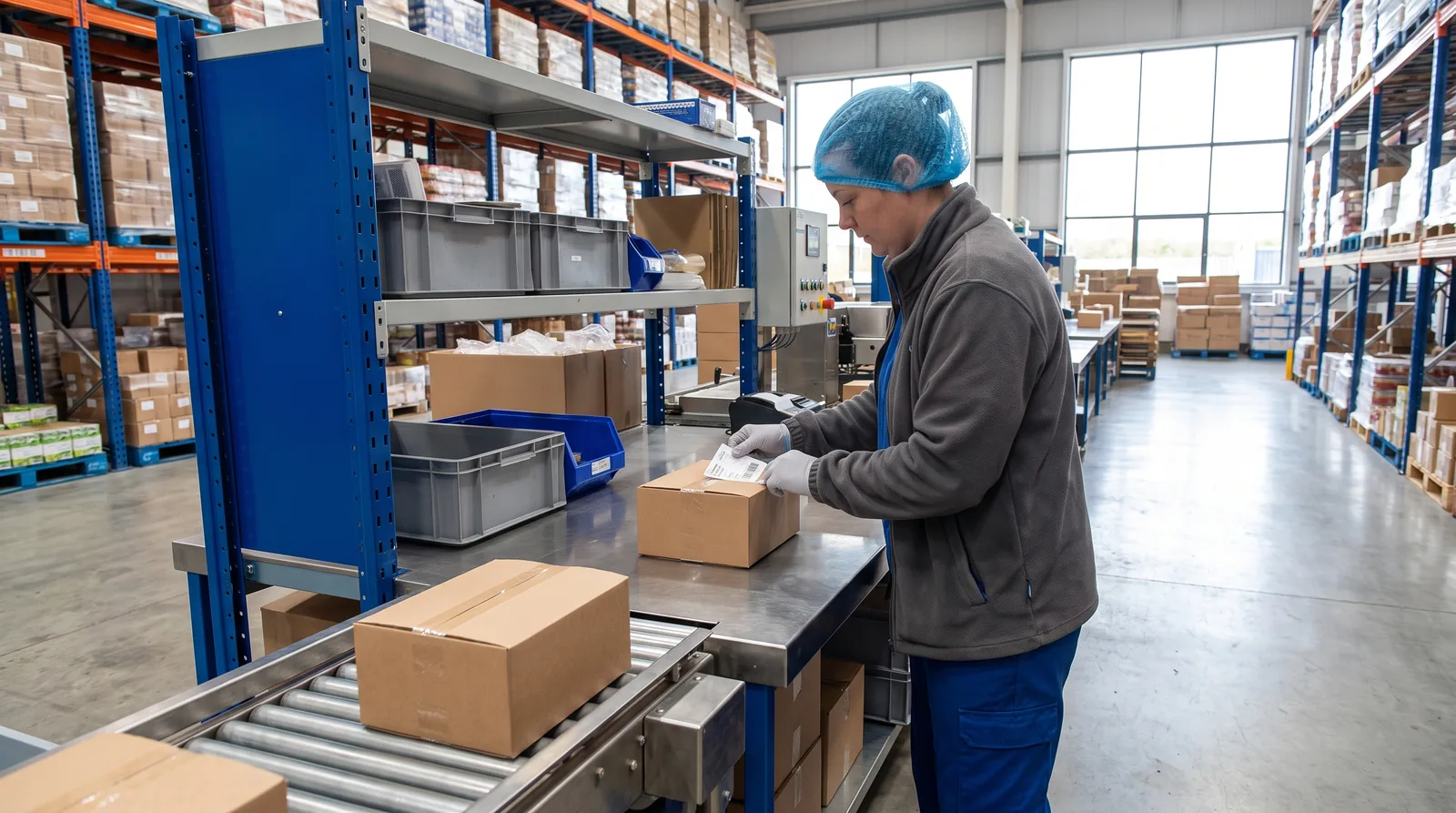
We move food and other cargo between Poland and the United Kingdom, and we know that the fate of a batch is often decided by a sticker, not by the freight. At our Milton Keynes warehouse we work at pallet and outer-carton level: we apply the carton markings your consignee requires and GS1/SSCC logistics labels to retailer specifications, and before delivery we check that the unit labels — the UK food business operator's address and the Not for EU mark for batches routed to Northern Ireland — arrived complete. We do not label individual selling units; unit-level gaps go back to the producer, while carton and pallet markings are corrected on the spot, so the batch does not cross the Channel again without need. The full shipping route is described on our export to the UK page, more border topics sit in the knowledge base, and you can discuss a specific batch through the contact form.