Upholstered furniture sold in the United Kingdom must comply with the Furniture and Furnishings (Fire) (Safety) Regulations 1988: fillings and covers with the required ignition resistance plus a permanent label fixed to each item. Without the label the goods are unsellable, retail chains reject the delivery and Trading Standards can stop the batch. Verify the details on legislation.gov.uk and gov.uk.
A market that plays by its own rules
The European Union has no harmonised fire safety requirement for domestic furniture; the United Kingdom has had one since 1988. A manufacturer in Poland or anywhere else in the EU who has supplied compliant sofas to European customers for years is not one step closer to UK compliance: on the British market, the legality of the sale turns on flammability testing and labels that EU rules simply do not mention. The effect shows up at distribution centre docks: a trailer of sofas without permanent labels is stock a UK retailer cannot legally sell to a consumer, so it will not accept it at all.
The Regulations were made under the Consumer Protection Act 1987 and amended in 1989, 1993 and 2010. They cover new upholstered furniture intended for private use: sofas, armchairs, upholstered bed frames, children's furniture, and garden furniture suitable for use in a home. They also cover second-hand furniture supplied in the course of business, with an exemption for furniture made before 1950; mattresses and bed bases follow separate rules within the Regulations. The Office for Product Safety and Standards has been working on a reform of this regime, but until any new rules take effect, the 1988 text applies. Check the scope, the exemptions and the current state of the reform directly on legislation.gov.uk and gov.uk, not in trade summaries.
Three pillars of compliance: fillings, covers, labels
The Regulations operate on three levels at once, and all of them must be right on every single item, not just in the batch paperwork.
| Element | What the Regulations require | Consequence of failure |
|---|---|---|
| Filling materials | foams and other fillings meet the ignitability requirements set out in the schedules | item illegal to supply regardless of the label |
| Covers and fabrics | resistance to a smouldering cigarette and a match flame, tests based on the British BS 5852 series | item illegal to supply, batch at risk of withdrawal |
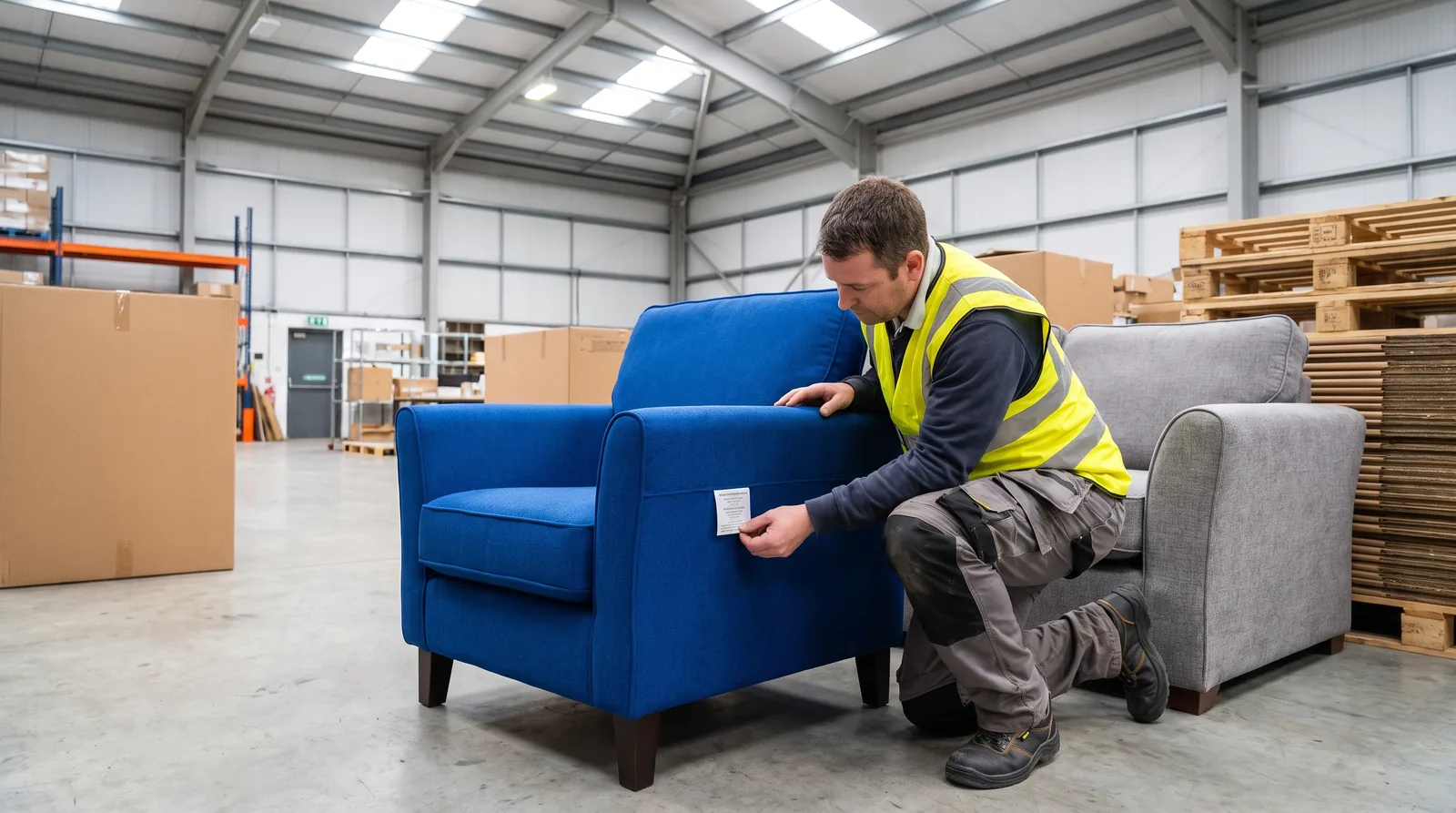
| Permanent label | a durably attached label with prescribed content on every item | goods unsellable, retail chains reject the delivery |
| Display label | a point-of-sale label on new furniture offered at retail | a problem for the shop, Trading Standards enforcement |
The order matters. The label is the last link: it confirms testing that must have happened earlier, on the materials actually used in production. The test documentation has to be available on demand, because a label with no testing behind it is not compliance, it is misleading the market.
The permanent label: a strip of fabric that decides the whole delivery
In export practice it is the permanent label that generates most rejections, and for reasons far more mundane than the word „regulations” suggests:
- No label at all. A manufacturer who has only ever supplied the EU market simply did not know the requirement existed. The whole batch is technically sound and commercially worthless.
- The label was there but came off. Glued instead of sewn, fixed to the wrapping instead of the item: after a couple of handling operations it stays in the trailer, not on the sofa. At the dock the result is the same as no label.
- Wrong content. A template copied from the internet, missing elements, wording that matches neither the full nor the short version in the schedules.
- Labels on part of the batch only. Retail quality control checks samples; one unlabelled armchair can stop an entire trailer.
The cost is easy to add up: a return crossing of the Channel, storage, the labour of re-labelling, a lost selling window. With seasonal collections and promotions comes the most expensive line of all, losing the retail contract, because the chain does not have to wait for a supplier to learn British law.
Who is liable: manufacturer, importer or retailer
The duties under the Regulations fall on anyone who supplies furniture in the course of business on the UK market. In practice the chain looks like this: the manufacturer outside the UK is liable contractually to its buyer, the UK importer as the first supplier in the country is responsible for placing compliant goods on the market, and the retail chain answers for what it sells to the consumer. That is why chains police compliance at goods-in and push the risk back down the chain in their contracts: rejected deliveries, chargebacks and, in the worst cases, delisting.
Breaching the Regulations is a criminal offence enforced by local Trading Standards services: fines, withdrawal of stock from sale and, in serious cases, the criminal sanctions provided for in the Consumer Protection Act 1987. One distinction matters here: the fire safety label is a different regime from conformity marking. Furniture does not become legal by having a mark stuck on it, and when a product genuinely needs UKCA or CE marking is a separate question we cover in UKCA or CE: product marking when exporting to Great Britain.
Why retail chains reject furniture deliveries
- Missing or defective permanent labels, all the scenarios above: the most common furniture-specific reason.
- Labels that do not match the batch paperwork. The label points to a different batch or supplier than the delivery documents, so the chain cannot tie the item to any test evidence.
- No test documentation at a supplier audit. The labels are there, but no test results stand behind the declaration. That disqualifies the supplier, not just one delivery.
- Standard distribution centre issues unrelated to fire safety: a missed slot, damaged packaging, wrong logistics labels. How those requirements work is covered in deliveries to UK retail distribution centres (RDCs).
A rejected delivery does not vanish: the truck is standing, the slot is gone and the goods either go back or go to a warehouse. What can still be done with such a batch on the UK side, from re-booking to alternative sales channels, is covered in distressed load management and rejected retail loads.
The role of transport and warehousing: what can be fixed near Milton Keynes
Transport has one job here: making sure the label the manufacturer sewed on in Poland arrives on the furniture, not on the trailer floor. That means proper securing, minimal and careful handling and a check at loading. How to move furniture without dents and torn labels is covered in furniture transport to the UK. A separate case is furniture travelling to an exhibition: it returns to Poland, but pieces sold straight off the stand enter the British market and fall under the same requirements, which we set out in furniture transport to the January Furniture Show at the NEC.
A warehouse close to the consignee changes the economics of a mistake. Instead of sending the trailer back across the Channel, the batch can be held near Milton Keynes: inspection before booking, a piece-by-piece check that labels are present and legible, attachment of labels supplied by the manufacturer, repacking, quarantine of the rejected part of the batch and a fresh RDC booking. The difference is days instead of weeks and one transport leg instead of three.
The honest boundary: a warehouse cannot run flammability tests for the manufacturer and cannot legalise an item whose materials never passed them. Warehouse labelling saves a delivery only when compliance is real and what was missing was the physical label or the correct wording. Sewing labels onto untested furniture is not a logistics service, it is participation in fraud, and no serious operator will do it.
How we run this
OPTIMUS TRANSPORT runs road transport of furniture between Poland and the United Kingdom and warehouse operations near Milton Keynes: pre-RDC inspections, labelling with materials entrusted by the manufacturer, repacking and quarantine of rejected batches. On the Polish side of the chain we operate warehouses in Kielce and Legnica. The full route to the British market is described on our export to the UK page, more topics sit in the knowledge base, and you can discuss a specific furniture shipment through the contact form.
Sources
- The Furniture and Furnishings (Fire) (Safety) Regulations 1988, SI 1988/1324 (legislation.gov.uk)
- The Furniture and Furnishings (Fire) (Safety) (Amendment) Regulations 1993, SI 1993/207 (legislation.gov.uk)
- Consumer Protection Act 1987 (legislation.gov.uk)
- Office for Product Safety and Standards (gov.uk)