On a crop sprayer the boom folds for transport and that part is designed in. The tank is the awkward one. Residues of plant protection products are a haulage matter and a border matter at the same time, so before a vehicle is sent we ask whether the tank has been emptied and rinsed. Written confirmation of the rinse from the seller is worth having, not out of habit but because without it nobody knows what is inside.
The tank is where the conversation starts
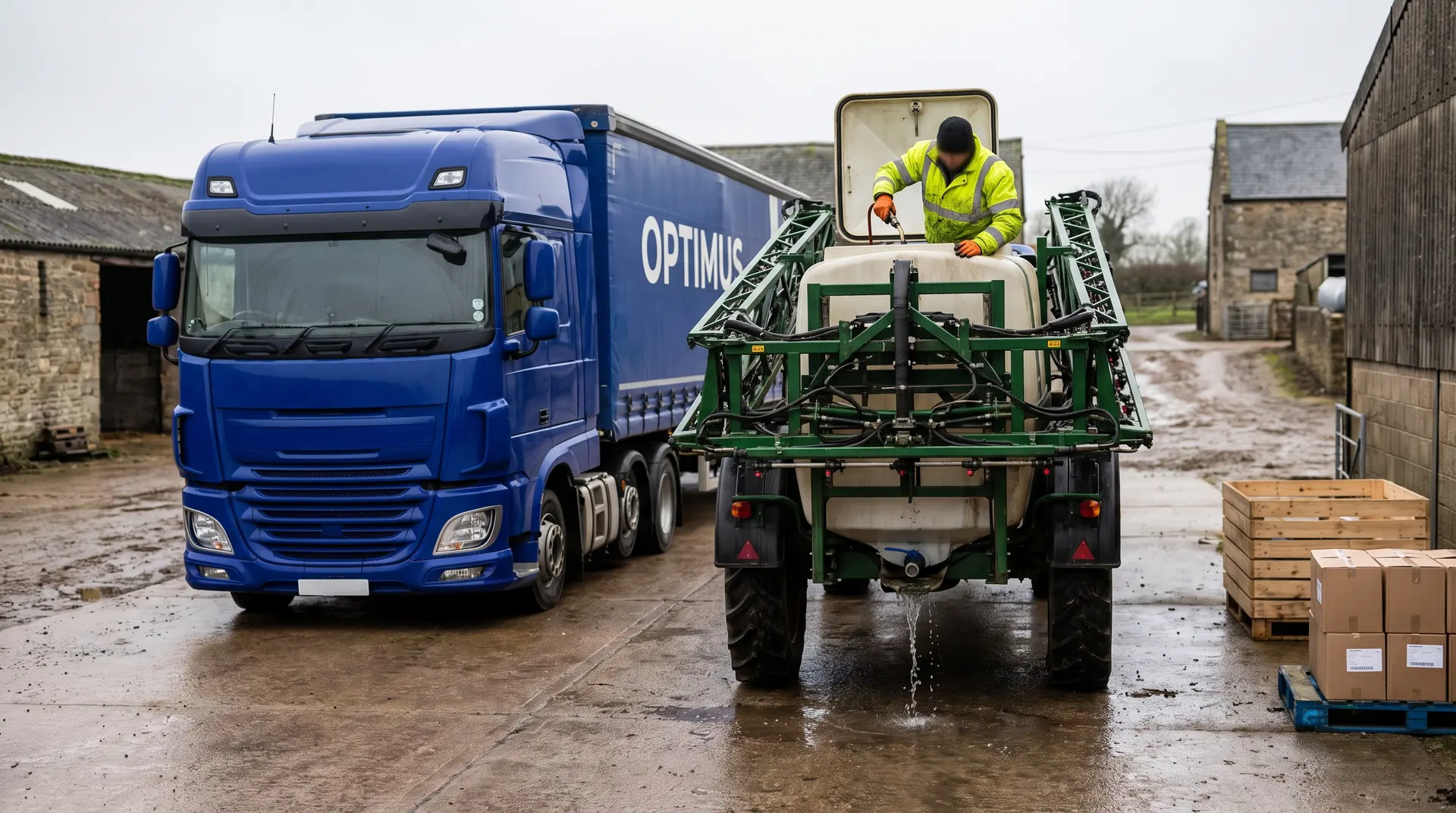
A sprayer bought in Britain almost never arrives at the sale cleaned out completely. It is usually drained of spray liquid, but sediment stays on the floor and walls of the main tank, suspended matter stays in the mesh filter, and some fluid remains in the lines and the pump. Then there is the clean water tank for washing hands and nozzles, which everyone forgets, and the induction hopper reservoir.
So we ask for two things together: written confirmation that the system has been flushed, and a note of which product was applied last. The second leads straight to the safety data sheet. We ask for it before a vehicle is despatched, because what it says determines whether we are talking about an ordinary load or about something that has to be checked against the dangerous goods rules. That is a matter to verify case by case, not a conclusion to assume in advance.
- main tank — drained, rinsed, lid closed and secured;
- filter and pump — emptied, since residual fluid can split a housing in a hard frost;
- clean water tank — drained so that it does not surge on bends;
- nozzles and hoses — nothing dripping onto the deck or onto a neighbouring load.
Folding the boom and locking the sections
The boom folds hydraulically, section by section, and in the transport position it rests on catches along the sides of the tank. Trouble starts when someone folds it in a hurry and does not engage the catches. A section held only by oil pressure can drop after a few hundred kilometres, and a boom that unfolds on the move is real damage rather than a theoretical risk: it catches a barrier, a sign, a vehicle alongside.
We therefore do three things: engage every transport catch, close the ram locks wherever the manufacturer has fitted them, and additionally tie the boom ends back to the frame so that they cannot work vertically. The rules for choosing lashings and calculating forces are set out in our article on cargo securing to EN 12195. Nozzles and the sensors at the boom tips count as fragile and get covered, because replacing a full set can cost more than the difference in rate for a more careful move.
Mounted, trailed or self-propelled: three different moves
A mounted sprayer is a tank and boom carried on the tractor linkage. It has no wheels of its own, so it goes onto the deck by crane or loading shovel and stands on a prepared cradle; on the other hand it makes a sensible part load alongside another machine. A trailed sprayer has its own running gear and drawbar, so it can be pulled up ramps, but it takes more length. A self-propelled sprayer is a category of its own: high clearance, large wheels, a cab, and often a height that forces a low loader.
That choice feeds straight into which vehicle we send and how much room is left for anything else. The ways of getting a machine onto a deck — ramps, a loading dock, a crane or a recovery vehicle — are compared in our piece on loading a machine at the auction yard. It pays to think it through before bidding, because with a self-propelled sprayer the haulage is a meaningful share of the total.
Tank residue and the checks on entry to the European Union
A sprayer does not carry as much soil as a cultivation machine, but after a season in the field the wheels and mudguards look exactly as you would expect, and a mixture of earth and dried spray liquid settles between the tank and the frame. That is enough for the machine to fall under border plant health checks as used agricultural equipment. How those checks run, which documents follow and where goods must enter is described in our guide to farm machinery auctions in the UK.
The practical difference from other machines is that washing a sprayer goes hand in hand with flushing the system. It is not only about clean bodywork, it is about having no chemistry left inside. Both jobs are best done in one visit on the British side, with a single piece of paper coming out of it.
What to settle before you bid
A short list of questions to the seller saves weeks. Has the tank been rinsed and is there a record of it. Which product was applied last and does the safety data sheet still exist. Does the boom fold properly and is the set of transport catches complete, because a missing catch is not a detail. Is the machine a runner, if it is self-propelled. Are the terminal and control console still on board or have they been removed.
A sprayer does not travel as groupage. The threshold above which we send a dedicated vehicle rather than a groupage one is around twelve pallets, and every version listed here is past it. A groupage vehicle waits for the next scheduled line departure and passes two transhipments on the way, which makes no sense for a machine with a boom. We do not dispose of chemical residues, we do not flush tanks and we do not issue opinions on mechanical condition — that belongs to the seller or to a specialist workshop.
Sources
- UNECE: the ADR agreement and rules on carrying dangerous goods by road
- GOV.UK: guidance on moving dangerous goods
- HSE: workplace safety in loading and transport operations
- PIORiN: phytosanitary conditions for importing used agricultural machinery
Before you raise your bid, send the sprayer model, the version and the boom width through our haulage quote form and we will add which trailer it needs and what to ask the seller for. Import paperwork is handled through our customs clearance service, and doubts about what is left in the tank are settled fastest by talking to the team.