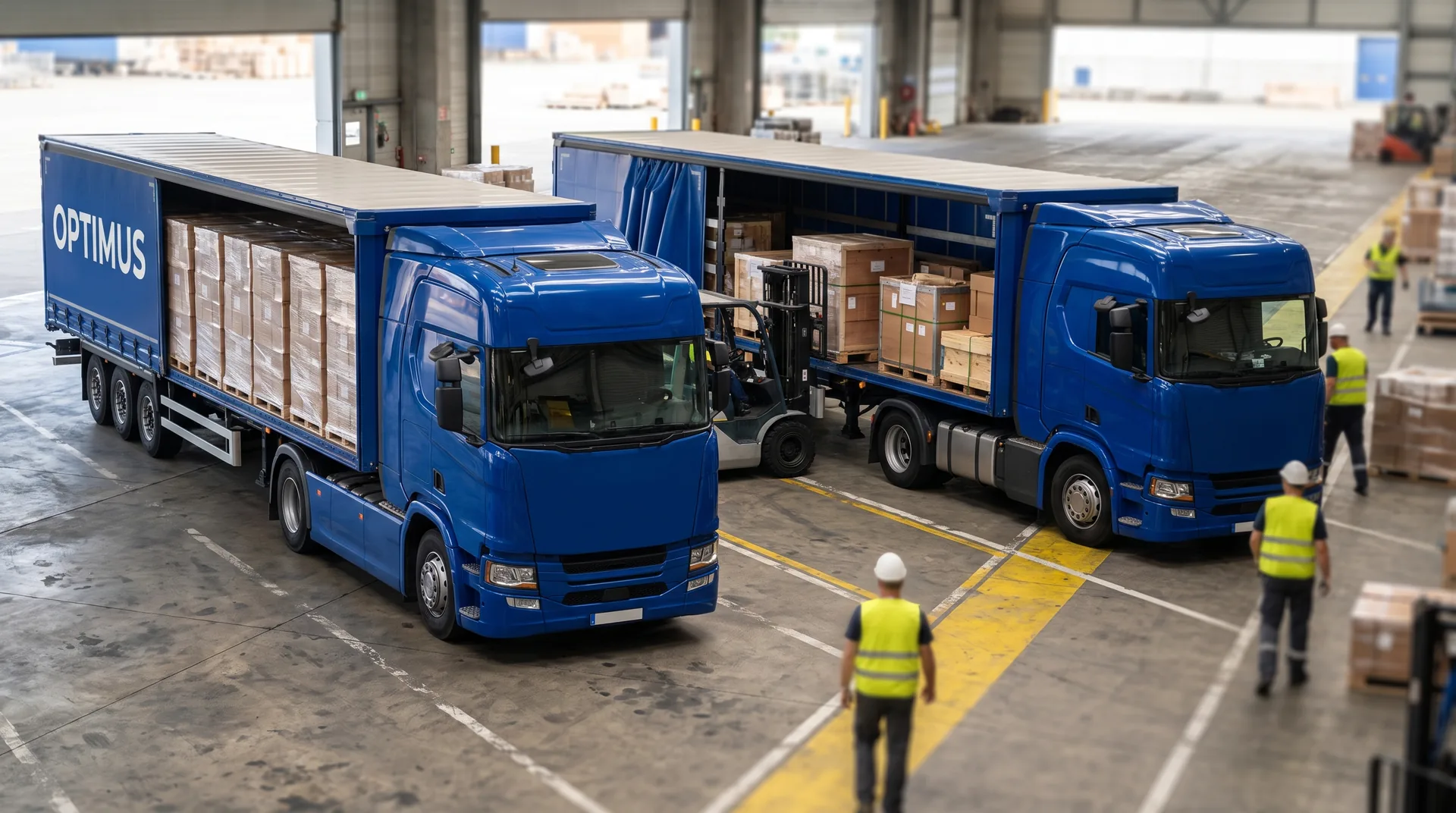
The cut-off is the last moment at which a shipment must be ready at the shipper, so that it joins the next groupage departure to the United Kingdom. It is not the departure time of the truck but a deadline counted back from it. The further the loading point sits from the Polish hub, the earlier the cut-off. We confirm the exact date at booking.
How does a cut-off differ from a delivery date?
The delivery date is when the goods stand at the ramp of the consignee in the United Kingdom. The cut-off sits at the opposite end of the same axis: it is the point from which we start counting everything that has to happen along the way. Clients most often confuse the two when they ask how soon we can deliver without saying when the goods will be packed. The answer is always the same: give us the readiness date and we will calculate the delivery. The reverse order leads to promises nobody can keep, because between readiness and departure from Poland there are several links, and each has a minimum length.
How do we count the cut-off back from the hub departure?
The groupage departure from Poland to the UK is the zero point. Counting backwards from it, we allow for:
- the feeder leg from the address of the shipper to our hub in Poland, including driving time rules on that route,
- receipt at the hub: unloading, checking against the booking, labelling the consignment,
- building the load: arranging cargo to match the sequence of drops in the UK, plus repacking and palletisation where they are needed,
- documents: the export declaration, data for the declarations on the British side, invoices and packing lists.
Each of these links can be shortened, none can be skipped. The cut-off is simply the sum of those times subtracted from the departure date, not a figure invented for the convenience of the forwarder. That is why it moves with the collection route and with whatever has to be done to the cargo at the hub.
Why is the cut-off for Czechia, Austria or Finland earlier than for Poland?
Because the feeder leg is longer, and collections from Czechia, Slovakia, Hungary, Austria, eastern Germany, Finland and Scandinavia usually involve planning pickups at several shippers in one run. A vehicle collecting abroad does not travel for a single pallet; it builds a route so that it returns to the hub complete. The further the loading point and the more addresses on the way, the earlier the shipment list has to close. We describe the mechanism for these countries in the article on consolidation from Czechia, Slovakia, Austria and Hungary, and separately for the most distant direction in the piece on consolidation from Finland via Poland.
What moves the cut-off even when the departure calendar does not change?
- Public holidays in the country of loading - the calendar in Czechia, Austria or Finland does not match the Polish one, and a warehouse closed on the collection day pushes the shipment to the next departure.
- Goods-in and goods-out windows at the shipper - a plant that releases cargo only in set hours narrows our room for manoeuvre across the whole collection route.
- Gaps in the paperwork - an incomplete packing list or missing declaration data stops a shipment just as effectively as goods that are not packed.
- Cargo needing handling at the hub - palletisation, repacking or rewrapping are jobs that must be finished before loading for the UK.
- Season - in the pre-Christmas peak space runs out faster, which we cover in the article on the pre-Christmas peak in transport to the UK.
What happens when the goods miss the cut-off?
Nothing dramatic, provided we hear about it early enough. The shipment moves to the next groupage departure and you receive a new delivery date before you promise anything to your consignee. The worse scenario is the one where the driver is already at the ramp and the goods are half packed: we then lose not only the space on the vehicle but also the time window at the remaining shippers on the route. If the deadline is fixed and there is no room to move it, the alternative is express transport or a dedicated vehicle running to its own rhythm, independent of the groupage calendar. A comparison of both is in the article express LTL or a dedicated van.
Why do we not publish fixed cut-off hours?
Because for most consignments that information would be untrue. The cut-off depends on the country and region of collection, on the number of loading points on the route, on whether the cargo needs handling at the hub, and on current vehicle occupancy. An hour published once would go stale within a week, and the client would plan production around a number nobody would confirm. Instead we do something simpler and more honest: at booking we give the departure date and the exact moment by which the goods must be ready at the stated address. That deadline binds both sides and goes into the order confirmation.
How to book a groupage shipment for the next departure
It goes fastest when the first message contains four things: the loading address and country, the readiness date, the number of pallets with dimensions and weights, and the delivery postcode in the UK. The rest - vehicle selection, pickup sequence, documents - is on our side. If you ship regularly, it pays to set a fixed booking rhythm: on repeat flows from one plant we can reserve space in advance, before the goods even leave the production line. We cover departure regularity in the article on groupage LTL to the UK with regular departures, and the model itself in groupage from one pallet.
One practical note at the end: the cut-off is not a barrier we set against the shipper but a tool that lets us promise dates we can keep. A carrier who takes cargo on the spot without asking about readiness usually makes up for it later with a delay the client learns about on the delivery day. We prefer to say early that a shipment joins the next departure rather than explain ourselves afterwards.
Planning a groupage shipment from Poland or Central Europe to the UK? Write through the quote form and we will come back with a departure date and a readiness deadline. The whole model is described on the consolidation via Poland page.