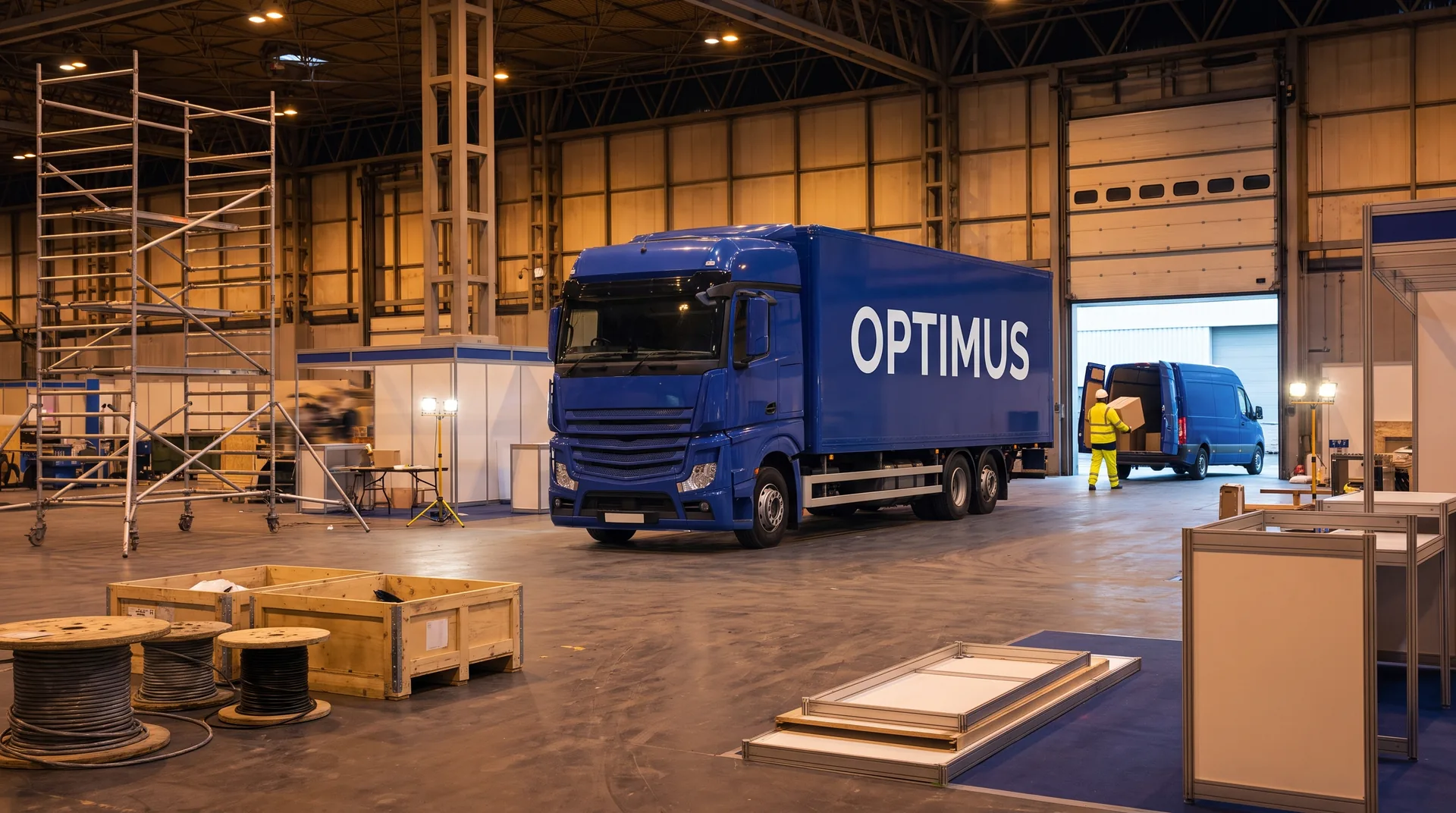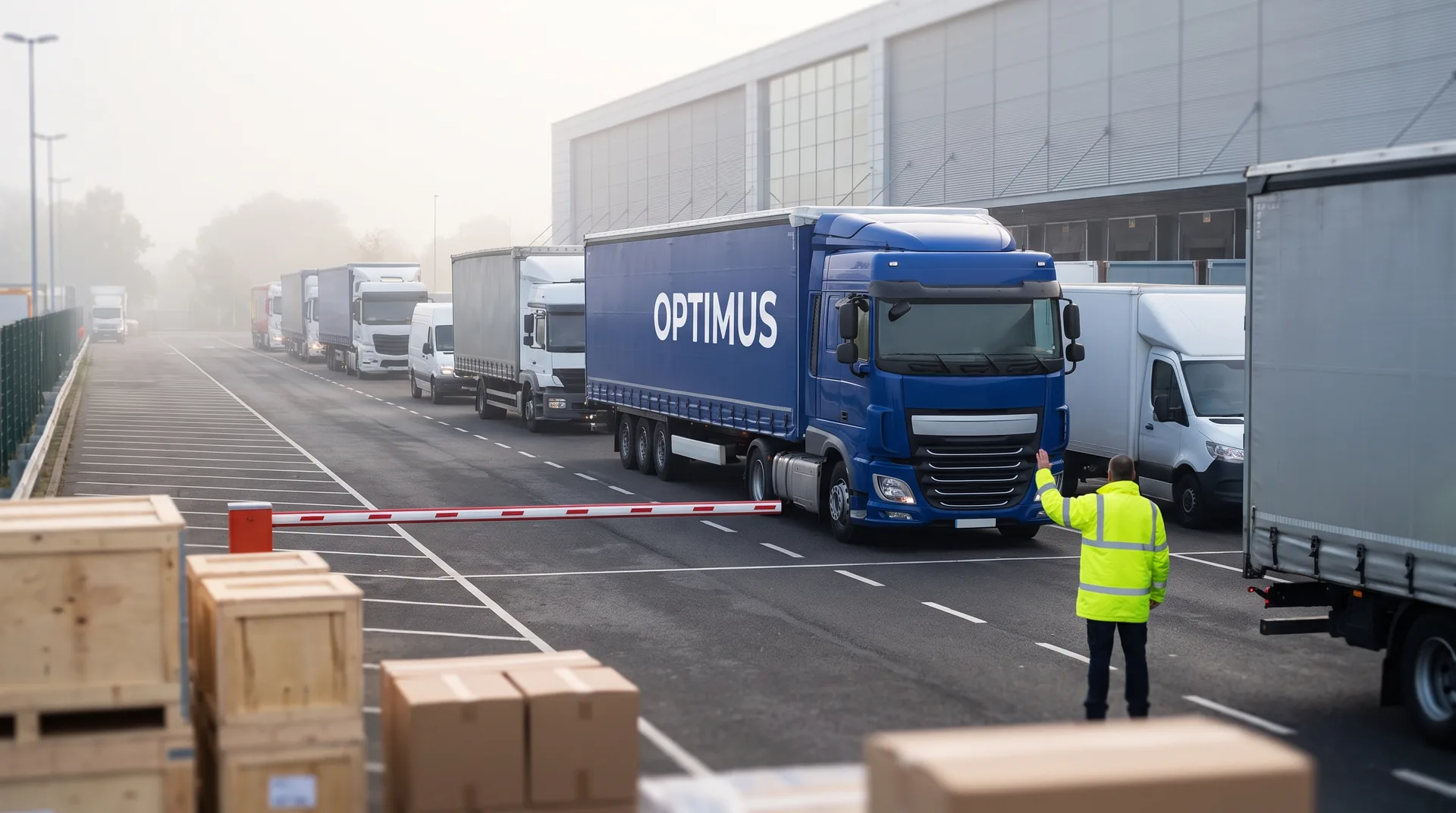
A marshalling yard is a designated area outside the venue where vehicles wait to be called forward. The venue admits only as many vehicles as it can unload at once, because internal routes and unloading points have finite capacity. That is why on a fair delivery we promise an arrival time at the gate rather than an unloading time: the first depends on us, the second on the queue.
Why the venue does not admit everyone at once
A hall has a fixed number of gates, docks and places where a vehicle can safely stand while it is unloaded. At the peak of build-up there are many times more candidates. If everyone drove in, the internal routes would block within minutes and the forklifts would lose their run. The marshalling yard is a valve: it meters the flow so there is always working room inside.
The second reason is procedural. Entry to an event site requires document checks, a vehicle pass and often confirmation that the destination stand is ready to take the load. That check happens in the yard rather than at the gate, so traffic is not held up.
How the yard works, step by step
The driver reaches the yard address, which can be several kilometres from the hall and carry a different postcode from the venue itself. He books in at the control point, quotes the stand number, exhibitor name and vehicle booking reference. He is given a card or queue number and a place to park. Then he waits. The call comes when an unloading point suitable for his vehicle frees up. After the call he normally has a few minutes to reach the gate, because the space is already reserved for him.
Waiting time is neither fixed nor published in advance. It depends on the day of build-up, on how many large builds are entering in parallel, and on whether earlier unloads have overrun. The same venue can turn a vehicle around immediately on the second day of build-up and hold it for many hours on the eve of opening.
What that means for the carrier's promise
A carrier is answerable for having the vehicle in the right place at the right time with complete paperwork. It is not answerable for the order in which the venue calls vehicles forward, because it does not set that order. So our orders state an arrival time, not a time when unloading will finish. Anyone promising the latter at a fairground during peak build-up is promising something outside their control. The division of roles is set out in who is responsible for what at a trade fair.
The cost of waiting and where it comes from
A driver's time is capped by drivers' hours rules and cannot be stretched by an exhibitor's decision. Hours spent in the yard consume the daily driving allowance, so a long wait can shift the vehicle's entire onward plan, including the return. On a dedicated movement that means demurrage settled under the contract; on groupage it usually means later deliveries move. This is a real component of the cost of a fair delivery and it is better discussed before the event than after it. We break down pricing in the cost of exhibition transport to the UK.
City venues and open showgrounds behave differently
A venue in dense urban fabric usually has no yard next to it. The buffer sits some distance away, the approach runs through streets with lorry restrictions, and entry windows are partly set so the city is not blocked. Low emission zones add another layer that has to be checked before leaving Poland, not at the gate.
An open showground, typical of agricultural, industrial and outdoor events, usually has its own yard on site and more room to manoeuvre, but the ground may be unsurfaced. After rain the same yard that takes a trailer easily in summer can bog it down. We show these approach differences on real routes in trade fairs in Scotland.
How to shorten the wait
Three things genuinely work. First, entering off peak, in the middle days of build-up rather than the eve of opening. Second, a smaller vehicle where the load allows it, because smaller vehicles are often processed faster and have more unloading points available. Third, a storage buffer near the venue, from which goods are delivered exactly when the stand is ready to take them. We describe that last option in the buffer warehouse next to Targi Kielce, and on the British side the role is played by our Milton Keynes warehouse.
What cannot be fixed on the spot
A driver sitting in the yard will not speed up the queue by calling the carrier, because the decision is not the carrier's. Driving in without being called does not help either: the vehicle is turned back and rejoins the end of the queue. The only effective route runs through the organiser or the venue's own team, and only in exceptional cases, for instance a load that needs power. We describe vehicle booking rules in vehicle booking and site passes.
Sources
Planning a delivery at peak build-up? Send the venue, stand number and time windows through the quotation form and we will propose an arrival time, plus a buffered option if the queue is a predictable problem. The full scope is on our exhibition logistics page.