A mobile crane is a borderline item, and this article describes that border rather than promising to carry any crane at all. Anything larger than compact does not travel as cargo: it moves under its own wheels, on permits and in convoy, while counterweights and the boom equipment travel on separate movements. Which side of the line your machine falls on is decided by gross mass, axle loads and height, not by the lifting capacity on the nameplate.
Where carriage as cargo actually ends
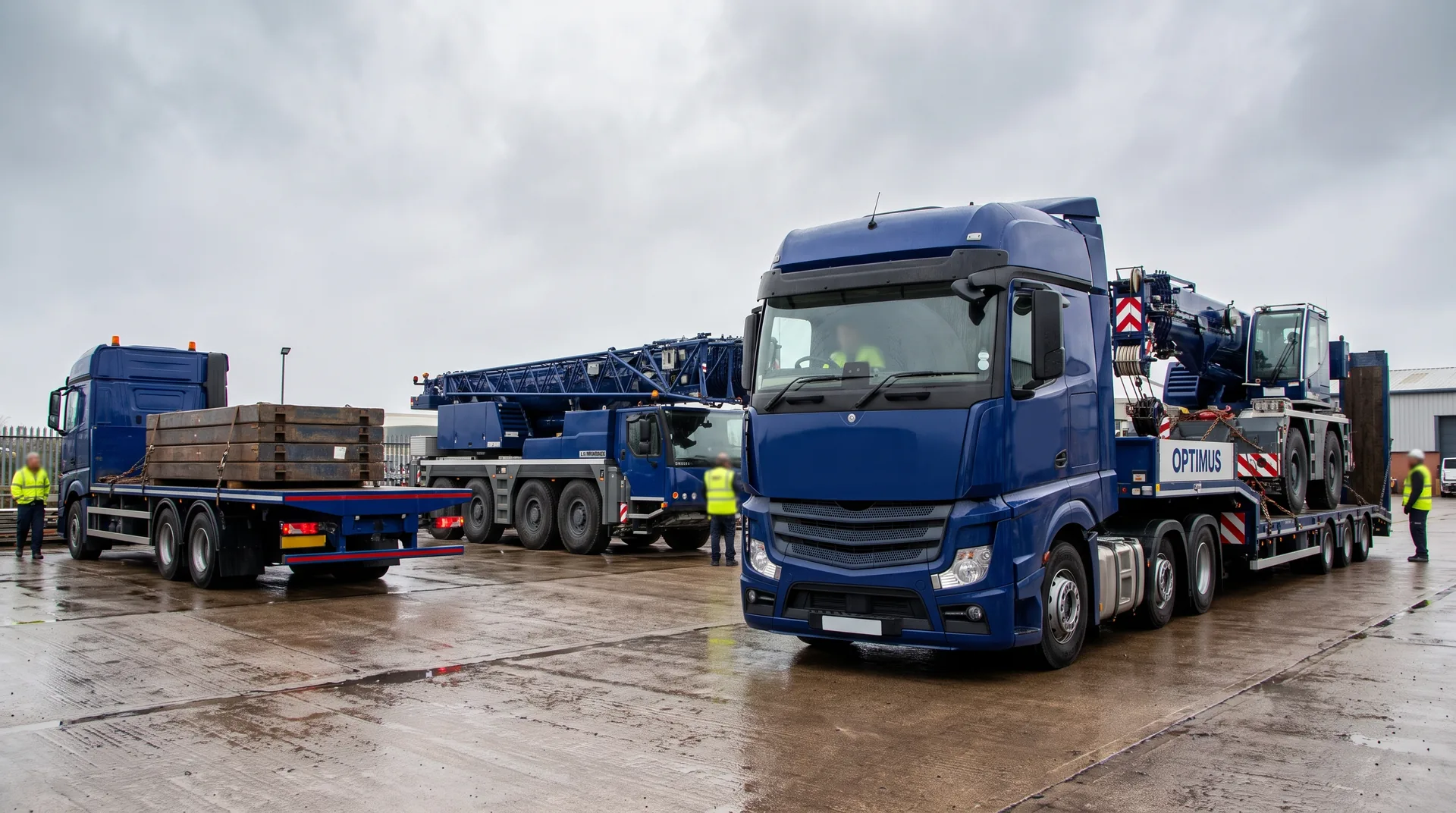
The rule is simple and inconvenient. A machine becomes cargo when, together with the trailer and the tractor unit, it fits within what can be taken along a route on sensible terms. A construction-class wheeled crane weighs enough on its own that, once placed on a trailer, the outfit no longer fits any reasonable arrangement. That is why such machines do not travel on a low loader but on their own chassis, with counterweights carried separately and boom equipment carried separately again.
For a buyer this means one thing: before bidding you need to know whether the machine can be moved at all within a sensible budget. Buying a machine whose haulage exceeds its purchase price happens in this category more often than in any other.
What genuinely fits on a trailer
Several groups of equipment we do carry as ordinary, if heavy, cargo. Each one is assessed individually, because a trade name says very little about the actual figures for a given example.
- Compact cranes and wheeled mini cranes, designed to work in confined spaces.
- Truck-mounted cranes built on small lorry chassis, provided the bodywork does not lift the whole thing beyond a sensible height.
- Tracked mini cranes, commonly known as spider cranes, with folding outriggers and a retractable boom.
- Loader cranes removed from a vehicle, carried as a separate assembly together with the base and the stabilisers.
Anything above that shelf we treat as a matter for individual agreement, and very often as work we will decline. That is not coyness but an honest statement of position. The rules for loads exceeding normal dimensions are covered in the article on oversized transport to the United Kingdom, and plant of a broadly similar character is discussed in the article on excavators and loaders from British auctions.
Mass and axle loads decide, not nameplate capacity
The commonest misunderstanding in this category concerns which figure to read. Lifting capacity describes what the machine will raise at a stated radius and is a working parameter. For haulage it serves no purpose. What counts is the kerb weight of the machine ready to travel, how that mass distributes across the axles of the outfit once loaded, the overall height measured from the trailer floor, and the width in transport configuration once outriggers and mirrors are folded in.
That is why a quotation starts from the nameplate and the documentation rather than from a model name. Where to find those details and how to read them is explained in the article on serial numbers and nameplates. If the plate is illegible or missing, the quotation becomes indicative, and an indicative quotation in this category is worth very little.
Counterweights and boom as separate cargo
With machines carrying removable ballast the job splits into several consignments. Counterweight blocks come off the machine to bring the mass down and then travel separately, because they are heavy, compact and convenient to stow low. They are always separate cargo and a separate line in the quotation, never an extra thrown in with the machine. The same applies to boom equipment, extensions, hook and block, where those exist at all.
We do not carry out the dismantling or the later reassembly. That is done by the yard staff or by a firm appointed by the buyer, and we collect components already prepared for loading. Arrange it in good time, because collection deadlines tend to be firm, as the article on collection deadlines and storage charges explains.
On the machine itself you lock down everything that moves. The boom folded and supported, telescopic sections retracted and secured, the slew ring mechanically locked so the superstructure cannot turn on a bend, outriggers stowed and pinned, spreader plates removed and lashed separately.
Permits and planning the date backwards
A load that exceeds normal dimensions needs a permit on each side of the route, and it is the road authority that issues it, not the haulier. That sentence has a practical consequence easily forgotten at auction: the dates are set by an office, not by transport. The collection date is planned backwards from the moment the permits will be ready, not the other way round.
Then there is the route itself. A permit covers a specific run, so structures, bridges and local restrictions may force a diversion that lengthens the journey and changes the arithmetic. An escort vehicle is sometimes required. All of that is settled before collection, not on the day the machine is due to leave the yard.
What to check before bidding, and what we do not do
Before you raise your hand, gather the facts that decide feasibility: kerb weight from the plate, height and width once folded, whether the ballast is removable, the condition of the outriggers, and whether the machine drives and steers on the yard at all. Without those a quotation is guesswork. What exactly to send with an enquiry is listed in the article on quoting transport before a UK auction.
And finally the limits on our side. We do not organise a crane travelling under its own wheels with a driver, because that is a different service under different authorisations. We do not issue opinions on a machine's mechanical condition or its value. We do not carry out repairs, servicing or acceptance testing. We carry what can be carried as cargo, we handle customs entries in cooperation with our regular customs agencies, and we say plainly when a machine falls outside that definition.
Sources
- GDDKiA: rules for abnormal load movements in Poland
- GOV.UK: carrying out international road haulage
- GOV.UK: securing loads on HGVs and goods vehicles
Got a particular lot in mind? Send a photograph of the nameplate and the folded dimensions through the transport quotation form and we will tell you honestly whether we can move that machine as cargo. Entry matters are described on the customs clearance page, and the harder cases are best talked through with the operations team.