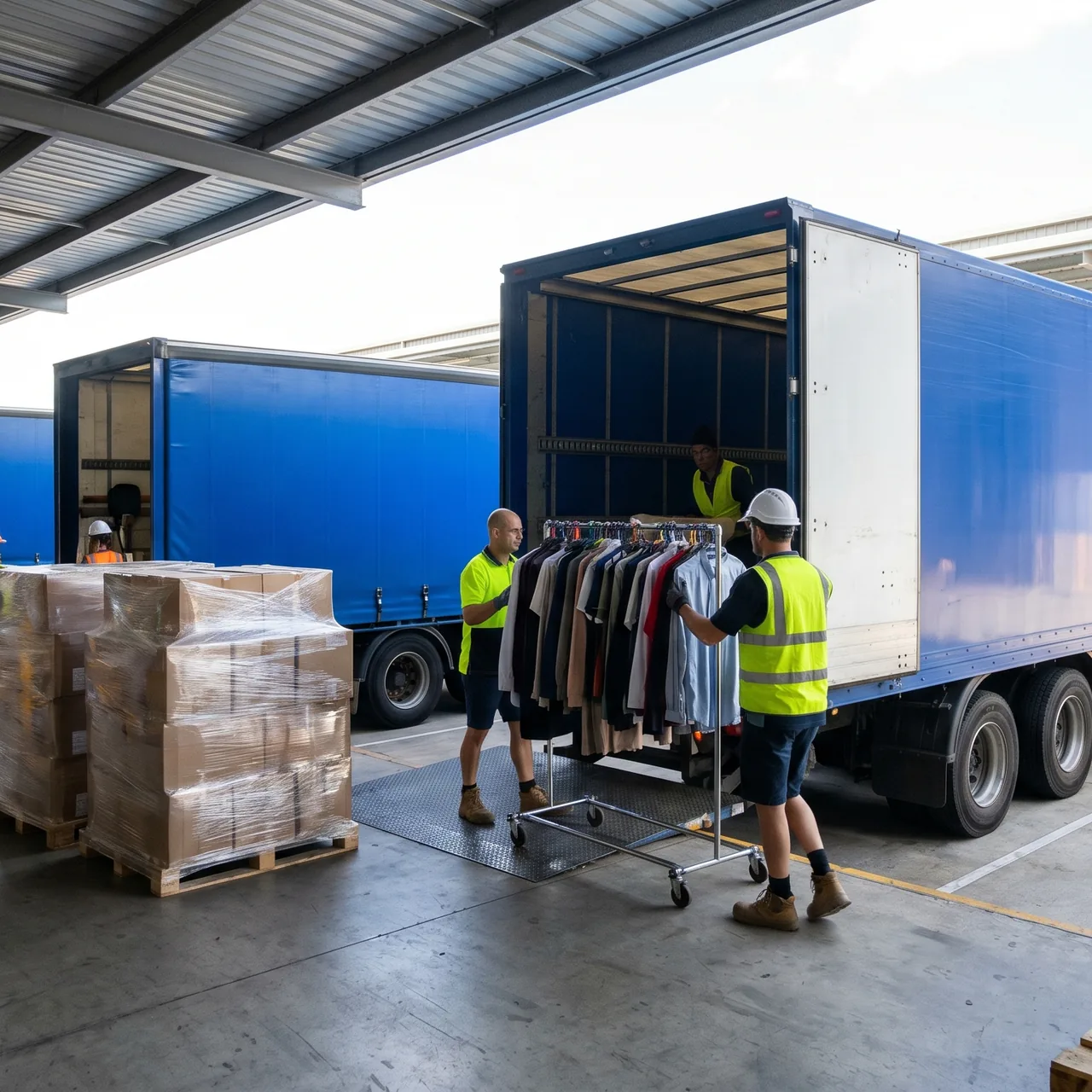
We move clothing and textiles to the United Kingdom in cartons on pallets and on hanging rails in a trailer fitted with beams. The main risks are not on the road but in the paperwork: the goods description on the safety declaration has to be specific, and tariff codes differ between knitted and woven garments. On top of that come the receiver labelling requirements.
Why the goods description governs how smoothly a load runs
On the safety declaration and the customs entry the description has to allow the goods to be identified. The word "clothing" or "textiles" is not enough: risk analysis systems treat such entries as inadequate and raise a query, and every query costs time. A correct description names the item and the material, for example knitted cotton t-shirts or woven polyester blend trousers. We have collected the wordings to avoid in unacceptable goods descriptions in an ENS.
Hanging garments or cartons
Hanging garments travel in a trailer fitted with beams and rails, in protective covers. The advantage is that nothing needs pressing and the stock is shop-ready on arrival. The drawback is poorer use of space and greater sensitivity to damp and to how well the rails are secured. Cartons on pallets are cheaper to move and easier to consolidate with other freight, but need steaming at the far end. The choice depends on whether the goods go to a shop floor or a warehouse, and it is worth settling before despatch rather than after.
Damp, odour and what travels alongside
Textiles absorb moisture and smells, so when consolidating we watch what sits next to them. Clothing does not travel beside strongly scented goods or beside loads that could leak. On winter runs condensation matters too: stock moved from a warm warehouse into a cold trailer and back can pick up damp inside the outer packaging. We cover the neighbouring-cargo question in odour contamination and cargo compatibility.
Duty, origin and the reality of the apparel trade
Apparel is rarely produced solely within the EU. If goods leave Poland but were manufactured outside the Union, they do not qualify for preference in trade with the United Kingdom, even when the shipment departs from a warehouse in Lodz. Origin is not the same as place of despatch, as we explain in rules of origin under the TCA. Without proof of origin the importer pays the duty rate, so this is settled before the first shipment rather than after the first invoice.
Labelling and receiver requirements
Clothing sold in the United Kingdom needs legible fibre composition and care labelling, and retailers add their own requirements for logistics labels, barcodes and packing. Deliveries into retail carry a separate layer of carton and pallet labelling, which we describe in GS1 and SSCC labelling. Where stock arrives incompletely labelled we relabel at pallet and outer-carton level at our own warehouse in Milton Keynes rather than sending pallets back to Poland.
How we carry it
Single pallets and smaller batches travel as groupage on our regular departures to the islands; full collections and seasonal deliveries go on a dedicated vehicle. Customs on both sides is handled within the job. With e-commerce there is also the returns question, which can cost more than the outbound leg and which we cover in reverse logistics in the UK. The wider category view is on our clothing and consumer goods page.
Seasonality: when the lane to the islands gets tight
Apparel runs on collections, which means several clear peaks a year: deliveries ahead of the autumn and winter season, top-ups before the Christmas period and the spring changeover. In those windows it is not only receiver warehouses that are stretched but also the Channel crossings and intake slots at distribution centres. The practical conclusion is simple: for a collection with a hard on-sale date the transport is booked early rather than in the week of despatch, with a buffer for a check or a cancelled sailing. On retail deliveries it is also worth confirming early that an intake window is available, because in peak season the next one can be far off. Booking in the busy period is covered in the pre-Christmas peak, and intake windows in delivering into a retail distribution centre.
Sources
- GOV.UK: UK integrated online tariff, chapters 61 and 62
- GOV.UK: rules of origin and tariff preference
Shipping clothing or textiles to the islands? Tell us the packing method, pallet count or hanging metres and the timing in our quote form and we will match the vehicle and prepare the paperwork.