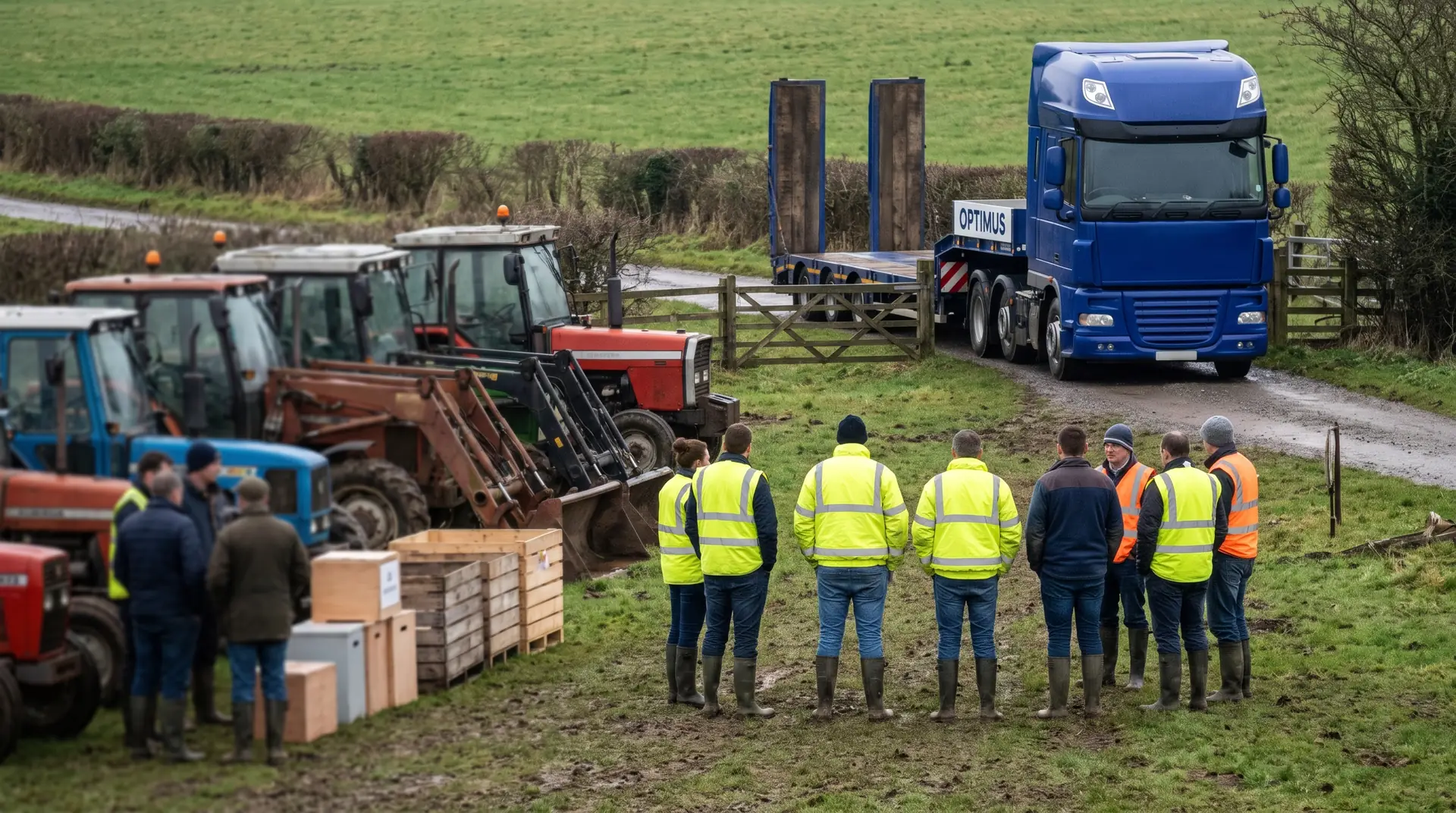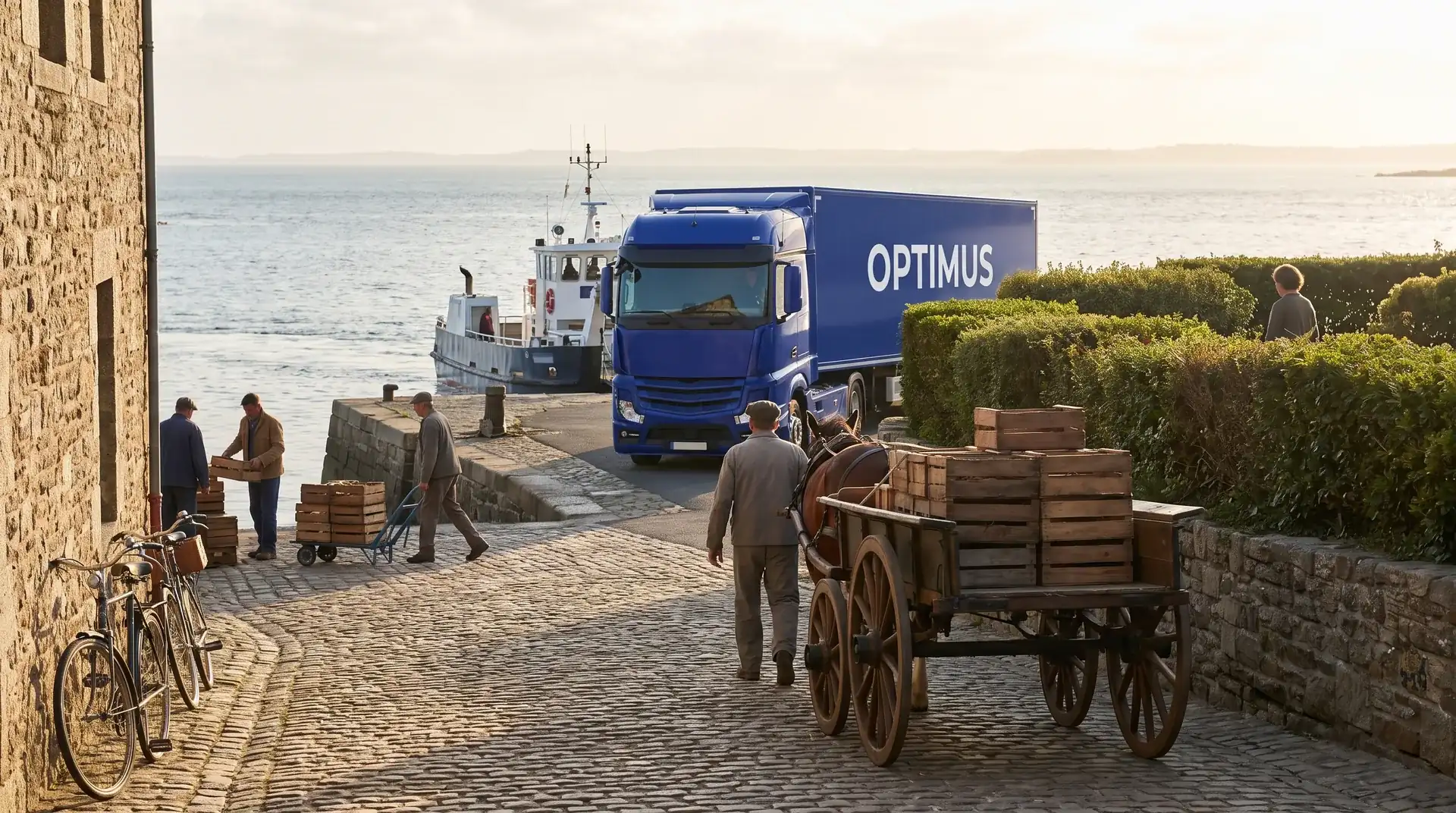
Sark belongs to the Bailiwick of Guernsey and shares its customs status: inside the customs union with the United Kingdom, outside the UK VAT area. The island is one of the few places in the world where motor traffic is banned — tractors and horse-drawn vehicles use the roads, and they are what moves goods from the harbour to the door.
Can a delivery van drive onto Sark?
No. The island does not permit motor traffic as a matter of course; land transport relies on tractors and horse-drawn vehicles, and moving luggage and supplies from the harbour is handled by local tractor haulage. For a carrier from the continent the consequence is unambiguous: a truck from Poland will not reach a Sark address under any variant. We hand the cargo over earlier and plan the handover as a separate, documented stage of the job.
How do goods reach the address?
The chain looks like this: the road leg from Poland to the United Kingdom, sea carriage to Guernsey, then the connection to Sark; on the island side collection from the harbour and delivery to the address is done by local tractor haulage. Each link has its own time window and its own limits, and the more links there are, the more the documentation matters. So for Sark we are especially strict about piece marking and handover confirmations — that is the only way to establish afterwards where and when the cargo changed hands.
What is the weight limit for a single piece?
We do not quote a figure, because it depends on the vessel working the connection and on local haulage capability — it has to be settled on the specific job. We do state the design rule: assume handling without a forklift and break the cargo into pieces that two people can carry or simple equipment can lift. Heavy, monolithic items are the biggest problem here, because they cannot be broken down at the stage where the problem surfaces. How limits are established is described in our text on size and weight limits on island ferries.
Is a EUR pallet suitable for a Sark delivery?
As a carrier for the road and sea legs, yes. As the form in which goods arrive at the consignee's door, generally no. In practice the pallet will be broken down before the final leg and the goods will arrive in smaller units. That produces concrete requirements: cartons and pieces must be labelled individually, not just collectively on the film; packaging must survive being carried; the packing list must allow completeness to be checked without unpacking everything. Details are in our texts on preparing a pallet for the islands and securing a pallet for export.
Does Sark share Guernsey's customs status?
Sark is part of the Bailiwick of Guernsey and falls under its customs regime — the bailiwick remains in a customs union with the UK, Jersey and the Isle of Man, and goods from outside that union require an import declaration. Being outside the UK VAT area means a shipment from GB is not a domestic supply for tax purposes. We settle the tax treatment with a customs agent before dispatch, because it determines how the goods are invoiced. The context of the two main islands is covered in our texts on transport to Guernsey and on transport to Alderney.
What we carry to Sark
Supplies for shops and restaurants, fit-out for accommodation, building materials in batches matched to handling capacity, equipment, furniture and household goods. The characteristic feature is that consignment size is governed by the capability of the last leg rather than by the consignee's needs — so large orders are split into batches and spread over time. When planning a refurbishment or a re-equipping project it pays to set out a delivery schedule in advance rather than shipping everything at once.
Timing and cost
The date is built by connection availability, not by distance. The cost combines the road leg, sea carriage and local delivery on the island — we show those separately, because only then is it clear where the cost actually arises. The logic is described in our text on the crossing cost in the quote, and how we plan margin in our article on the time buffer for island deliveries.
Sources
- Isle of Sark: getting around the island (no motor traffic)
- States of Guernsey: moving goods and the bailiwick customs union
Have goods for a consignee on Sark? Describe the consignment in the quote form and we will break the delivery into stages together with single-piece limits. Our other islands are on the island transport page.