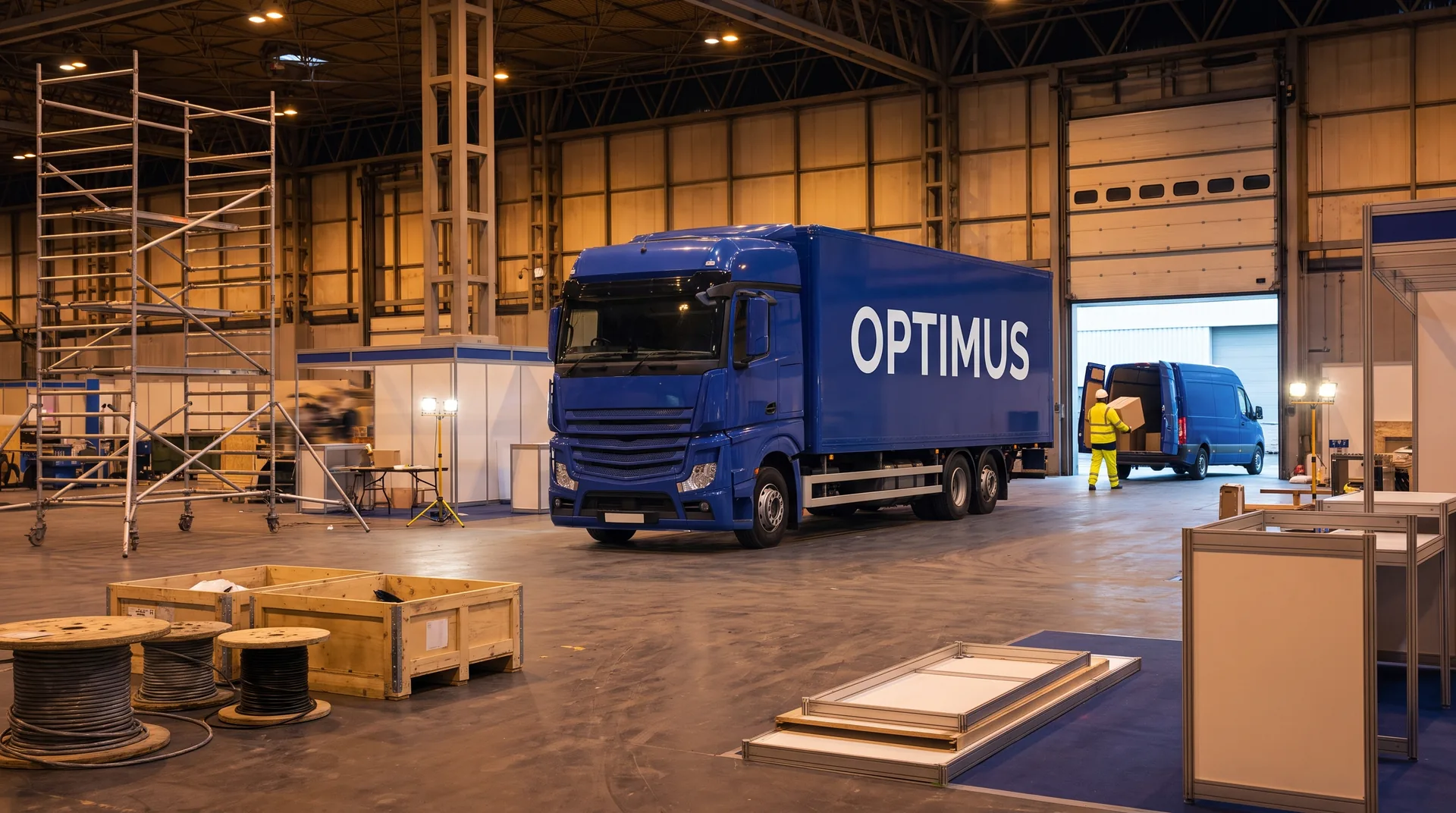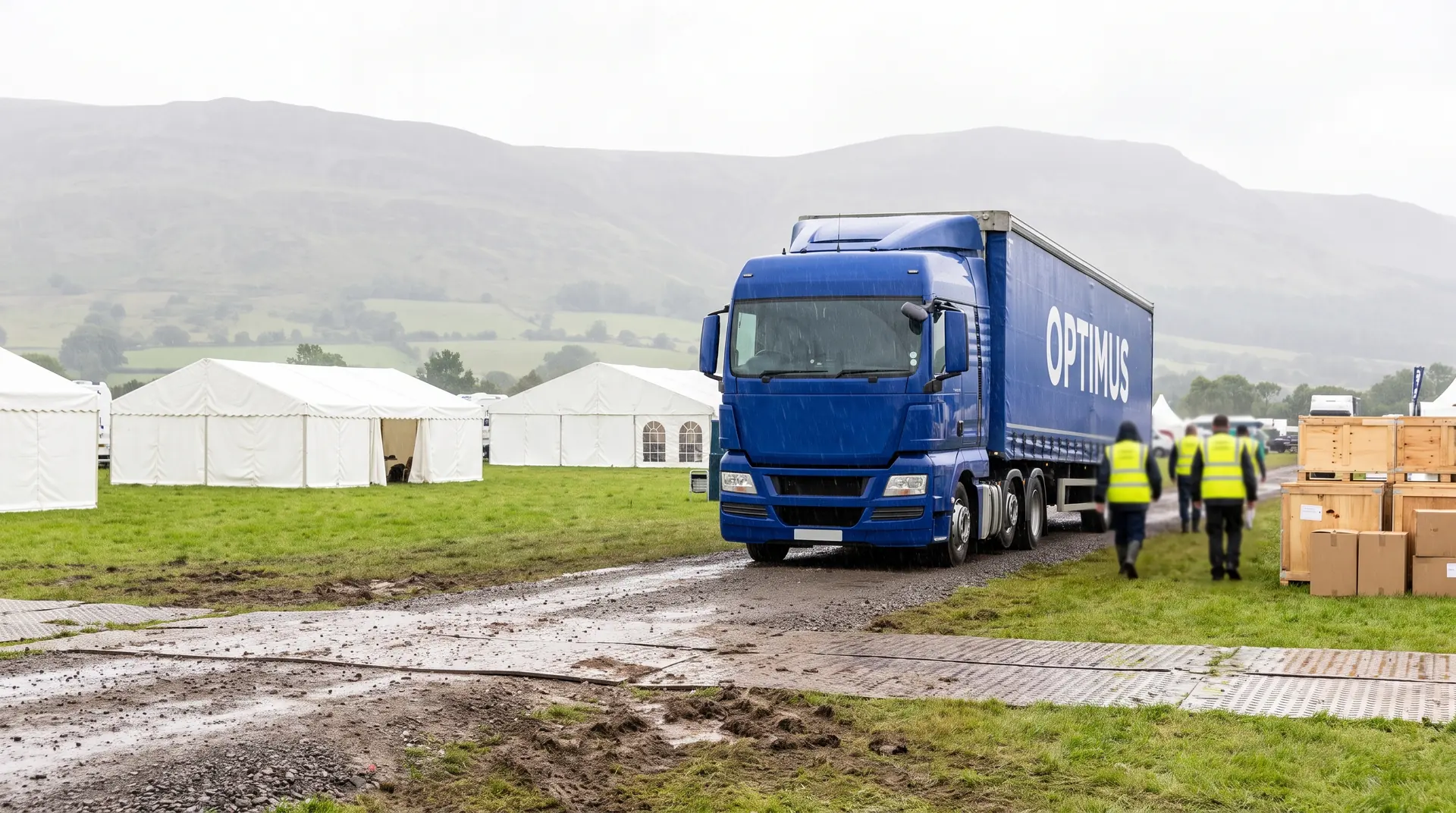
The Three Counties Showground sits near Malvern in Worcestershire, about ten miles from the M5 and M50, so the final leg runs on lower-category roads. The venue has a separate exhibitor gate, marked as the Yellow Gate, and its outdoor area is largely grassed, with adjacent hard surfaces described for only some of the halls. We carry stands and exhibits here from Poland, assemble them in Kielce before departure and collect them after breakdown.
The motorway ends a long way before the gate
The venue itself states that it lies roughly ten miles from the M5 and M50. From the north you leave the M5 at junction 7 and head for Malvern. From the south you leave the M5 at junction 8 onto the M50 and then immediately at its first junction towards the A38 and Malvern. From there brown tourist signs take over, joined on event days by yellow directional signage.
The venue also gives an instruction worth taking literally: navigate by postcode, not by venue name. On a large rural site a name search can put a driver at a different entrance from the one he is meant to use, and the entrances are some distance apart. The venue also warns that during its largest show the A449 near British Camp can be closed, with traffic routed by signed diversions. This is exactly the sort of information you will not find on a map and have to take from the organiser materials before departure.
What makes an agricultural ground different from an exhibition hall
The venue has four exhibition halls totalling over ten thousand square metres, but the way it describes them shows they are not equivalent for unloading.
- Wye Hall is the largest and the venue describes it as separated into four bays of varying levels. A change of level inside a single hall alters how a load is brought onto a stand, and it is the first thing we ask about with a heavy exhibit.
- Kildare Hall has close to two thousand square metres and, importantly for a carrier, a dedicated hard-standing area directly beside the hall.
- Avon Hall is open plan, with an adjacent tarmac area of markedly greater size, and can be joined to Kildare by marquee.
- Severn Hall offers around two thousand square metres in an open-plan layout.
Beyond the halls the venue has land measured in hundreds of acres, described as predominantly grassed. That is the heart of the difference from urban venues: there you ask about door height, here you ask whether the pitch is grass or hard standing and what happens after two days of rain. A heavy exhibit standing on grass needs a different approach plan and different equipment, which we cover in the article on unloading an oversized exhibit. The same questions arise with construction plant, described in the piece on machinery transport to UK sites.
Restrictions worth knowing
No charging clean air zone applies in the Malvern area. The British list of charging zones covers Bath, Birmingham, Bradford, Bristol, Portsmouth, Sheffield and Tyneside. The national register of air quality management areas holds no entry for the Malvern Hills district, and such an area would in any case impose no charge and no ban on lorries, only a duty on the local authority to act. The real constraint here is therefore not a zone but the geometry of the approach and the ground surface. We gather the zone rules in the article on UK clean air zones.
What to settle before arrival
To the show organiser: hall name or outdoor pitch number, the designated entry gate, how vehicles are booked in and passes collected, the ground surface under the pitch, who supplies the forklift and where the vehicle goes after unloading. To the venue: the navigation postcode and any diversions on event days. We do not quote hours or dates, because the organiser sets them separately for each edition and they change from year to year. The method for scheduling backwards is in the article on the build-up and breakdown calendar, and the split of roles in the piece on responsibilities at a trade fair.
What we do at our end
We collect stands and exhibits in Poland, and from exhibitors in Czechia, Slovakia, Austria and Hungary we gather the load through our hub. The Kielce base sits about 4 km from the fairground, a few minutes away, works around the clock and serves to assemble a stand into one consignment before departure. A groupage vehicle waits for the next scheduled line departure. On the British side the load usually passes through a cross-dock at our warehouse in Milton Keynes, which gives two transhipments across the route. On site we deliver to the handover point and the venue equipment takes over. We commit to an hour at the gate rather than an hour of unloading.
Groupage or a dedicated vehicle
The threshold runs at roughly a third of a trailer, about twelve pallets. At Malvern a ground-related argument is added. If the pitch is outdoors and on grass, a dedicated vehicle lets you match the truck to the approach and arrive in one load rather than splitting the delivery into several smaller ones. For an indoor stand of panels and printed material, groupage is usually enough. We break down the components of that decision in the article on choosing between FTL and groupage.
Sources
- Three Counties Showground: exhibition halls, directions and gates
- GOV.UK: list of British charging clean air zones
Exhibiting at Malvern? Send the hall name or pitch number and the item list through the quotation form and we will match the vehicle to the gate and to the ground. See also the exhibition logistics page.