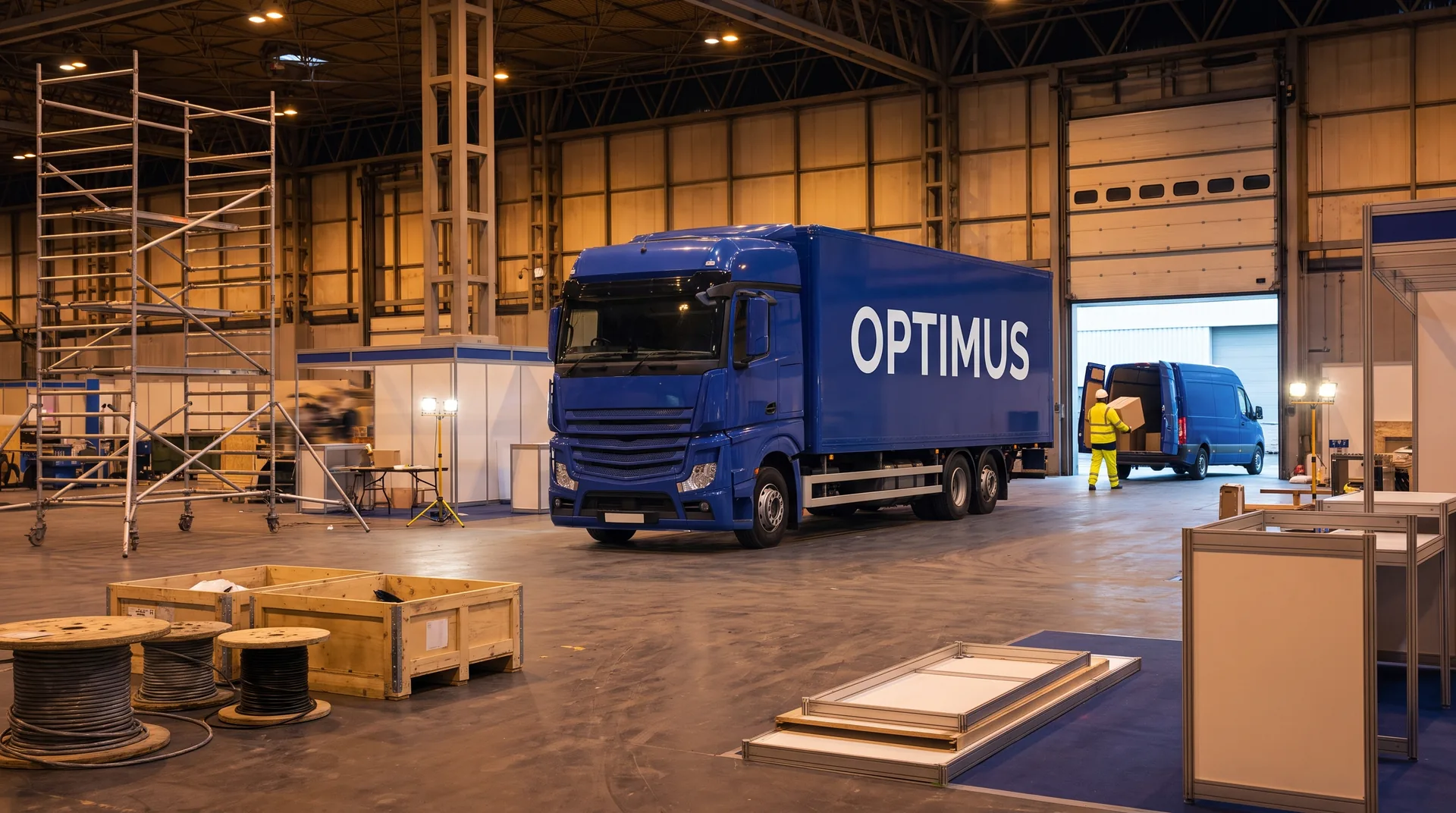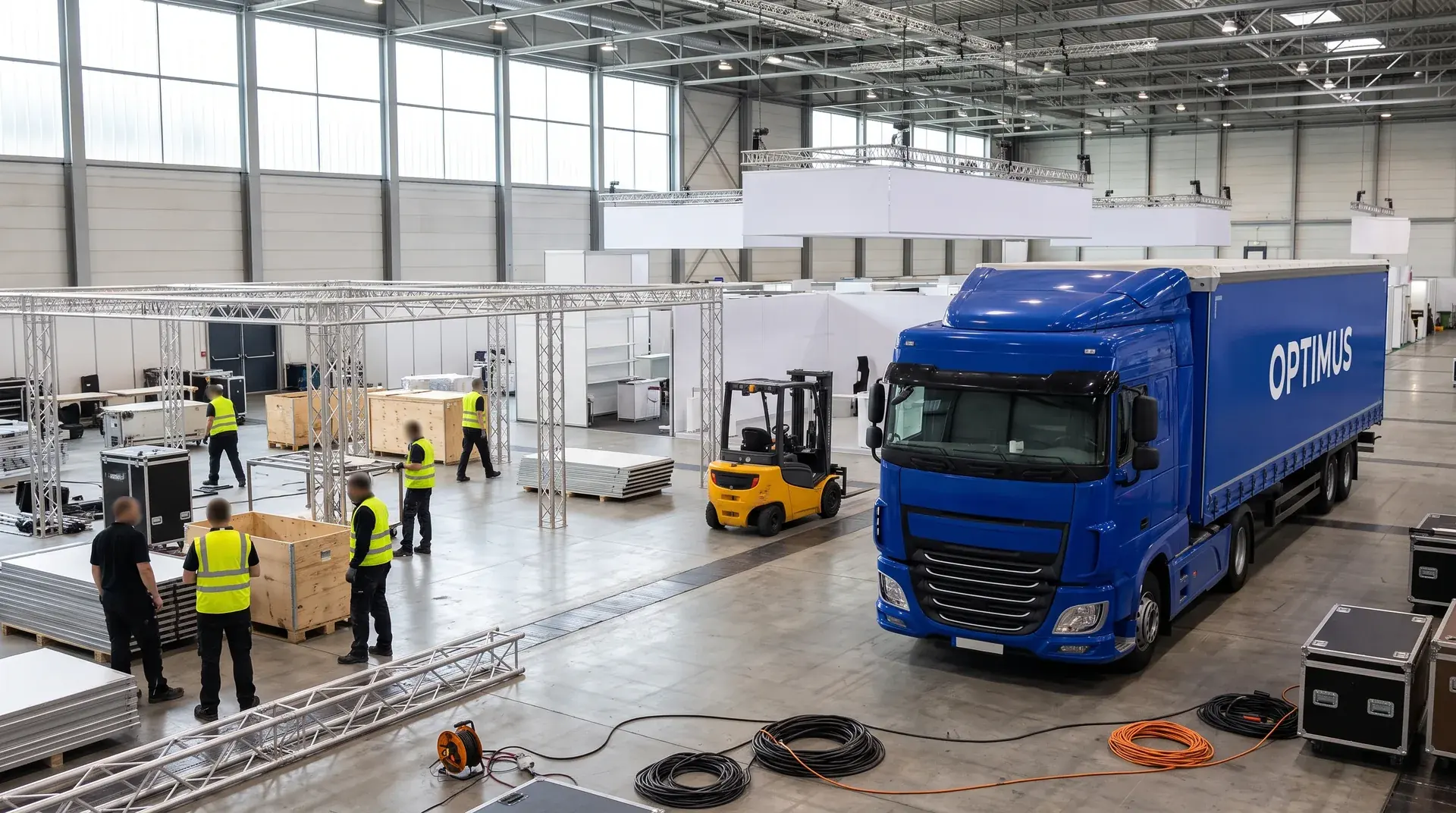
Fair transport is planned backwards from the first hour of the build-up window, not from the opening day. From that point you subtract travel, loading, stand production and formalities, and then add slack. Anyone counting forward from the day they decided to exhibit almost always finds they are already late.
Why count backwards rather than forwards
Because only one point in the whole schedule is non-negotiable: the hour by which the load must stand on the stand. Everything else is a variable that can be shortened or stretched. Counting forwards creates an illusion of slack, because each stage looks feasible on its own; counting backwards shows which week the stand has to be ordered in for any of it to work.
The method is simple. Write down the site entry hour. Subtract travel time from the loading point, increased by a margin. Subtract loading and load preparation. Subtract the time needed to finish and pack the stand. Subtract formalities: booking, passes and, on runs outside the EU, customs paperwork. What remains is the date by which decisions must be made.
The stages that most often do not fit
The first is stand production and a trial build. A stand assembled for the first time in an exhibition hall is the worst possible moment to discover a missing part. The second is completing the load: exhibits, printed matter and equipment are rarely ready on the same day, and the vehicle leaves when the set is complete. The third is entry formalities, meaning declaring the vehicle and driver and collecting passes; we cover them in the article on vehicle booking and site passes at Targi Kielce.
The fourth, for heavy or abnormal loads, is the movement permit. Processing times are published by the Polish roads authority and for higher categories they run into weeks, not days. That is the stage capable of upending the whole schedule if discovered too late; details in the article on road machinery transport.
How much slack to leave
There is no single number and we will not invent one, because it depends on route, cargo and season. There are three rules that always hold. Slack must be larger where there are fewer fallbacks: greater for one unique exhibit than for a pallet of materials that can be reprinted. Slack grows with route length and the number of transhipments. And slack must be larger in winter, because weather adds variance, as covered in the article on winter fairs and frost-sensitive freight.
A practical way to buy slack without stretching production is a buffer close to the venue: the load leaves early, waits minutes from the fairground and enters on time. We describe it in the article on the buffer warehouse next to Targi Kielce.
What happens when a vehicle misses its window
The answer depends on the show, but in most cases it means agreeing an out-of-window entry with the organiser, where that is permitted at all, or unloading off site and moving the freight in with equipment available there. It also happens that once build-up closes and the show opens to visitors, vehicle entry is not possible at all. So rather than counting on an exception, you plan with margin. Who decides in that situation is covered in the article on responsibilities at a trade fair.
Breakdown is planned together with build-up
The most common mistake is ordering transport one way. The breakdown window is short and every exhibitor is looking for a vehicle at the same moment, so the return is booked together with the delivery. If the set is not coming straight back, storage until the next show is the alternative; we set out the options and their cost components in the article on what to do with a stand after breakdown, and a season covering several shows in the piece on one stand, several shows. With one stand kit serving several shows the timeline is built from breakdown and build-up dates rather than opening dates; we set it out in schedule, buffer and clashing dates for one stand kit.
Transport from the UK: extra stages
A load coming from Britain to Kielce adds three items absent from domestic movements: the Channel crossing with its own rhythm, clearance on both sides and, for exhibits that will return, a temporary admission document. Each carries its own variance, so slack on such a route is markedly larger than on a run from within Poland. The documentary path is covered in the article on a UK exhibit at Targi Kielce, and general trip preparation in the piece on UK trade fairs for Polish exhibitors.
Who confirms the dates
Build-up and breakdown windows are set by the show organiser and published in the regulations and exhibitor materials. The venue operator sets the rules for entering the site. The carrier sets neither, but has to know both in order to plan the run. So at enquiry stage we ask for those two facts directly rather than hunting for them: they differ between shows and change from edition to edition.
When the schedule does fall apart and a part has to arrive during build-up, separate rules apply. We set them out in our article on emergency delivery to a stand.
Sources
- Targi Kielce: site entry regulations (PDF, Polish)
- GDDKiA: abnormal load permits, categories and deadlines
Got a show date and want to check whether the schedule closes? Send the build-up and breakdown windows through the quotation form and we will count backwards with you. See also the exhibition logistics page and the United Kingdom direction.