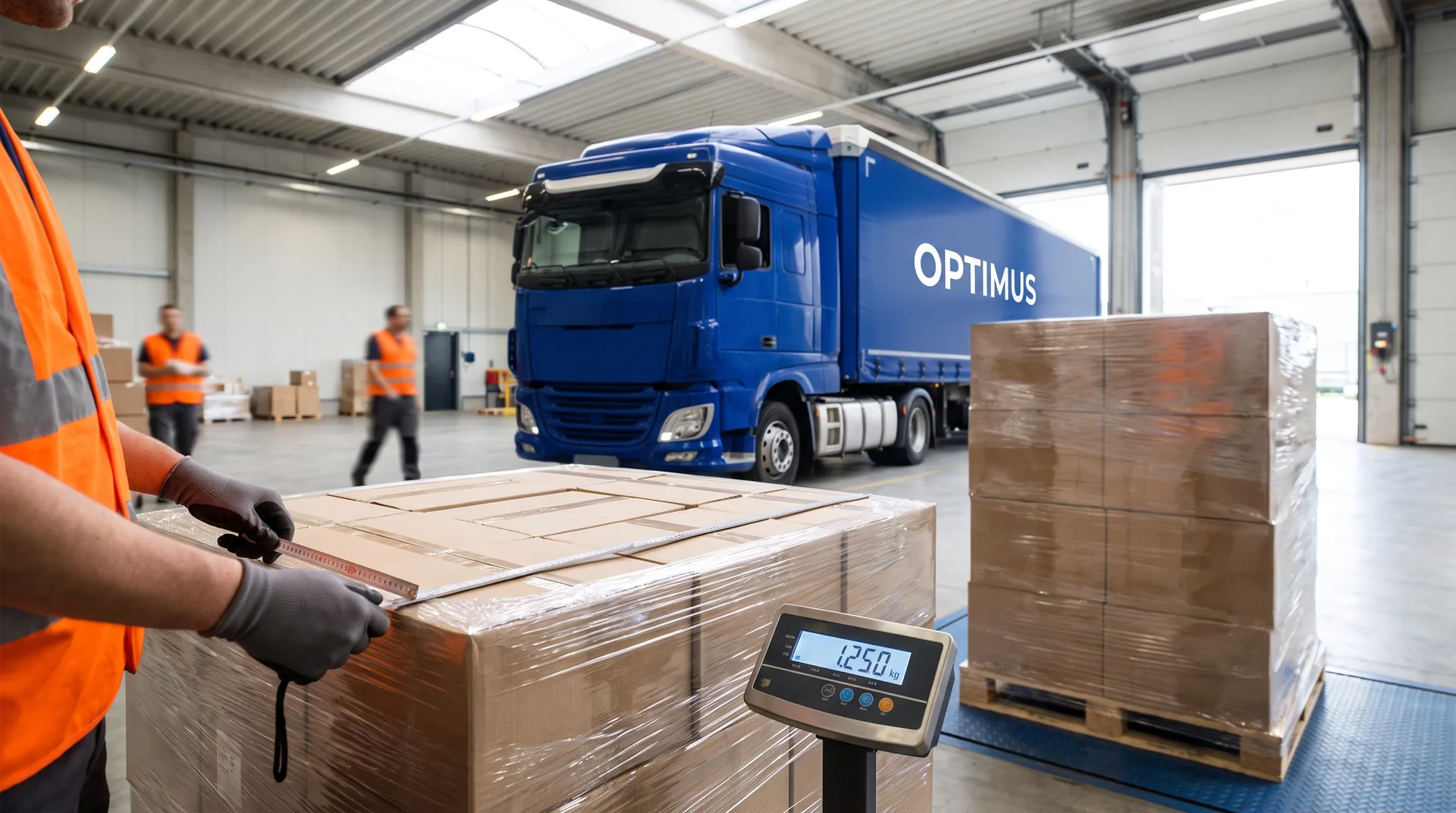
Palletise when the cartons fill at least one full layer of a carrier, when they exceed the parcel network's single-item weight or size limits, or when the consignee has a ramp and a forklift. Palletising cuts the number of handlings from several to two, and that is its main value, more than the freight price itself.
From how many cartons does palletising pay?
Not from a fixed number, but from three thresholds. The first is geometric: once the cartons fill a full layer on a euro pallet — eight at a 400×300 mm module, four at 600×400 mm — the pallet unit becomes the natural form, because it will occupy that trailer area anyway. The second is weight: parcel networks impose limits on single-item weight and size, and exceeding them brings surcharges or refusal; check your own tariff, because limits differ between operators. The third sits with the receiver: with a ramp and a forklift a pallet is easier for them; for an office with no facilities a pallet becomes the problem.
A comparison of the services themselves — pallet courier, groupage, dedicated vehicle — is in pallet courier, groupage or dedicated transport to the UK. The spectrum of formats for small B2B batches is in samples and small B2B batches.
Does palletising reduce damage risk?
It does, and that is its strongest argument. Twenty loose cartons in a parcel network travel separately, each passing through sorters, each liable to be crushed by a heavier consignment, and each capable of ending up on a different vehicle. One pallet unit travels complete, stands on its own base, and nothing gets placed on it without a human decision. For fragile or high-value goods the difference in claims often exceeds the difference in freight cost.
One condition: the unit has to be built properly. A badly wrapped pallet in groupage is worse than twenty parcels, because it topples with its entire contents. The parameters that decide this are in stretch wrapping and in corner boards and straps.
How palletising changes the paperwork
It simplifies and complicates at the same time. It simplifies because instead of twenty tracking numbers you have one logistic unit identifier: one SSCC, one line on the consignment note, one proof of delivery. It complicates because the packing list must still describe contents at carton level — checks on the British side test the contents, not the pallet count. The consequences of an incomplete description are in an incomplete packing list and HMRC checks.
A practical tip: declare the package count at carton level and describe the pallet as an aggregate unit. Any rebuild en route then leaves the document intact — the mechanism is in changed pallet counts and customs paperwork.
Bulk palletising at the hub
Not every shipper has space, a wrapper and pallets. So on consolidation we collect loose cartons and build the unit ourselves: count the pieces, stack the layers, wrap, label and measure. The shipper gets a statement of what went onto which unit, and the consignee gets a pallet built for their goods-in. Where several SKUs share one carrier, we build a mixed unit to the rules in mixed pallets.
Does the receiver need a forklift?
They need some way to take the pallet off the vehicle, or you have to provide one. Two standard answers: a tail lift on the vehicle lowering the unit to road level, and unloading by the receiver's own forklift. Tail lifts are covered in tail lift deliveries. A practical note: a tail lift lowers the pallet to the ground but does not carry it inside. Where the receiver is a unit with no facilities, it often makes more sense to break the pallet into cartons before the final leg rather than after it.
How much space it takes once palletised
Worth calculating before deciding, because a pallet takes its space regardless of how full it is. A euro pallet turned crosswise takes 0.4 loading metres, a 1200×1000 unit half a metre. The counting method is in how many pallets go to the UK and how to count LDM. If twenty cartons make half a layer, palletising means paying for a full pallet space — and then adding those cartons to an aggregate unit in LTL groupage often beats building your own pallet.
Sources
Unsure whether your shipment should travel as parcels or as a pallet? Give the carton count and dimensions in the quote form and we will price both. The lane is described on our transport to the United Kingdom page.