The Bath & West Showground lies near Shepton Mallet in Somerset, postcode BA4 6QN, on the A371 with a further entrance off the A37. It is run by the Royal Bath & West Society, an agricultural society. The venue has four gates spread around the perimeter, several halls with concrete and tarmac floors, and over 240 acres of outdoor ground. The name misleads: the city of Bath is not on the way at all.
The approach and the trap in the name
The venue itself names two approach roads, the A371 and the A37, and publishes no motorway junction number and no distance to a motorway. That is information in itself: the final leg runs on county trunk roads rather than on the fast network, so transit time is calculated differently from a motorway run.
The second issue is money. The city of Bath runs a class C clean air zone in which vans, lorries and buses are charged while cars and motorcycles are not. The zone covers the city, not the county. The approach along the A37 and A371 does not pass through it, but satnav set to the shortest route can send a vehicle through central Bath, and then the charge appears. So we plan the run on the venue postcode and with the city excluded. The zone rules are gathered in the article on UK clean air zones.
Four gates and an address made of three words
The venue publishes four entrances: Main Gate, Blue Gate and Purple Gate off the A371, and Green Gate off the A37. It gives each one a separate what3words reference, an address made of three words that identifies a three-metre square. For a carrier that beats a postcode, because there is one postcode for the whole site and four gates, separated by several hundred metres of perimeter driving.
So the transport order carries the gate name together with its three words. A driver who arrives at the wrong gate on build-up day cannot cut across the site, because internal traffic is often one way and subordinated to stand construction. It is the same mechanism we describe at the Three Counties Showground in Malvern, where gates are identified by colour.
The halls: concrete, tarmac and pillars inside
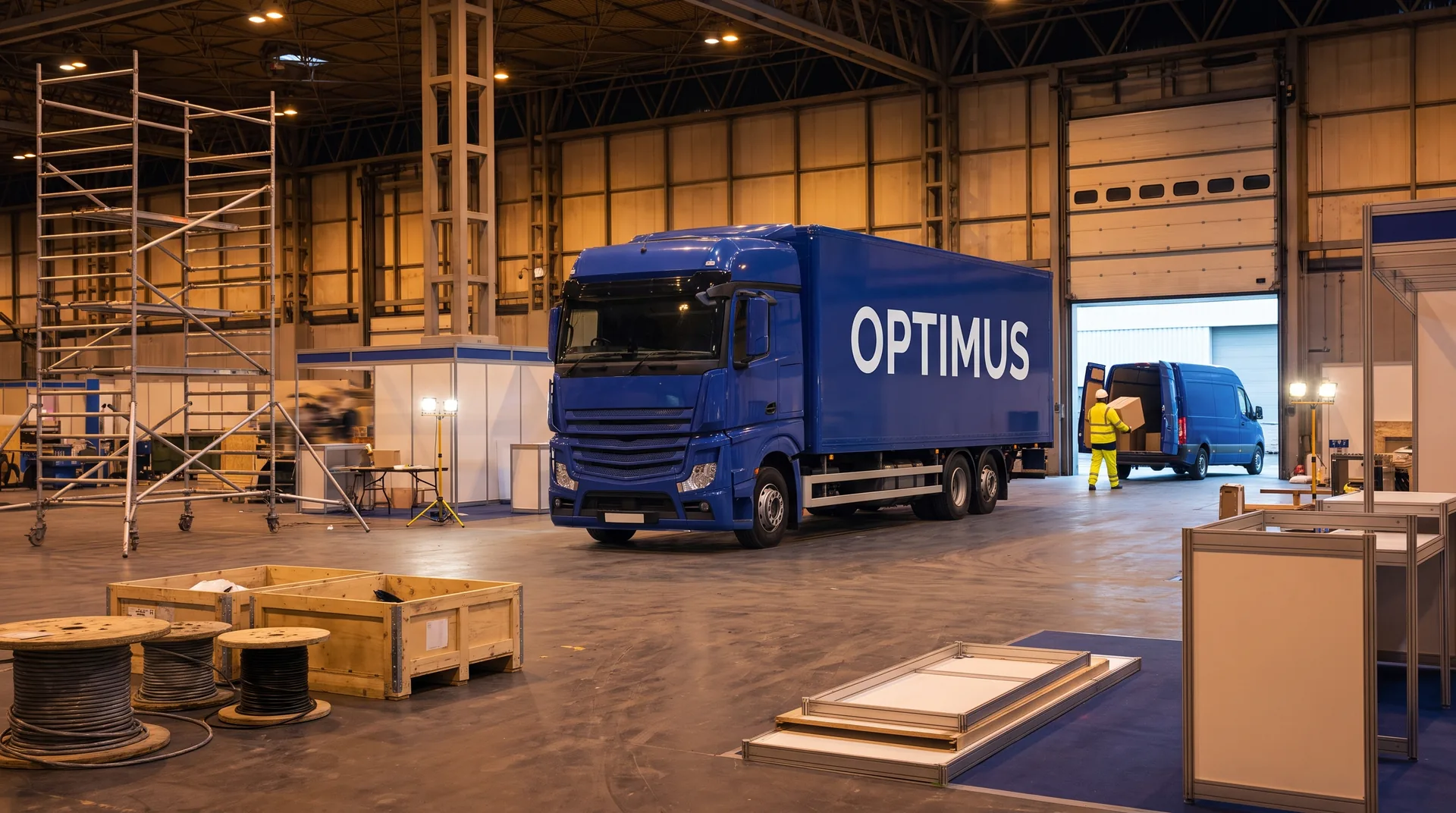
The venue describes its halls in enough detail to plan the unloading from, not just the approach.
- The Showering Pavilion is the largest space, with a power-floated concrete floor and direct vehicle access to the arena; the venue also lists a side off-loading door and room for an articulated vehicle to turn.
- Edmund Rack has a tarmac floor and three roller shutter doors, but its layout is broken by supporting pillars: the venue publishes them as standing 7.6 metres from the wall at 6.1 metre intervals. With a long exhibit that is the first figure to check, because a pillar will not disappear from the stand plan.
- Exmoor Hall 1 and Exmoor Hall 2 have concrete floors and access doors of different sizes, so they are not interchangeable for the same load.
- Mendip and Sedgemoor are reached through roller shutter doors, which the venue explicitly ties to installing large equipment, and connect to the Showering Pavilion by a covered walkway.
The practical conclusion is simple: at this venue the hall name changes the unloading more than the stand area does. Door heights and widths differ between buildings, so the trailer is matched to a specific hall. We unpack the mechanism in the article on venue access limits, and items that exceed the clearance in the piece on unloading an oversized exhibit.
The outdoor ground and the weather
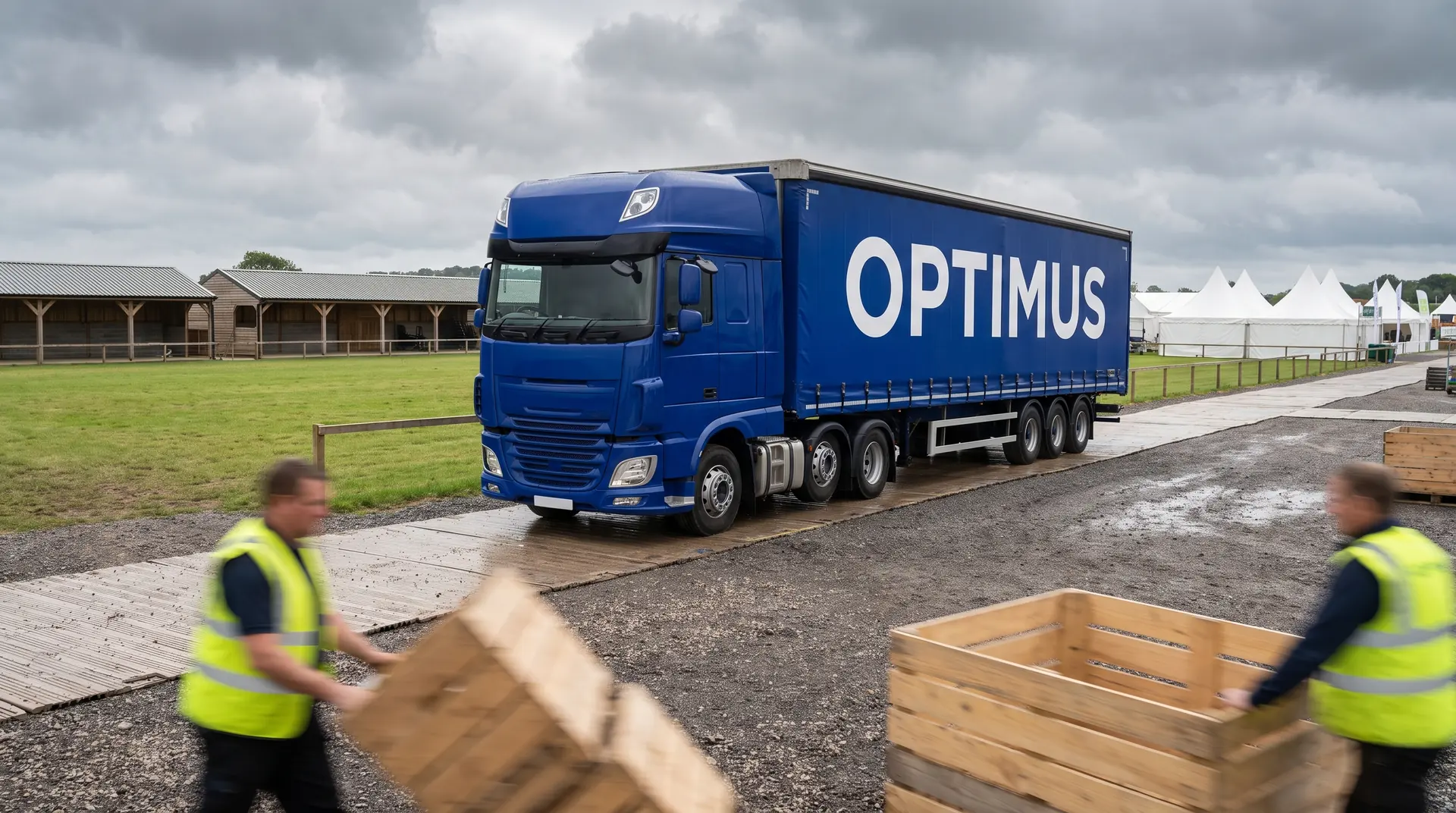
The venue quotes over 240 acres of outdoor space and notes that all avenues have hard surfaces while parking is laid out on both hard standing and grass. That distinction matters: a hard-surfaced avenue lets a heavy vehicle reach the sector, but the pitch itself may still be on turf. After two days of rain the difference between the two decides whether the vehicle drives up or bogs down a dozen metres short of the stand.
So for outdoor events we ask not about the pitch area but about what is underneath it and how far it sits from a hard-surfaced avenue. If the answer is grass, we plan a fallback: unload on hard standing and shuttle to the plot with smaller equipment. Who is responsible for that unloading is set out in the article on unloading inside a venue.
What to settle before arrival
- The hall name or outdoor pitch number, and the surface under the pitch.
- The designated gate together with its what3words reference.
- How the vehicle is booked in and where passes are collected.
- The door dimensions of the destination hall, and the pillar positions if it is Edmund Rack.
- Who supplies the forklift and where the vehicle goes after unloading.
- A fallback for soft ground.
We quote no build-up hours or dates, because the organiser sets them separately for each edition. The method for counting the schedule backwards is in the article on the build-up and breakdown calendar.
What we do at our end
We collect stands and exhibits in Poland, and from exhibitors in Czechia, Slovakia, Austria and Hungary we gather the load through our hub. The Kielce base sits about 4 km from the fairground, works around the clock and serves to assemble a stand into one consignment before departure. A groupage vehicle waits for the next scheduled line departure. Clearances run in cooperation with the customs agencies we work with regularly on both sides. On the British side the load usually passes through a cross-dock at our warehouse in Milton Keynes, which gives two transhipments across the route. On site we deliver to the handover point and the venue equipment takes over. We commit to an hour at the gate rather than an hour of unloading, because site staff set the order of entry.
Groupage or a dedicated vehicle
The threshold runs at roughly a third of a trailer, about twelve pallets. Here the gate and the ground add arguments of their own. An indoor stand of panels, graphics and furniture travels comfortably as groupage. An outdoor display on turf, or a machine going in through a roller shutter door, is a separate movement matched to the door size and the bearing capacity of the ground. We break down that decision in the article on choosing between FTL and groupage.
Sources
- Bath & West Showground: directions, gates and what3words references
- Bath & West Showground: the site, avenues and facilities
- Royal Bath & West Society: the owner of the venue
- GOV.UK: list of British charging clean air zones
Exhibiting near Shepton Mallet? Send the hall name or pitch number and the item list through the quotation form and we will match the vehicle to the gate, the door and the ground. See also the exhibition logistics page.