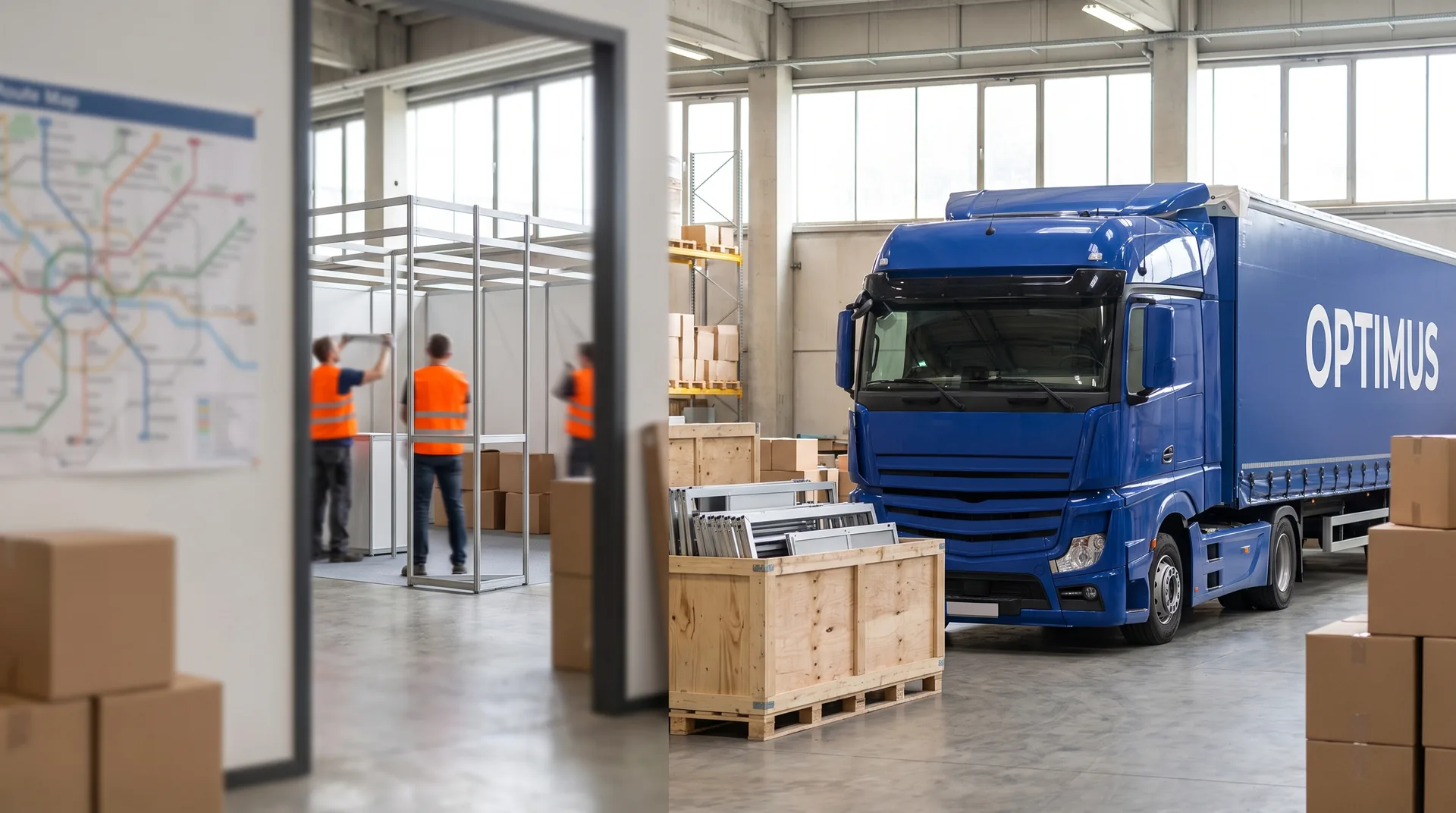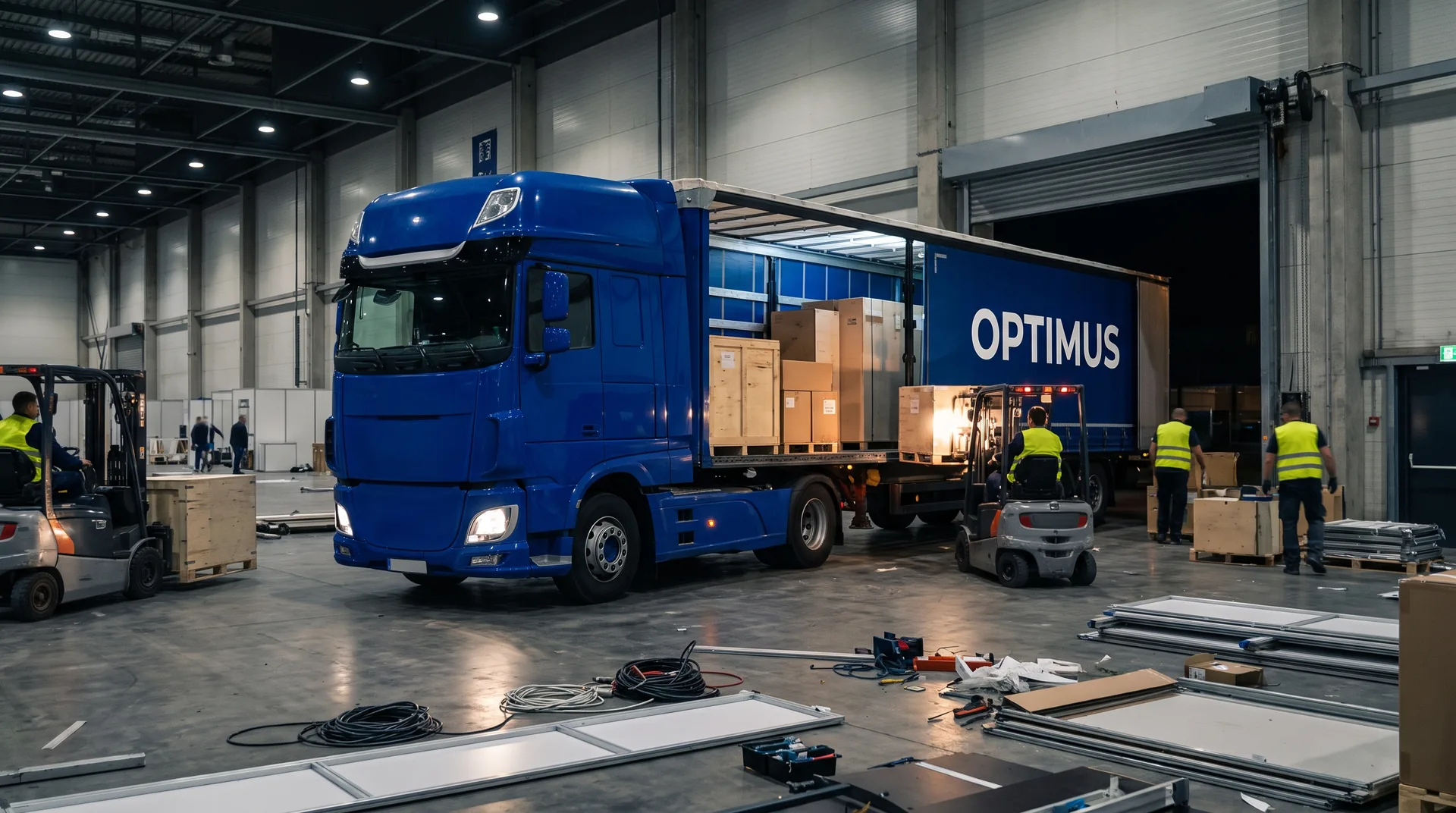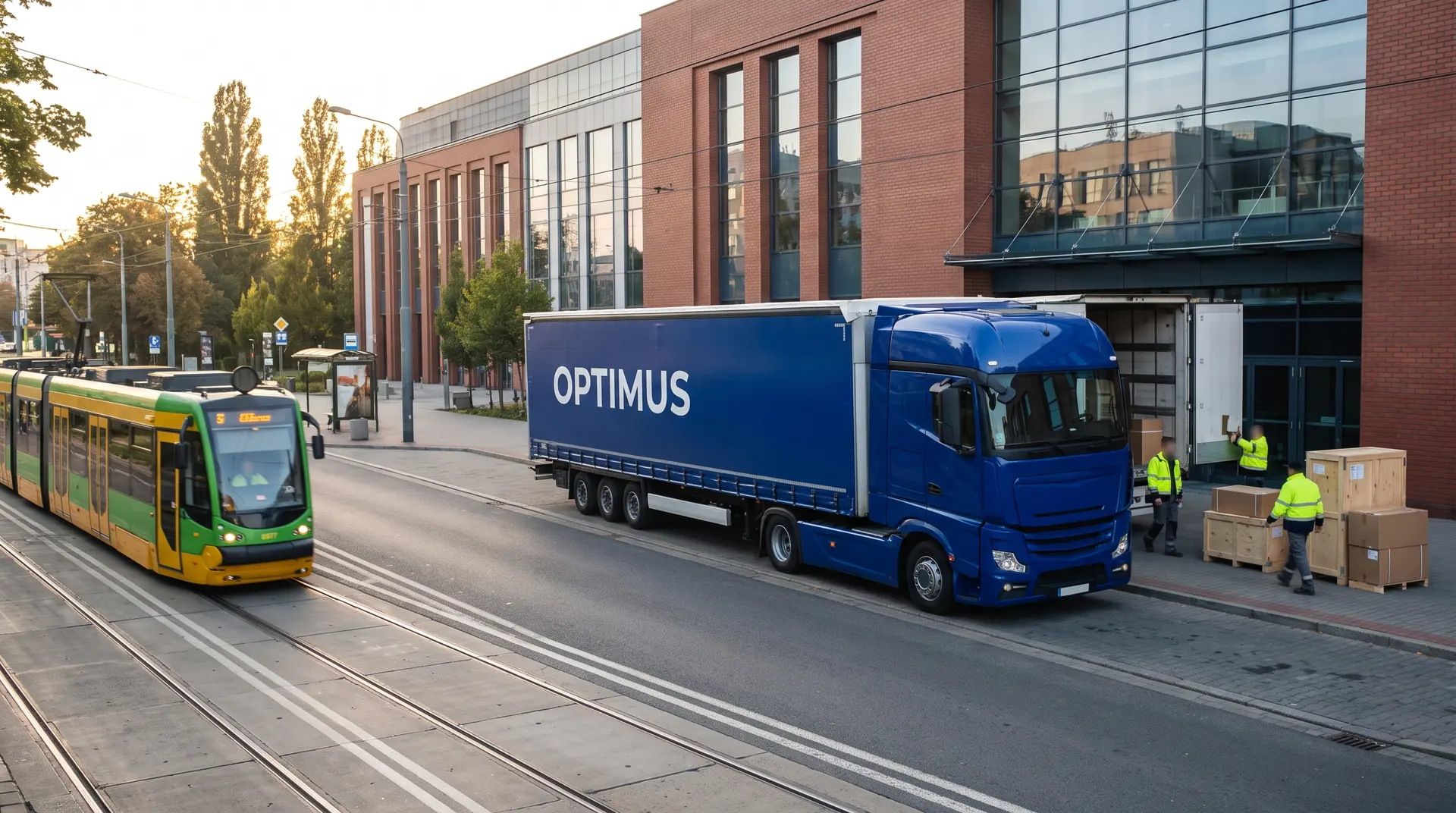
Poznan International Fair sits at ulica Glogowska 10 in Poznan and comprises, on the organiser figures, fifteen pavilions with roughly 150,000 m² of exhibition space. It is an inner-city venue, so the approach runs through the urban fabric, and the rules for entry and unloading come from the participant regulations, the technical rules of the site and the detailed provisions of the individual event.
Fifteen pavilions in the middle of a city
The scale of the Poznan centre is impressive, but for a carrier the location matters more than the square metres. The site is in the centre of Poznan, which is an advantage for a visitor and means three things for the driver of an articulated unit: an approach through city traffic, no freedom to choose the hour of arrival, and very little margin for a navigation mistake. A trailer that misses the right turning will not turn round at the next roundabout. Other Polish centres are laid out the other way round: AmberExpo in Gdansk sits by the port, with halls divided by movable walls, which we cover in AmberExpo in Gdansk.
The planning consequence is simple: entry to an inner-city venue is planned outside peak hours, and the load must be ready to leave the vehicle the moment it stops. The same principle governs deliveries to venues in central London and is covered in our article on delivering exhibits to London trade shows.
Where to look for the entry rules
The organiser publishes participant regulations for its fairs and a set of technical and fire safety rules applying across the site. Those two documents give the general framework. Details for a particular event, including build-up and breakdown windows and the procedure for vehicle entry, come from detailed provisions issued separately for each show. Space and technical services are ordered through the exhibitor portal run by the organiser.
A practical warning: do not assume that gate numbers or standing rules learned at one event apply to the next. In a venue with more than a dozen pavilions the pattern of internal traffic changes with which pavilions are occupied. We recommend the same caution at every centre, as set out in our piece on the build-up and breakdown calendar. The same goes for the names of the companies running the venues: exhibition activity in Lodz is now run by Expo-Lodz rather than the centre known under its former name, which we cover in Targi Lublin and Expo-Lodz.
An exhibitor from the Isles travels the other way
A British company exhibiting in Poznan faces the customs picture in reverse from the typical scenario described across this site. Export formalities are handled on the British side, and the goods enter the customs territory of the European Union at the first customs office on the external EU frontier, not in Poznan. After that clearance the load moves within the Union without further declarations, so the final leg into Wielkopolska is already intra-EU carriage.
That distinction has a practical consequence: a customs delay, if it happens, happens several hundred kilometres before the venue rather than at its gate. Time reserve therefore belongs on the border section, not on the run into Poznan. The British side of the process is described in our article on a UK exhibit and the ATA carnet on the British side.
The ATA carnet works in the opposite direction here
A Polish exhibitor going to the Isles obtains a carnet from the Polish Chamber of Commerce. A British exhibitor coming to Poland obtains one from a chamber of commerce in the United Kingdom, because a carnet is always issued by a chamber in the country the goods temporarily leave. A British carnet cannot be issued in Poland or the other way round, and trying to arrange it after the fact ends in an ordinary import clearance.
The alternative remains temporary admission with a customs declaration and a guarantee lodged in the country of import. That can make sense for a single event with a short list of items. A carnet wins where there are several events, or where the same kit travels through a season. The two routes are compared in our piece on the ATA carnet versus temporary admission, and the mechanics of the document in the article on the ATA carnet step by step.
Where freight from the Isles can wait before build-up
The situation is the same as for any fair delivery: the build-up window is fixed and the journey is variable. Our Kielce site works around the clock and takes in loads travelling onward, while the Milton Keynes warehouse serves the British side before departure and after the return. For a Poznan event a Kielce buffer makes sense when the load passes through our line-haul flow anyway; on a direct run from the Isles into Poznan it is often better to adjust the departure hour than to add a handling operation. The scope of warehouse work is described on the page of our Milton Keynes warehouse.
What to confirm before dispatch to Poznan
- Pavilion and stand number plus the build-up window from the detailed provisions of the event.
- The vehicle entry procedure and the place where entry documents are collected.
- Whether the load needs venue equipment and how that is ordered.
- On the British side: the customs document and the full data set for the list of items.
- A contact on the stand on delivery day, reachable by phone.
The general picture of exhibitor preparation is collected in our article on exhibit transport to trade fairs, and the division of roles on site in the piece on who is responsible for what at a trade fair.
Sources
- MTP: the Poznan International Fair site
- MTP: contact details and address
- MTP: regulations and technical rules
- GOV.UK: How to use your ATA Carnet
Exhibiting in Poznan, or bringing an exhibit from the Isles to a Polish show? Send the list of items and the build-up window through the quote form. See also our trade fair logistics and customs clearance pages.