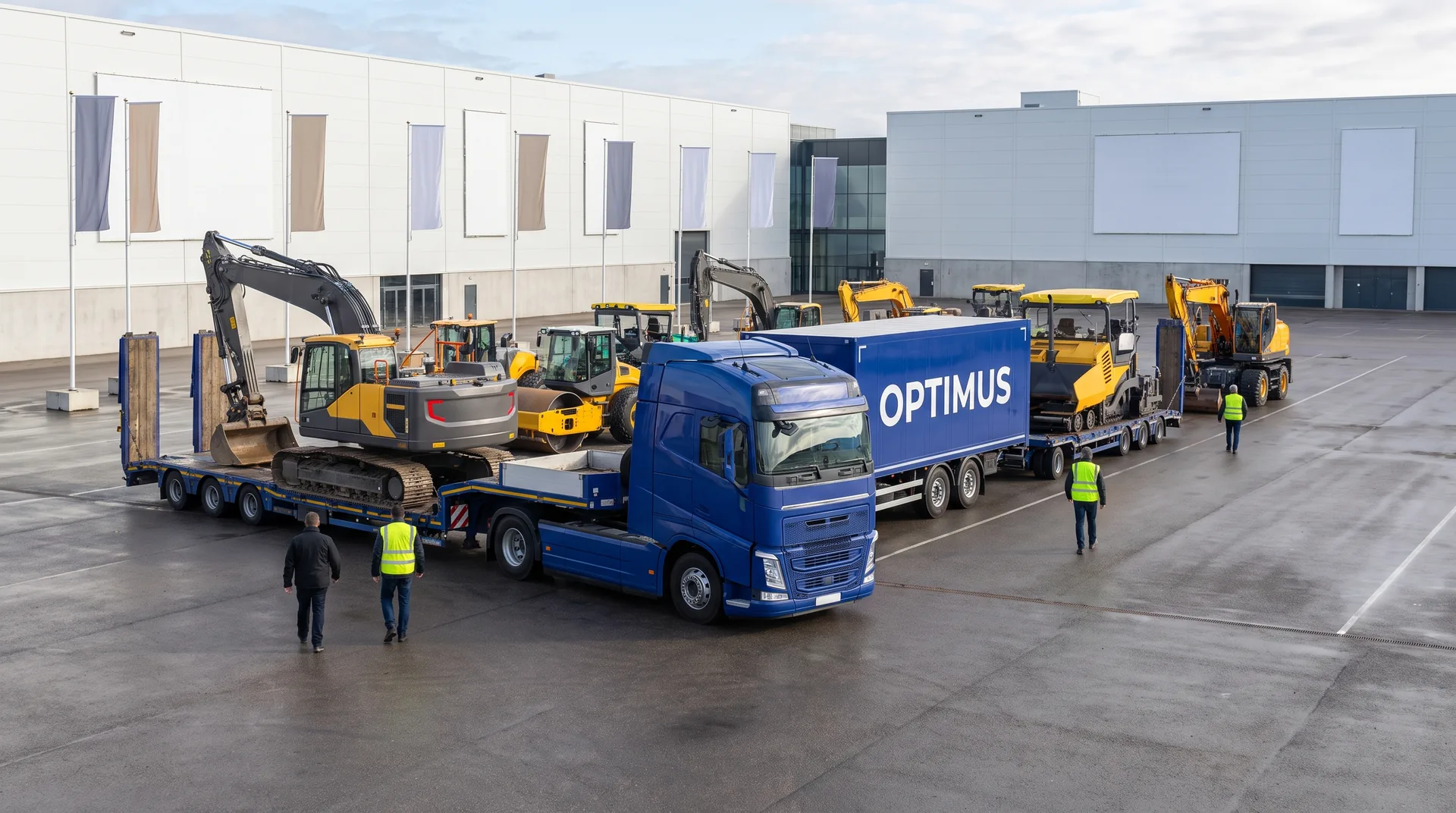
Heavy road plant travels to AUTOSTRADA-POLSKA on a low loader, and the plan starts with three numbers: machine mass, folded transport dimensions and the axle loads of the combination. Only those tell you whether the run is within legal limits or needs a permit and a route agreement, which takes time you have to book before build-up.
A note on the name: the Kielce road construction fair ran for years as AUTOSTRADA-POLSKA and now appears in the organiser calendar as AUTOSTRADA Nowa Infrastruktura. Before signing a space contract, check the current name and edition date directly with the organiser, because both can change from year to year.
Where does the plan for a construction machine start?
With the datasheet, not a photo. The maker states operating mass, transport mass, dimensions in transport configuration and lashing points. Those differ from each other: a tracked excavator with the bucket removed and the boom folded can be half a metre lower, and a paver with the screed retracted loses almost a metre of width. Transport configuration is therefore the first lever for cutting cost and avoiding a permit.
The second number is the height of the combination. A low loader exists precisely to drop the machine deck and keep the whole thing inside the legal height. The third is mass distribution: a heavy machine set too far back overloads the trailer axles, and too far forward the fifth wheel. Distribution is worked out before loading, because correcting it in the yard means driving the machine off and on again.
When is a permit needed and how long does it take?
A permit is needed once the loaded combination exceeds permitted axle loads, dimensions or mass. The application goes to the competent authority and processing time depends on the category: for lower categories it is counted in working days, for the highest it is clearly longer, and longer still where the route requires infrastructure adaptation. Single-journey and multiple-journey permits have different validity periods. All of these are published by the roads authority, and that is what we check at quotation stage rather than repeating remembered figures.
For an exhibitor the practical conclusion is one: if the machine is abnormal, the decision to display it must be taken with weeks of margin, not days. Scheduling backwards from the build-up window is covered in our article on planning fair transport backwards. Permits and escort practice on UK-bound runs are in the piece on oversized transport to the UK.
How does an outdoor display differ from a stand in a hall?
From a transport point of view they are two different jobs. Outdoors the machine stands on a hard surface with manoeuvring room around it, and a full combination can usually reach it. There is no door, no height restriction and no floor loading question. Other questions appear instead: a surface that tracks can mark, drainage that must not be crossed by heavy plant, and entry sequence, because the first machine parked will block the way for the rest.
Inside a hall it reverses. There the constraints are the door, clear height, turning radius in the aisle and permitted load per square metre of floor. These differ between halls in the same venue and are published by the organiser. We gather them in the article on floor loading and door clearance.
Driving the machine off the low loader
Low loader ramps are designed for a given angle and load, but that does not mean you may drive off anywhere. It needs flat, firm ground in front of the trailer, space to roll the machine out and someone qualified to operate it. The driver answers for the vehicle, not for the machine: starting an excavator or a roller is the exhibitor operator side of the job unless the order says otherwise. We write that split into the order, because in a dispute over damage during unloading it decides more than any report drawn up afterwards.
With tracked machines there is also surface protection. A steel track leaves a permanent mark on block paving, so mats or plates are laid along the run-off path. Who supplies them is agreed before arrival, not once the combination is already in the yard.
Fuel, fluids and safety on the display area
Machines on an outdoor display carry fuel, hydraulic oil and coolant. Venue rules commonly cover the permitted fuel level, the duty to prevent leaks and a ban on refuelling on site. The specific requirements are set out by the organiser in the rules for each show, and those are what to read before loading, because the differences between shows are real. We note in the order what condition the machine must arrive in, so that nobody discovers at the gate that the tank has to be drained.
The machine after the show closes
Plant shown at a fair often does not go back where it came from. It may be sold during the show, handed to a dealer or sent straight to a site. Settle the return option before build-up, because abnormal load transport ordered on breakdown day is the hardest to arrange: a permit has a defined validity and the return route may differ from the inbound one. The options after a show closes are gathered in the article on what to do with a stand after breakdown, and the Kielce buffer in the piece on the buffer warehouse next to Targi Kielce.
Sources
- GDDKiA: abnormal load movements, permit categories, authorities and deadlines
- biznes.gov.pl: category V abnormal load permit
- Targi Kielce: AUTOSTRADA Nowa Infrastruktura (dawniej AUTOSTRADA-POLSKA)
Planning to display road or construction plant in Kielce or at a UK show? Send the machine datasheet through the quotation form and we will come back on whether the run is within legal limits and how much time the formalities need. See also oversized loads and the exhibition logistics page.