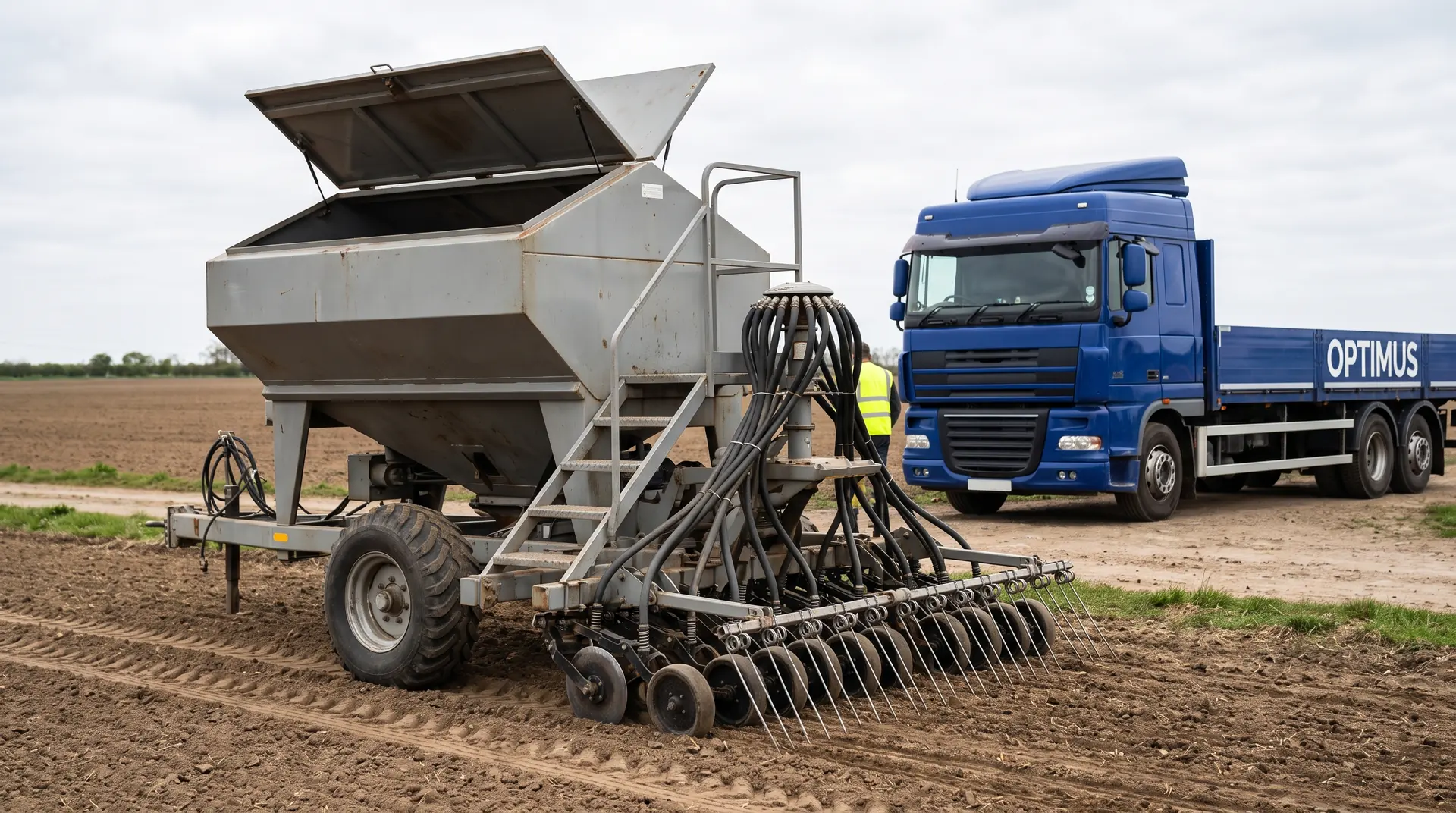
With a seed drill or a planter it all comes down to one thing: working width can be several times the transport width, so what matters is folding the sections correctly and locking them. A machine folded carelessly opens out on the road, and that is a recurring claim rather than a theory. Add sharp coulters and discs, a hopper holding treated seed, and a terminal that travels separately and has to be listed.
Folded is not the same as locked
A hydraulically folding drill can be brought to a narrow outline in two minutes. Keeping it in that outline for a thousand kilometres is another matter. Wings raised and left on their rams sink slowly, because oil creeps past the valve and the temperature changes along the route. So once folded, we engage the transport latches or pins with split cotters, close the hydraulic isolating valves, and disconnect from the tractor only after confirming that the sections hold mechanically.
Potato planters with wide frames and precision drills with row units on outriggers have exactly the same weakness. The order never changes: fold, lock, and only then measure the height and width of the outfit. We take the dimension in transport configuration, because a brochure normally quotes working width and that figure is of no use to us. When a machine still exceeds ordinary limits after folding, we move into the regime described in our article on oversized transport, STGO permits and escorts.
Coulters, discs and the load next door
The working parts of a drill are sharp by design. Hoe coulters, seeding discs, the cutting discs on a combination drill — all of them cut, and on a trailer they cut not soil but a lashing strap, a curtain or a crate standing alongside. Guards go on every time, even when the machine travels alone, because a strap chafed on the edge of a disc lets go without warning.
- cutting edges are covered with guards or packers, never with cardboard alone;
- corner protectors go under the straps wherever they cross the frame, so they do not chafe on an edge;
- spring coulters are pinned, because they work vertically over rough surfaces and hammer the deck.
Pre-tension and the number of lashings come from mass and friction rather than from a rule of thumb — the method is written up in our article on cargo securing to EN 12195.
The seed hopper and treated seed
A drill hopper is rarely empty at the end of a season. Grain stays on the floor and in the metering channels, and very often it is treated seed, coated with a chemical dressing. That is material we would rather not carry: it spills in transit, it dusts when the lid is opened and it is awkward at any inspection. We therefore ask for the hopper to be emptied and swept out while the machine is still in the yard, with the lid closed and secured afterwards.
Potato planters bring a different problem: instead of grain they carry soil. Earth packs into the pockets of the planting belt, into the ridging bodies and into the running gear, and once dried it clings harder than fresh mud. That is the part which triggers border plant health checks when the machine enters the European Union — the procedure itself, the documents and the entry points are described separately, in our guide to farm machinery auctions in the UK.
Terminal, console and the list of loose items
Newer drills and planters are operated from a terminal in the tractor cab. The terminal does not travel on the machine: it is removed, packed separately and written onto the list of loose items together with the wiring loom, the bracket and the setting spanner. That list also matters when the completeness of a machine has to be evidenced — what belongs on it is covered in our guide to documents for a machine bought at auction.
It is worth settling before the bidding, because the terminal is sometimes sold as a separate lot or is not part of the outfit at all. A drill without electronics is still a drill, but buying the control system afterwards can change the arithmetic of the purchase.
Mounted versions as a natural part load with a tractor
Drills mounted on a tractor linkage are one of the few pieces of farm equipment that pair sensibly with another purchase from the same sale. They have no running gear of their own, they stand on a prepared cradle and they use little length, so they fit alongside a tractor or a loader provided the axle loadings work out. Combination drills and wide planters offer no such option — they fill an outfit by themselves.
A part load should not be confused with groupage, though. The threshold above which we send a dedicated vehicle instead of a groupage one is around twelve pallets, and even a mounted drill is past it. A groupage vehicle waits for the next scheduled line departure and passes two transhipments on the way, and a machine with guarded coulters is not a load that takes kindly to being moved about. We do not set up or service the equipment you buy and we do not judge its condition — we prepare it for the road and carry it.
Sources
- PIORiN: phytosanitary conditions for bringing used agricultural and forestry machinery into the European Union
- EUR-Lex: Implementing Regulation (EU) 2019/2072 on quarantine plant pests
- GOV.UK: roadside checks on commercial vehicles and load inspection
Have you spotted a drill or a planter in a British catalogue? Send the model, the working width and the folding arrangement through our haulage quote form and we will tell you whether it can share a deck with another purchase from the same sale. Export and import formalities are handled through our customs clearance service, and questions about latches and guards are answered quickest by speaking to the operations team.