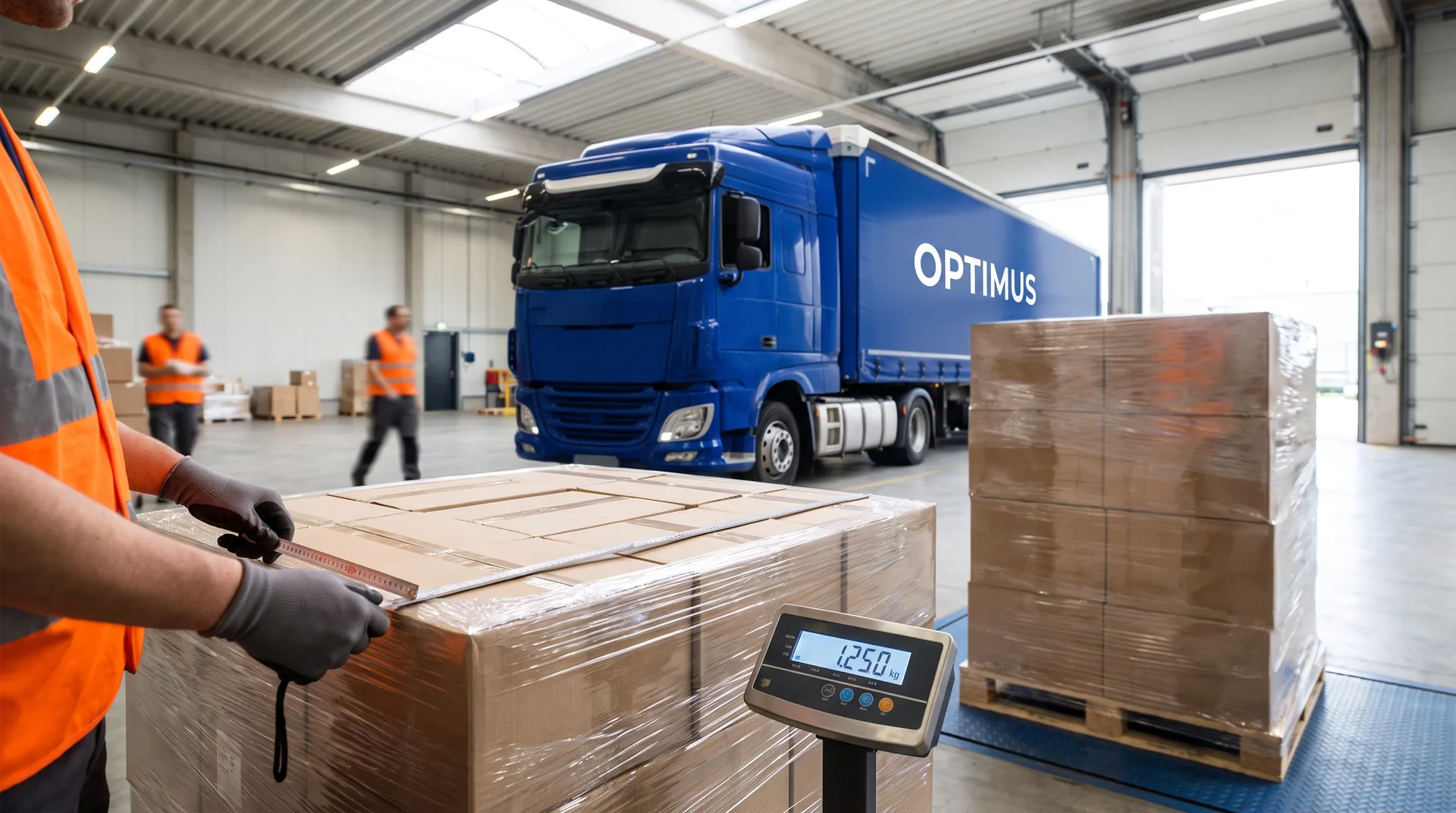
A dimensioning scanner reads the smallest cuboid the whole unit fits into — film, carton overhang, a protruding pallet board and corner boards included. Shippers usually quote either the goods' dimensions or the carrier unit's. The gap between the two is a few centimetres, which converted into loading metres becomes a surcharge.
What the scanner actually measures
The bounding box: the smallest cuboid enclosing the unit. Everything protruding counts — a carton two centimetres past the pallet edge, loosely hanging film, a document wallet stuck to the side, a corner board rising above the load, even a skewed top layer. Height is measured from the floor, so the carrier is included — a euro pallet is 144 mm that the goods dimension usually omits. That single element can overturn a declaration when the shipper says "load 160 cm" and the unit measures 174 cm.
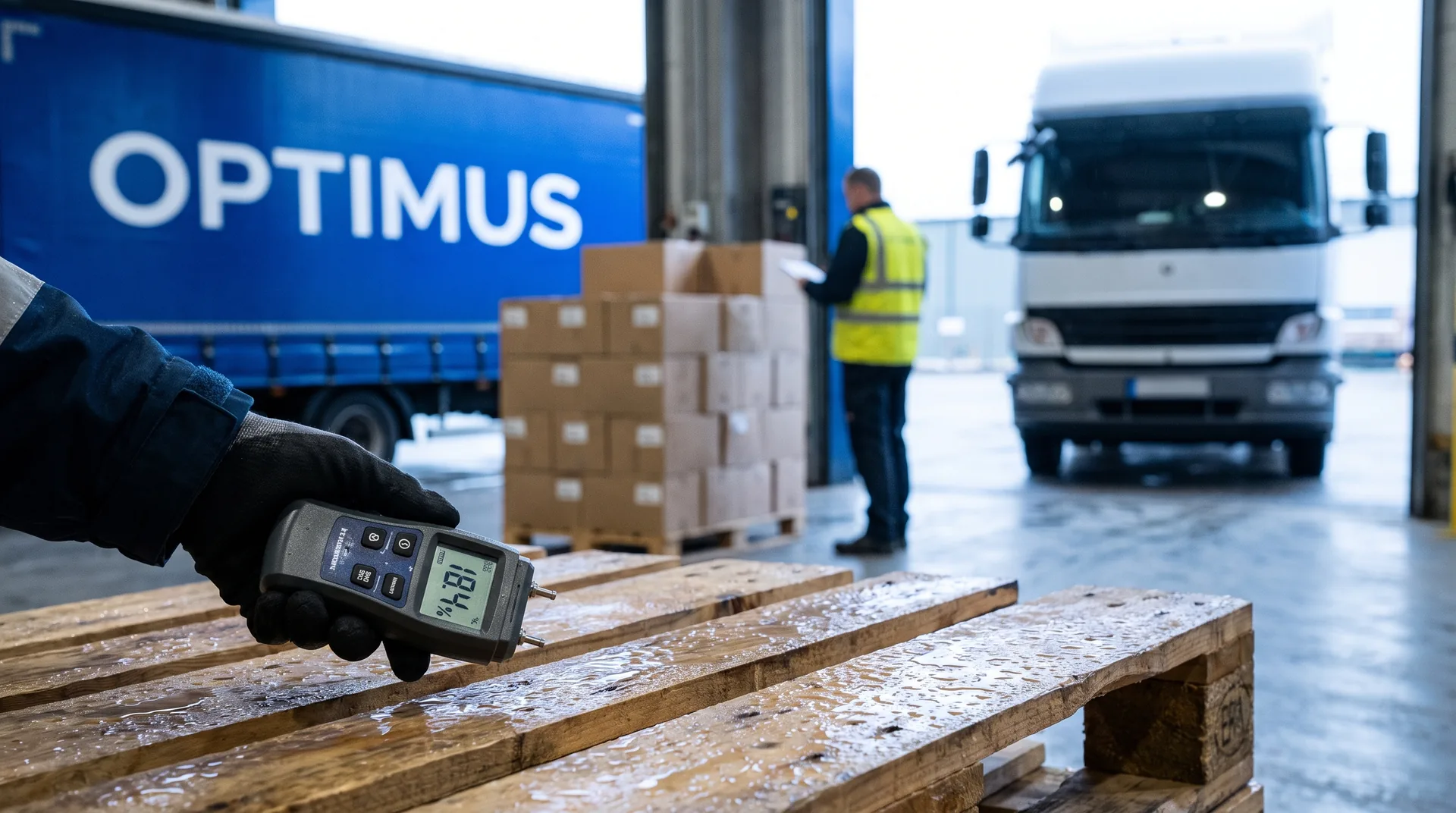
Weight follows the same logic: gross for the unit including carrier, film and interlayers. EPAL puts the euro pallet's own weight at approximately 25 kg, and a damp pallet weighs noticeably more — how much the carriers alone eat on a full vehicle is covered in pallet tare in payload maths.
Where discrepancies come from
Four sources, in order of frequency. First: the shipper's system holds the theoretical dimension of a full pallet, but a part pallet went out, or one with an extra layer added. Second: goods dimensions quoted without the carrier and without film. Third: carton overhang beyond the footprint, which nobody measures at packing because it is invisible from above. Fourth: height after wrapping, which grows when film lifts the top layer or a cap is fitted.
A fifth source is rarer but costliest: a leaning unit. A pallet off vertical has a bigger envelope than a straight one and the scanner sees it. Here the discrepancy does not stop at a surcharge, because a leaning unit is often simply refused at the consignee's goods-in.
Why the carrier re-rates after measuring
Because in groupage you pay for space, not for goods. A unit larger than declared takes trailer space that cannot be sold to anyone else, and when double stacking is involved it blocks the space above it too. The method for counting space is in our article on how many pallets go to the UK and how to count LDM, and how to read individual quote lines in reading a carrier quote.
Volume-to-weight conversion factors are written into tariffs and differ between carriers — there is no single market-wide value, so check your own contract rather than relying on a figure heard somewhere. What matters more: if a correction is to be made, it should rest on a measurement print-out with a photo of the unit and a date. Without that it is not a correction, it is an assertion.
Actual weight, volumetric weight and axle load
Three different things, easily confused. Actual weight is what the unit weighs. Volumetric weight converts occupied space into a billing unit — it exists purely for pricing. The third quantity, the most underrated, is how mass distributes across the vehicle's axles: two pallets of identical weight placed differently in a trailer produce entirely different axle loads. The consequences of a misdeclared weight on the British side are covered in misdeclared cargo weight and axle overload. One sentence suffices here: a roadside check does not care what the order said, only what the weighbridge shows.
How to measure a pallet yourself before the hub does
The procedure takes two minutes and saves weeks of argument. Measure after wrapping, not before. Measure at the widest point on both horizontal axes, taking the tape to the floor on both sides rather than diagonally. Measure height from floor to the highest point, including any cap, document wallet or protruding corner board. Weigh the unit with its carrier. Record the result against the SSCC, not the order number — because it is the unit that travels, not the order.
If production packs pallets in several variants, measure the tallest, not the average. A quote based on an average always drifts upward, because the hub measures each unit separately. On regular flows it is worth measuring each pallet variant properly once and keeping a dimension table with the packing specification — then nobody guesses on later shipments.
Who bears the cost of a discrepancy
In practice, whoever declared. That is not a matter of goodwill but of how the order is built: the carrier prices on the shipper's data and plans trailer space around it. The honest framing is this: the hub measurement is binding, evidenced by print-out and photo, and any correction covers only the gap between declaration and measurement. If the gap comes from our own error while rebuilding the unit, it shows in the repacking record, and then the cost is ours.
Sources
- EPAL: 1200×800×144 mm and a euro pallet own weight of approximately 25 kg
- DVSA / GOV.UK: duties of consignor, operator and driver at loading
Want certainty that the quote will not drift after measuring? Give the post-wrap dimensions in the quote form and we will count the space exactly. The whole lane is on our transport to the United Kingdom page.