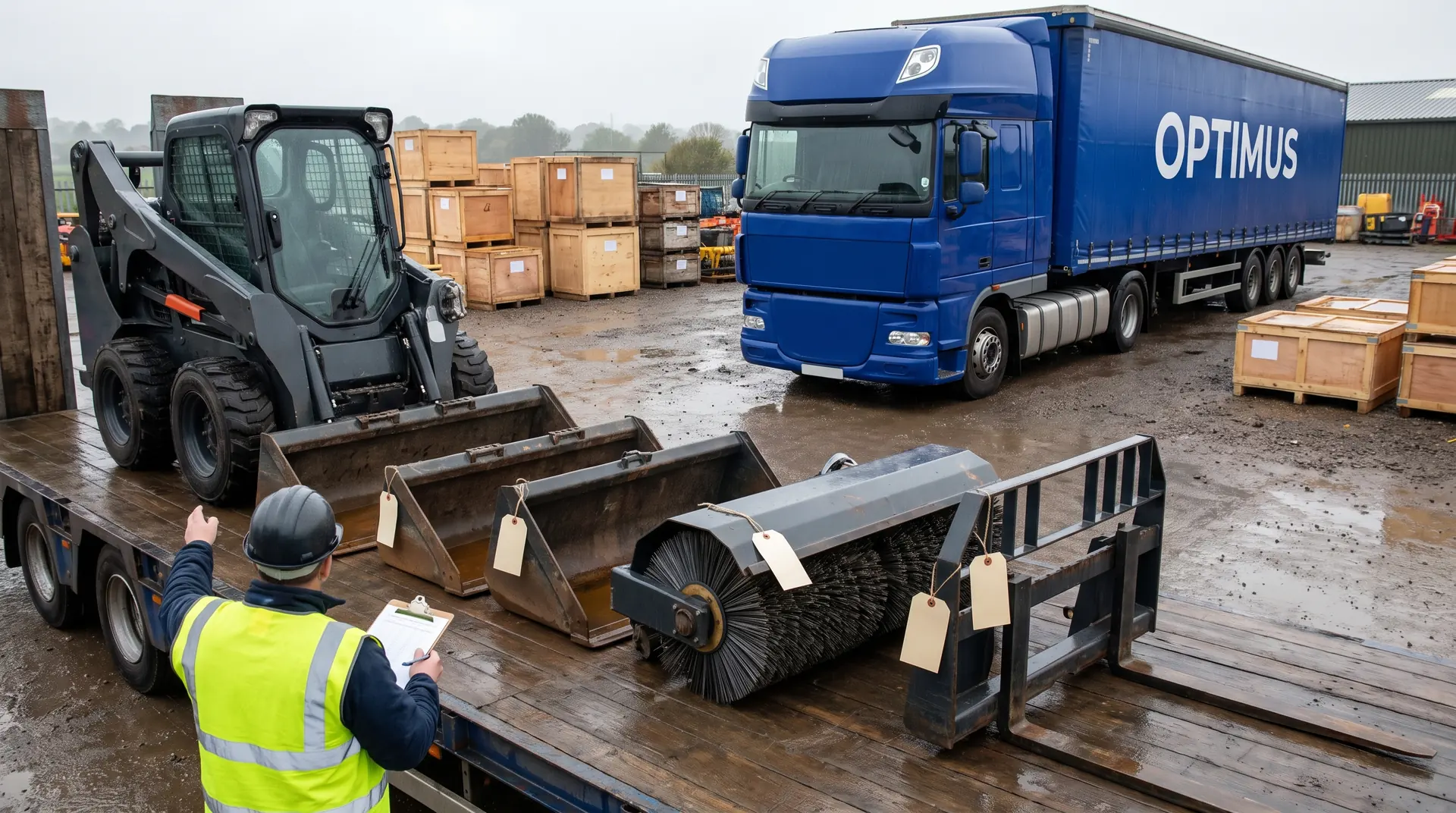
A skid steer loader is one of the few construction machines genuinely worth moving in groupage: it stays within normal dimensions, has a low profile and leaves deck space free. The biggest difficulty is not carrying it but describing the attachments. In a package purchase every bucket, broom and pair of forks is a separate line on the customs entry.
Why this machine suits groupage
A skid steer is short, narrow and low because it has to be: it works where a bigger machine cannot get in. The same qualities let it stand on a trailer beside other cargo without forcing a low loader. A consolidated vehicle waits for the next scheduled line departure, so the buyer pays for deck space taken rather than for a whole run out and back. The threshold where a load stops being groupage runs at roughly a third of the trailer, about twelve pallets, and a skid steer with its attachments normally sits inside it. We describe the groupage model more fully under small plant groupage from UK auctions.
Getting into groupage depends on being clean and tight. A machine dripping oil or shedding mud goes on its own vehicle, because the risk to the neighbouring load is real. Washing it and checking the hoses on the yard before collection is the cheapest thing you can do for the transport price.
Loading a machine with no steering wheel
A skid steer turns by driving its wheels or tracks at different speeds, so on ramps it behaves differently from a machine with steered wheels: it is nimble, but also easier to put on crooked. It usually goes up in reverse, so its weight ends over the trailer axles and the lift arms face forward. The tracked version holds the deck better, the wheeled one needs more careful chocking. A dead machine or one without keys goes on the winch; the options are set out in the piece on loading a machine at the auction yard.
Lashing and attachments
- The arms come fully down and the attachment rests on the deck. Arms left raised and held on the rams are the commonest mistake with this class of machine.
- The arm lock, where the machine has one, goes on mechanically. A holding valve is not a transport restraint.
- Chocks go under the wheels or tracks, lashings into the four points the maker specifies, pulled diagonally.
- Interchangeable attachments are lashed separately, laid flat, teeth facing inboard. A broom with synthetic bristles travels covered, because chafing against a strap wears it out faster than work does.
- Hydraulic quick couplings on the arms are capped, so oil cannot drip onto the neighbouring cargo.
The rules for choosing lashings and calculating forces are in the article on cargo securing under EN 12195.
Attachments on the customs entry
This is where the problem usually arises. The auction sells the machine with a set of attachments under one price, while clearance needs a breakdown: the machine is one item, the bucket a second, the broom a third, the forks a fourth. Each has its own description, quantity and apportioned value, and the customs value rests on the price actually paid, split in a way the auction documents can justify. How value is established is described in the piece on the customs value of a used auction machine, and the full document set in the article on documents for a machine bought at auction. Declarations are filed by the regular customs agencies we work with on both sides of the Channel; we supply the transport data and make sure the loading list matches what stands on the trailer.
Fluids, fuel and battery
A skid steer has a tightly packed hydraulic system with hoses routed close to the arms, so chafing is common. We check them before loading, especially on a machine that has stood on the yard through a winter. The fuel level is agreed before collection, because fuel type and tank construction decide whether the movement falls under dangerous goods rules. The battery is disconnected, the terminals protected, the keys travel with the paperwork.
Soil and cleaning
A machine that has worked in soil brings it in the tread, in the bucket and behind the panels. For equipment used for agricultural or forestry purposes, entry into the Union requires the phytosanitary conditions to be met, with a notification in TRACES NT, a CHED-PP certificate and the importer entered in the register kept by the Polish plant health service; we describe the procedure under farm machinery auctions in the UK. In groupage washing has a further reason: the machine travels beside someone else goods, and mud shedding off the tracks over a thousand kilometres lands squarely on them.
Sources
- GOV.UK: securing loads on HGVs and goods vehicles
- European Commission: calculation of customs duties and customs value
- PIORiN: phytosanitary conditions for machinery used for agricultural or forestry purposes
Bought a machine with a full set of attachments and unsure how to declare it? Send the lot listing and the yard address through the quote form and we will set up carriage and clearance together. See also groupage LTL and customs clearance. See also: a crawler dozer from the UK.