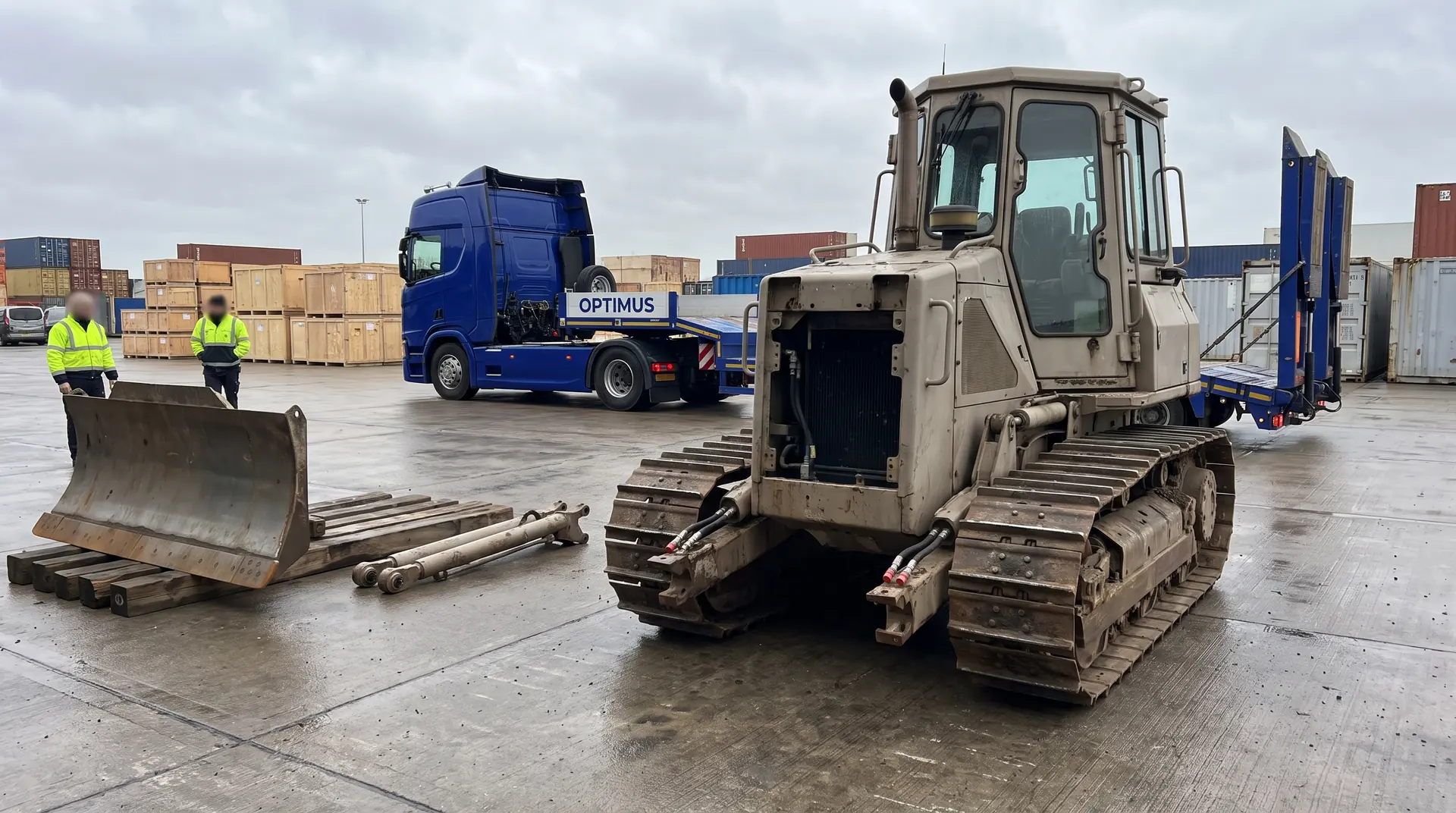
A crawler dozer travels with the blade removed and carried separately, because with it fitted the machine is usually wider than the road allows. Above medium weights the movement falls into the abnormal category anyway, and the permit comes from the competent road authority once the application has been processed. So with this machine the collection date is planned not forward from the sale but backwards from the permit.
Why the blade travels separately
The blade is the widest part of the machine and at the same time the easiest to detach, because the design provides for removal in servicing. Taken off and laid on the deck behind the machine, or carried on a separate vehicle, it stops defining the outline of the load, and that is often the difference between a normal movement and a permit application. Removal is the buyer responsibility and has to be agreed with the yard before the vehicle is despatched, because it needs equipment and space. An auction yard does not do it automatically, and a machine released with the blade still on its nose can stop the whole transport.
The ripper at the rear is a separate matter. Lowered, it lengthens the load; raised, it lifts the centre of gravity; removed, it becomes another line on the list. Which option applies follows from the dimensions of that unit, not from a rule.
Tracks, deck and yard surface
A steel track does two things at once: it tears up the surface during loading and it holds the deck by steel on steel friction, which is weaker than intuition suggests. The yard needs plates under the ramps and along the route the machine takes, and the deck needs chocking in every direction. Getting up onto the trailer requires hard, level ground in front of it; an uneven, softened yard changes the approach angle mid-climb, exactly when there is no way back. The options of driving on, winching and craning are set out in the piece on loading a machine at the auction yard.
The permit as the first step, not the last
With a machine of this class the order of work is the reverse of small plant. First we establish weight and dimensions in transport configuration, then we check what permit category follows and how long it takes to process, and only then do we book collection from the yard. The other order ends in storage charges, which we cover under collection deadlines at the yard. Permit categories, issuing authorities and lead times are published by GDDKiA, while the British side runs its own notification regime, described in the article on oversized transport to the UK. Those are two independent processes with their own timelines, and the vehicle moves when both are closed.
Lashing and protection
- Tracks are chocked fore and aft, and lashings go into the points the maker specifies, pulled diagonally.
- A blade carried on the deck is secured as a separate load, laid flat and supported so it cannot rock on its edge.
- Blade and ripper rams are capped after removal and the rods are covered, because a scored rod is a repair, not a cosmetic matter.
- Cab doors and windows are secured; glass left open on a standing machine cracks from vibration and draught.
- Lashing tension is checked after the first leg and at stops; a tracked machine settles less than a wheeled one, but vibration loosens fastenings on its own.
The method for selecting lashings is described in the piece on cargo securing under EN 12195.
Fluids, fuel and battery
A dozer has large tanks and an extensive hydraulic system, so before carriage we check for tightness and agree the fuel level with the yard. Whether the movement falls under dangerous goods rules depends on the fuel type, the tank construction and its contents, and the answer comes from the regulations rather than an assumption. The battery is disconnected and the terminals protected unless the machine is to drive off the trailer itself. The keys travel with the paperwork.
Soil in the tracks and entry into the Union
A dozer works in soil without exception, so it brings it in the tracks, in the tensioners and behind the guards. For machines used for agricultural or forestry purposes, entry into the Union requires the phytosanitary conditions to be met: a notification in TRACES NT, a CHED-PP certificate and the importer entered in the register kept by the Polish plant health service. We describe the whole procedure under farm machinery auctions in the UK. Whatever the classification: muddy tracks on an abnormal movement drop clods along the route, and that is damage on the road side, not the cargo side.
Sources
- GDDKiA: abnormal movements, permit categories and lead times
- GOV.UK: ESDAL and notifying abnormal loads
- GOV.UK: securing loads on HGVs and goods vehicles
Planning to buy a tracked machine and want to know how long the formalities take? Send the model, transport weight and yard address through the quote form. See also oversized loads and excavators and loaders from UK auctions. Related topic: a motor grader from a UK auction.